India's tunnel infrastructure has expanded dramatically in 2026, with over 200 kilometers of operational road tunnels and 150 kilometers of railway tunnels transforming connectivity across the Himalayan mountain ranges, Western Ghats, and strategic border corridors. According to official data from the National Highways Authority of India (NHAI), Border Roads Organisation (BRO), and Indian Railways, the Indian government has approved 77 major tunnel projects with a cumulative outlay exceeding 50,000 crore rupees under the Bharatmala Pariyojana and PM Gati Shakti initiatives. Key engineering marvels include the Atal Tunnel at Rohtang (9.02 km), which remains the world's longest single-tube highway tunnel above 10,000 feet, the operational Dr. Syama Prasad Mookerjee Tunnel (9.28 km), and the historic Pir Panjal Railway Tunnel (11.2 km). With groundbreaking milestones such as the June 2026 breakthrough of the 14.15-kilometer Zoji La Tunnel and the completion of Tunnel T-50 (12.77 km) on the Udhampur-Srinagar-Baramulla Rail Link (USBRL), India is rapidly solidifying its position as a global leader in high-altitude mountain engineering. This complete guide provides an in-depth analysis of India's longest road and rail tunnels, technical specifications, future mega-projects, regional geographical distributions, and engineering safety frameworks for 2026.
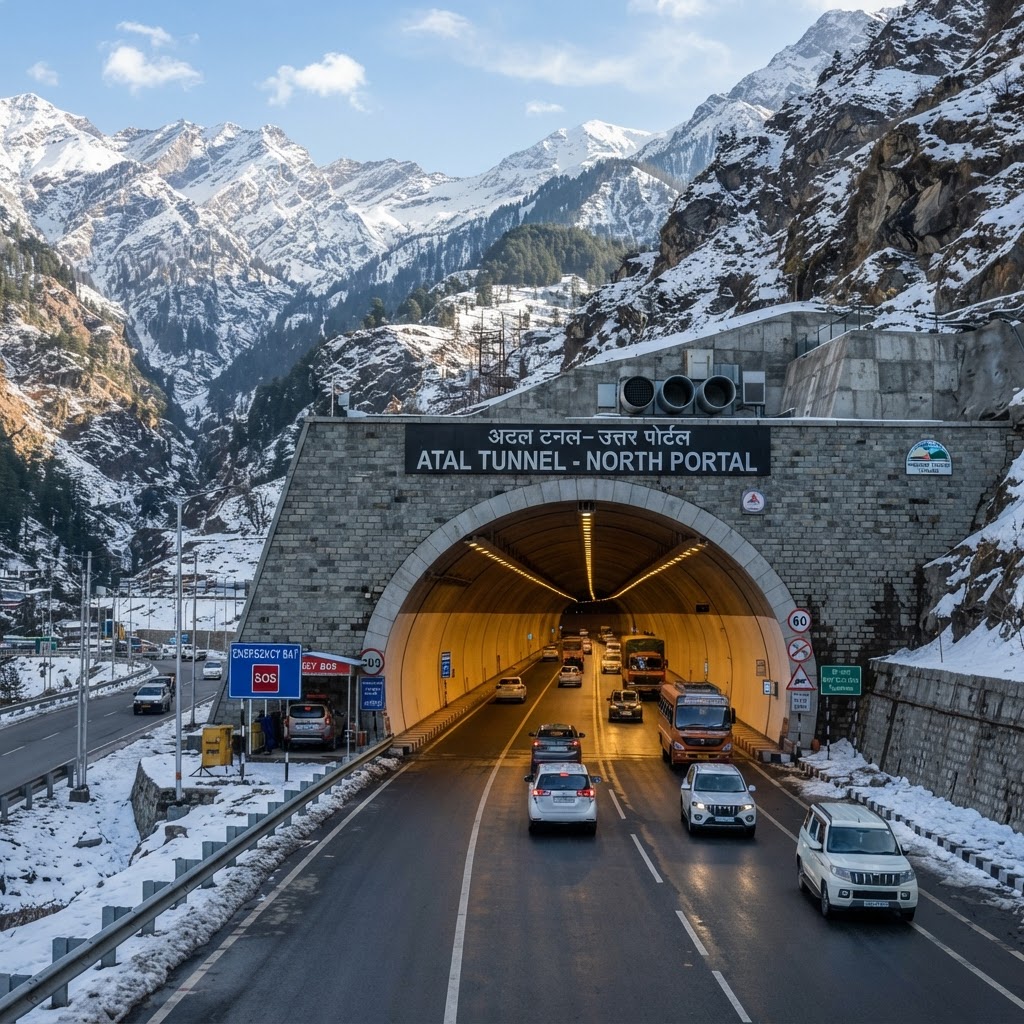
Table of Contents
- Current Landscape of Tunnel Infrastructure in India
- India's Longest Road Tunnels: Operational & Upcoming
- India's Longest Rail Tunnels & USBRL Mega Projects
- Technical & Operational Comparison: Road vs Rail Tunnels
- Government Schemes, Bharatmala Pariyojana & BRO Initiatives
- Regional Breakdown: Himalayan Ranges vs Western Ghats Tunnels
- Geological Challenges, Engineering Innovations & Safety
- Strategic & Economic Impact of Tunnels on Indian Connectivity
- Conclusion: Building India's Underground Transport Future
- Frequently Asked Questions
Current Landscape of Tunnel Infrastructure in India
The development of underground transportation infrastructure in India has witnessed unprecedented acceleration over the past decade. Driven by a dual mandate of national defense readiness and economic integration for remote mountain regions, Indian engineering agencies have transitioned from conventional drill-and-blast methods to state-of-the-art Tunnel Boring Machines (TBMs) and advanced New Austrian Tunnelling Methods (NATM). As of 2026, India's operational road and rail tunnel network spans hundreds of kilometers, overcoming some of the most daunting geological terrain on Earth, including fragile Himalayan thrust faults and monsoon-prone basalt formations in the Western Ghats.
Historically, remote northern regions such as Ladakh, Lahaul-Spiti, and upper Jammu & Kashmir were rendered inaccessible for up to six months every winter due to heavy snowfall over high-altitude mountain passes like Zoji La, Rohtang La, and Penni La. The deployment of all-weather strategic tunnels has systematically dismantled these geographical barriers. Today, year-round civilian travel and defense logistics are guaranteed, shortening travel distances by tens of kilometers and eliminating hazardous surface mountain passes subject to severe landslides and avalanches.
Furthermore, urban tunneling has emerged as a crucial component of metropolitan mass transit systems. Beneath major Indian cities including Mumbai, Delhi, Kolkata, Chennai, and Bengaluru, dozens of kilometers of underground metro tunnels and urban coastal road tunnels have been constructed. The successfully completed Mumbai Coastal Road undersea tunnels and Kolkata's East-West Metro underwater tunnel beneath the Hooghly River demonstrate that Indian tunneling expertise extends from high-altitude Himalayan peaks to complex sub-sea coastal environments.
India's Longest Road Tunnels: Operational & Upcoming
Road tunnels in India represent vital economic and defense arteries. The longest operational road tunnel currently in service is the Dr. Syama Prasad Mookerjee Tunnel (formerly known as Chenani-Nashri Tunnel) located on National Highway 44 in Jammu & Kashmir. Spanning a length of 9.28 kilometers, this bi-directional, twin-tube tunnel reduces the road distance between Jammu and Srinagar by 30 kilometers and bypasses snow-prone stretches vulnerable to winter closures. It is equipped with a fully automated transverse ventilation system, emergency escape ducts spaced every 300 meters, and continuous digital camera surveillance.
The Atal Tunnel at Rohtang, inaugurated in 2020 and expanded with enhanced smart telemetry by 2026, is an engineering wonder constructed by the Border Roads Organisation (BRO). Situated at an elevation of 3,060 meters (10,040 feet) above sea level in the Pir Panjal range of Himachal Pradesh, the 9.02-kilometer tunnel connects Manali to the Lahaul-Spiti Valley. It bypasses the treacherous Rohtang Pass, cutting travel time by 4 to 5 hours and reducing the road distance to Keylong by 46 kilometers. The tunnel features a horseshoe-shaped cross-section, heavy-duty fire protection, and an underlying emergency escape tunnel built directly into the main structure.
Among upcoming projects, the under-construction Zoji La Tunnel stands out as Asia's longest bi-directional road tunnel at high altitude. Spanning 14.15 kilometers at an altitude of 11,578 feet, the tunnel achieves all-weather connectivity between Srinagar, Kargil, and Leh on National Highway 1. Following its historic June 2026 breakthrough milestone, the project is entering its final lining and systems integration phase. Additionally, the approved Shinkun La Tunnel (13.5 km) on the Nimmu-Padam-Darcha road will connect Ladakh with Himachal Pradesh, becoming the highest highway tunnel in the world at an elevation exceeding 15,800 feet upon completion.
Other vital highway tunnels include the Banihal-Qazigund twin-tube tunnel (8.45 km) on NH-44, which reduces travel times across the Pir Panjal mountain barrier by bypassing Shaitani Nallah, and Kerala's Kuthiran Tunnel (1.0 km), which serves as the first six-lane twin-tube highway tunnel in South India, alleviating chronic traffic bottlenecks along the Palakkad-Thrissur trade corridor.
| Tunnel Name | Length (km) | State / UT | Connecting Highway / Route | Operational Status (2026) | Key Engineering Highlights |
|---|---|---|---|---|---|
| Zoji La Tunnel | 14.15 km | Jammu & Kashmir / Ladakh | NH-1 (Srinagar - Kargil - Leh) | Under Construction (Breakthrough 2026) | World's longest high-altitude bi-directional road tunnel at 11,578 ft |
| Shinkun La Tunnel | 13.50 km | Ladakh / Himachal Pradesh | Nimmu - Padum - Darcha Corridor | Approved / Pre-construction | Highest highway tunnel in the world at 15,800 ft elevation |
| Dr. Syama Prasad Mookerjee (Chenani-Nashri) | 9.28 km | Jammu & Kashmir | NH-44 (Jammu - Srinagar) | Fully Operational | Fully integrated transverse ventilation, emergency tube every 300m |
| Atal Tunnel (Rohtang) | 9.02 km | Himachal Pradesh | Leh-Manali Highway Corridor | Fully Operational | World's longest highway tunnel above 10,000 ft, saves 4-5 hours |
| Banihal-Qazigund Road Tunnel | 8.45 km | Jammu & Kashmir | NH-44 (Banihal - Qazigund) | Fully Operational | Twin-tube design bypassing Shaitani Nallah, cuts distance by 16 km |
| Silkyara-Barkot Tunnel | 4.53 km | Uttarakhand | Char Dham All-Weather Highway | Under Final Reconstruction | Critical link reducing Gangotri-Yamunotri distance by 26 km |
| Kuthiran Tunnel | 1.00 km | Kerala | NH-544 (Thrissur - Palakkad) | Fully Operational | Kerala's first six-lane twin-tube road tunnel through Western Ghats |
India's Longest Rail Tunnels & USBRL Mega Projects
India's rail tunneling achievements are centered around the flagship Udhampur-Srinagar-Baramulla Rail Link (USBRL) project, designed to seamlessly connect the Kashmir Valley to the national broad-gauge railway grid. The USBRL project encompasses over 119 kilometers of tunnels out of its total 272-kilometer length, making it one of the most concentrated rail tunneling projects in global engineering history. The flagship operational railway tunnel, Pir Panjal Railway Tunnel (Tunnel T-80), stretches 11.22 kilometers between Banihal and Qazigund, operating at a depth of up to 740 meters beneath the Pir Panjal mountain range.
Setting an even greater milestone, Tunnel T-50 on the USBRL network spans 12.77 kilometers between Khari and Sumber in Ramban district, making it India's longest transportation railway tunnel. Built using the New Austrian Tunnelling Method (NATM) with full ballastless trackbed and automated fire suppression systems, T-50 is accompanied by a parallel escape tunnel connected via cross-passages every 375 meters to ensure rapid evacuation in emergency scenarios.
Beyond Jammu & Kashmir, the Rishikesh-Karanprayag Railway Line in Uttarakhand represents another monumental mountain rail corridor. Spanning 125 kilometers through the Garhwal Himalayas, more than 105 kilometers of the line runs inside underground tunnels, including Tunnel T-8, which stretches 15.1 kilometers, making it the single longest railway tunnel under construction in India. In the Northeast, the Jiribam-Tupul-Imphal rail line features Tunnel T-12 (10.28 km), connecting Imphal to the national rail grid through complex Indo-Burmese mountain geology.
| Railway Tunnel | Length (km) | Railway Zone / Route | State / UT | Operational Status (2026) | Key Infrastructure Feature |
|---|---|---|---|---|---|
| Tunnel T-50 (USBRL) | 12.77 km | Northern Railway (Khari - Sumber) | Jammu & Kashmir | Fully Operational | Longest railway transport tunnel in India with parallel escape adit |
| Tunnel T-49 (USBRL) | 12.75 km | Northern Railway (Katra - Banihal) | Jammu & Kashmir | Fully Operational | Advanced ballastless trackbed, automated gas and smoke monitoring |
| Pir Panjal Railway Tunnel (T-80) | 11.22 km | Northern Railway (Banihal - Qazigund) | Jammu & Kashmir | Fully Operational | 3.0m maintenance road alongside tracks usable by emergency vehicles |
| Rishikesh-Karanprayag Tunnel T-8 | 15.10 km | Northern Railway (Devprayag - Janasu) | Uttarakhand | Under Construction | Single longest railway tunnel section under construction in Himalayas |
| Jiribam-Imphal Tunnel T-12 | 10.28 km | Northeast Frontier Railway (Imphal Link) | Manipur | Under Construction | Key strategic rail gateway connecting Manipur capital to national grid |
| Karwar Railway Tunnel | 4.20 km | Konkan Railway (Ratnagiri - Mangaluru) | Karnataka | Fully Operational | Longest operational railway tunnel on the Konkan Railway network |
Technical & Operational Comparison: Road vs Rail Tunnels
Comparing road and rail tunnels highlights distinct engineering mechanics, environmental controls, structural dimensions, and maintenance requirements. Road tunnels must accommodate mixed vehicle traffic, ranging from heavy multi-axle diesel trucks to private cars and motorcycles. As a consequence, road tunnels demand complex mechanical ventilation networks, such as longitudinal jet fans or fully transverse ventilation shafts, to continuously flush out toxic carbon monoxide and nitrogen oxide vehicle exhausts. In contrast, railway tunnels accommodate electrically powered locomotives operating in a closed system, requiring significantly less forced air ventilation during standard train passages due to the natural piston effect generated by moving train sets.
From an emergency management and fire safety perspective, road tunnels require wider cross-sections to permit vehicle breakdown lanes, towing access, and continuous LED roadway illumination. Rail tunnels, while narrower in cross-section per track, necessitate specialized escape adits, ballastless concrete trackbeds to prevent derailments, and overhead catenary equipment (OHE) rigid conductor rails. Maintenance cycles for rail tunnels focus on track geometry alignment and rail grinding, whereas road tunnel maintenance involves continuous road surface resurfacing, drainage clearance, and wall cleaning to maintain optical visibility.
Construction cost dynamics also vary significantly between the two modes. Road tunnels generally incur higher capital expenditures per kilometer owing to larger excavation diameters, dual-carriageway requirements, and intensive fire safety suppression systems. Rail tunnels, while slightly smaller in borehole radius, require stringent grade tolerances and continuous concrete lining to handle high-speed train vibrations and heavy freight axle loads.
Government Schemes, Bharatmala Pariyojana & BRO Initiatives
The strategic push behind India's tunnel building boom is fueled by key government programs and defense infrastructure directives. Under the Bharatmala Pariyojana Phase-I and Phase-II, MoRTH and NHAI identified critical mountain chokepoints and border passes requiring tunnel bypasses. Over 50,000 crore rupees has been committed for tunnel construction across the Himalayan belt, covering Jammu & Kashmir, Ladakh, Himachal Pradesh, Uttarakhand, Sikkim, and Arunachal Pradesh.
The Border Roads Organisation (BRO), operating under the Ministry of Defence, plays a pivotal role under executive initiatives such as Project Beacon, Project Himank, and Project Sampark. BRO engineers specialize in high-altitude construction under extreme sub-zero conditions, deploying insulated concrete curing systems and heated heavy machinery to maintain construction momentum through severe winter months. BRO's execution of the Sela Tunnel (13,000 ft) in Arunachal Pradesh provides all-weather tactical access to Tawang, underscoring the military and strategic significance of these underground transport corridors.
International technological collaborations have further elevated Indian tunneling standards. Government agencies routinely partner with leading international geotechnical firms from Austria, Norway, and Switzerland to deploy advanced Norwegian Method of Tunnelling (NMT) and 3D seismic refraction tomography. This cross-border technology transfer ensures that Indian tunnel designs comply with World Road Association (PIARC) international safety guidelines.
Regional Breakdown: Himalayan Ranges vs Western Ghats Tunnels
India's tunneling landscape exhibits striking regional geological differences between the young, tectonic Himalayan mountain ranges in the north and the ancient, basaltic Western Ghats in the south:
Himalayan Mountain Belt: Tunnelling in Jammu & Kashmir, Himachal Pradesh, and Uttarakhand involves navigating highly fragile sedimentary rock, major fault zones (such as the Main Boundary Thrust and Main Central Thrust), high water ingress under artesian pressure, and squeezing ground conditions. Projects like Zoji La and Atal Tunnel required extensive pre-grouting, heavy steel ribs, and flexible shotcrete linings to withstand immense mountain overburden stress and high seismic activity (Seismic Zone IV and V).
Western Ghats Corridor: Tunnelling through states like Maharashtra, Goa, Karnataka, and Kerala involves hard Deccan Trap basalt and granitic formations. While the hard rock provides structural stability during excavation, it causes severe tool wear on TBM cutter heads and drill bits. Western Ghats tunnels, such as the Kuthiran Tunnel in Kerala and Konkan Railway tunnels, are engineered to handle torrential tropical monsoon rainfall with high-capacity sub-surface drainage channels to prevent tunnel flooding.
Northeastern Frontier: In Arunachal Pradesh, Sikkim, and Manipur, tunneling teams face complex clay shales, mudstones, and high landslide frequency. Projects like the Sela Tunnel and Nechiphu Tunnel utilize insulated weatherproofing layers to prevent ground freeze-thaw cycles from degrading structural concrete linings, establishing vital transport arteries for North-Eastern border towns.
Geological Challenges, Engineering Innovations & Safety
Constructing multi-kilometer underground passages through high-altitude mountains entails extraordinary geotechnical risks. Unexpected geological fault encounters, high-pressure water bursts, methane gas pockets, and sudden rock bursts represent constant threats during excavation. The lesson learned from the 2023 Silkyara-Barkot tunnel collapse led MoRTH to mandate strict new safety protocols across all ongoing tunnel sites in 2026. Every tunnel under construction now requires a dedicated escape portal tube built parallel to the main heading from day one, alongside continuous real-time deformation sensors monitored via IoT micro-seismic networks.
Technological innovations have significantly boosted tunneling safety and construction speed. Modern 3D NATM techniques utilize fiber-reinforced shotcrete and expandable rock bolts that absorb ground deformation without structural cracking. Inside operational tunnels, sophisticated SCADA (Supervisory Control and Data Acquisition) systems monitor air quality index (AQI), visibility levels, water drainage pumps, and automated fire suppression sprinklers 24 hours a day, ensuring immediate emergency isolation if smoke or toxic gases are detected.
Furthermore, tunnel ventilation engineering has embraced automated computational fluid dynamics (CFD) modeling. In the event of a vehicle fire inside long road tunnels like Chenani-Nashri or Atal Tunnel, automated smoke extraction dampers activate within seconds, directing toxic fumes away from escaping passengers into dedicated emergency exit galleries.
Strategic & Economic Impact of Tunnels on Indian Connectivity
The economic and strategic benefits of India's long tunnel network are profound and far-reaching. Strategically, all-weather tunnels along the Line of Actual Control (LAC) and Line of Control (LOC) enable the Indian Armed Forces to move heavy artillery, armored vehicles, and troop logistics year-round without being blocked by winter snowdrifts. The time required to transport military supplies from Manali to Leh has been slashed from several days to under 10 hours, substantially boosting national security readiness along high-altitude borders.
From an economic perspective, high-altitude tunnels have unlocked year-round commerce and eco-tourism for isolated mountain communities. Lahaul Valley residents now enjoy uninterrupted access to healthcare and higher education in Shimla and Chandigarh during harsh winter months. Agricultural produce, such as apples from Himachal and Ladakh sea buckthorn, can reach national markets without spoilage. Furthermore, fuel consumption savings resulting from avoided mountain passes and shorter transit distances account for thousands of tons of reduced carbon emissions annually, directly aligning with India's Net-Zero sustainability targets.
Conclusion: Building India's Underground Transport Future
India's rapid expansion of road and rail tunnels in 2026 marks a transformative chapter in national infrastructure engineering. By overcoming formidable Himalayan geology with world-class engineering, advanced NATM tunnelling, and international safety protocols, India has built a resilient network of underground transport corridors that foster economic prosperity and national security.
With monumental projects like the Zoji La Tunnel, Shinkun La Tunnel, and Rishikesh-Karanprayag rail tunnels nearing completion, the future of Indian transport infrastructure is firmly rooted beneath the surface. These engineering marvels will continue to serve as vital lifelines, uniting remote border regions with the national economic mainstream for generations to come.
You May Also Like: Atal Tunnel, Zoji La Tunnel, and Chenab Bridge.
Frequently Asked Questions
Which is India's longest road tunnel?
The Chenani-Nashri tunnel at 9.28 km is the longest operational road tunnel. The Zoji La Tunnel at 14.15 km will be the longest when completed.
Which is India's longest rail tunnel?
The Pir Panjal Tunnel at 11.2 km is India's longest rail tunnel, part of the USBRL project.
How many tunnels are being built in India?
77 new tunnel projects have been approved under Bharatmala Pariyojana with investment exceeding 50,000 crore rupees.
How long is the Atal Tunnel?
The Atal Tunnel at Rohtang is 9.02 km, the world's longest highway tunnel above 10,000 feet.
What is the Shinkun La Tunnel project?
A planned 13.5 km tunnel connecting Ladakh and Himachal Pradesh, which will be the world's longest highway tunnel when completed.
Are Indian tunnels earthquake resistant?
Yes, tunnels in seismic zones like J&K and Himachal are designed for zone V earthquake intensity with flexible lining.