India's smart transport ecosystem has evolved rapidly in 2026, with digital ticketing, GPS vehicle tracking, artificial intelligence traffic management, and electric mobility transforming how millions of citizens navigate urban centers and national transit corridors. According to NITI Aayog and the Ministry of Road Transport and Highways (MoRTH), India's digital transport infrastructure now serves over 100 million daily commuters across Indian Railways, rapid transit metros, state bus corporations, and multi-lane expressways. From the nationwide adoption of FASTag electronic tolling to UPI-based Unified Metropolitan Transport Authority (UMTA) ticketing and IRCTC's second-generation AI chatbot AskDISHA, smart transport is substantially reducing travel delays, lowering carbon emissions, and eliminating cash-handling overheads across the country. Key technological integrations such as National Common Mobility Cards (NCMC), Vehicle Location Tracking Devices (VLTD), and AI-powered Automatic Number Plate Recognition (ANPR) cameras are reshaping Indian public transit into a modernized, digital-first network. This comprehensive guide examines all major smart transport initiatives, digital ticketing frameworks, telemetry networks, government policies, regional developments, and key commuter strategies across India in 2026.
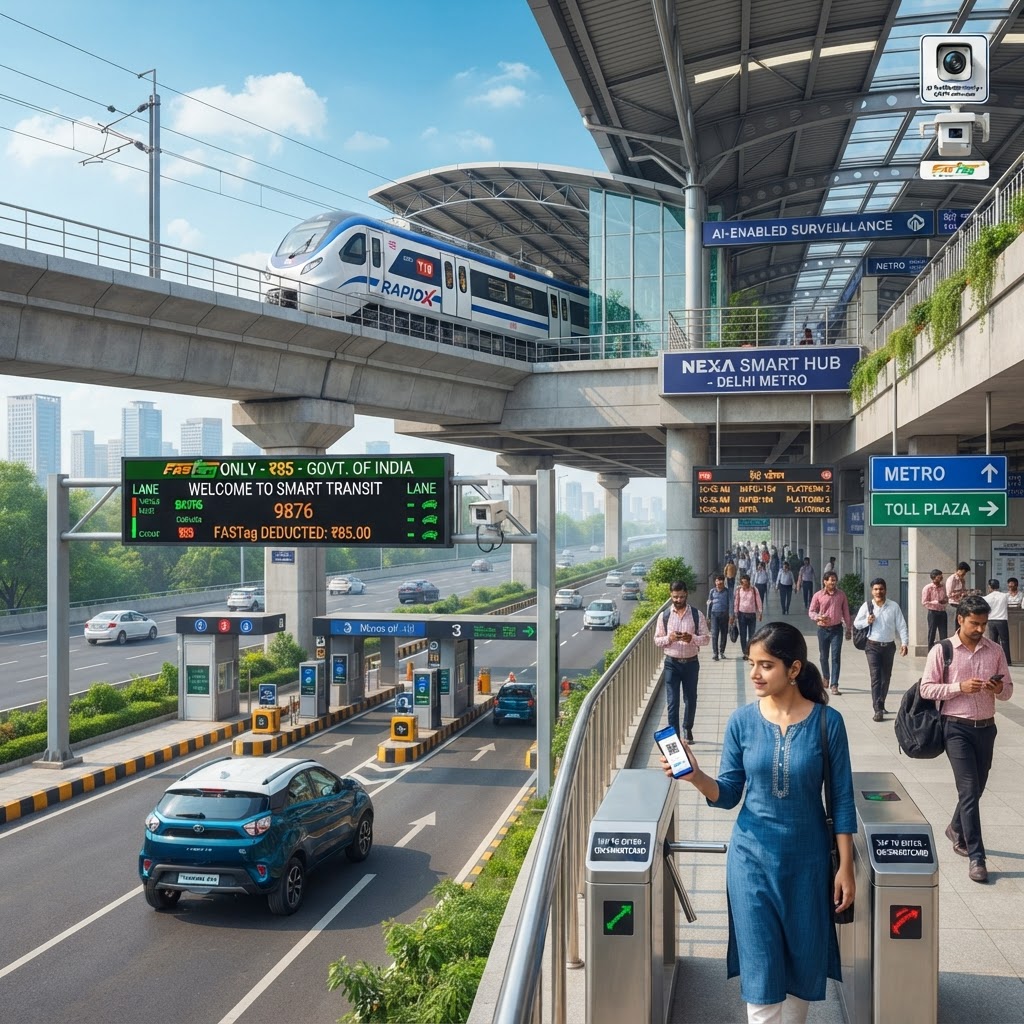
Table of Contents
- Current Landscape of Smart Transport in India
- Digital Ticketing Systems Across Transport Modes
- GPS & Real-Time Fleet Tracking Systems
- Artificial Intelligence in Traffic Management & Safety
- Government Policies, National Schemes & Investments
- Regional Analysis: Smart Transport Across Indian Metros
- Smart Transport vs Traditional Transport Infrastructure
- Key Challenges, Cybersecurity & Commuter Tips
- Conclusion: The Future of Indian Smart Mobility
- Frequently Asked Questions
Current Landscape of Smart Transport in India
The landscape of Indian transportation in 2026 represents a landmark shift from fragmented, manual operations to an integrated, data-driven Intelligent Transportation System (ITS). Modern urbanization, coupled with high smartphone penetration and ubiquitous high-speed 5G mobile networks, has created an ideal environment for smart mobility solutions. Today, urban public transport systems in major tier-1 and tier-2 cities are designed with interoperability at their core, allowing commuters to transition seamlessly between suburban railways, underground metro lines, municipal bus fleets, and last-mile electric auto-rickshaws using single digital credentials.
According to recent industry benchmarks, India's Intelligent Transportation Systems market reached a valuation exceeding 2.5 billion US dollars in 2026, driven by aggressive public infrastructure outlays under PM Gati Shakti and the Smart Cities Mission. Urban congestion, historically one of India's biggest economic bottlenecks, is being actively mitigated through centralized command and control centers (ICCCs) established across 100 designated smart cities. These centers aggregate real-time feeds from transit telemetry, traffic signal sensors, weather monitoring stations, and emergency dispatch systems to maintain smooth traffic flow during peak hours.
Furthermore, the environmental imperative has accelerated the integration of electric vehicles (EVs) into the public transit framework. State Road Transport Corporations (SRTCs) across states such as Maharashtra, Karnataka, Tamil Nadu, and Uttar Pradesh have onboarded over 15,000 electric buses, all equipped with smart telematics, automated fare collection (AFC) gates, and real-time passenger information displays (PIDS). As a result, public transit in India is becoming not only more digital but also cleaner and more energy-efficient.
Digital Ticketing Systems Across Transport Modes
Digital ticketing is the cornerstone of India's smart transport transformation. The era of standing in long queues at railway ticket counters or searching for exact physical currency on city buses has been replaced by contactless digital fare collection platforms. At the national level, Indian Railways operates the Unreserved Ticketing System (UTS) app alongside the IRCTC Rail Connect portal. Together, these digital platforms process over 1.2 million ticket reservations daily, servicing an active registered user base exceeding 50 million citizens. Passengers can instantly purchase unreserved suburban rail tickets, platform tickets, and long-distance passes directly on their smartphones using geofencing technology.
For urban rapid transit, the Ministry of Housing and Urban Affairs (MoHUA) spearheaded the National Common Mobility Card (NCMC) standard, popularly branded as 'One Nation One Card'. Operating on open-loop EMV contactless technology, the NCMC allows passengers to use a single RuPay debit card, smart prepaid card, or mobile wallet across all operational metro networks in India, including Delhi Metro, Mumbai Metro, Bengaluru Namma Metro, Chennai Metro, and the Kochi Water Metro. This eliminates the necessity of purchasing separate tokens or state-specific transit cards when traveling across different metropolitan regions.
On national highways and expressways, the National Electronic Toll Collection (NETC) programme powered by FASTag has achieved near-100 percent digitization. Over 80 million vehicles in India are fitted with RFID-based FASTag devices, enabling automated, cashless toll payments across more than 1,000 toll plazas operated by the National Highways Authority of India (NHAI) and private concessionaires. FASTag has also expanded into urban parking management, enabling cashless entry and exit payments at major airports, railway stations, shopping malls, and municipal parking zones across top cities.
| Transit Mode | Primary Platform / Standard | Active User Base | Key Features & Payment Options | Operational Scale (2026) |
|---|---|---|---|---|
| Railways (Reserved & Unreserved) | IRCTC App & UTS Mobile Platform | 50M+ active users | Paperless QR tickets, UPI, debit/credit cards, AI PNR predictions | 1.2M daily bookings across 13,000+ trains |
| Metro Transit Networks | National Common Mobility Card (NCMC) | 20M+ cardholders | Contactless EMV tap-and-go, multi-city compatibility, UPI auto-top-up | 20+ operational metro rail networks |
| Expressways & Highway Tolls | FASTag (NETC Network by NPCI/NHAI) | 80M+ tags issued | Automatic RFID toll debit, bank wallet sync, parking payment integration | 1,000+ toll plazas, ₹190+ Cr daily collection |
| Interstate & City Bus Networks | State SRTC Apps & ONDC Mobility | 15M+ commuters | Live seat booking, GPS route tracking, UPI/QR code boarding | 150,000+ smart buses across 25 states |
| Parking & Urban Feeder | City Smart Parking Apps & FASTag Parking | 5M+ drivers | ANPR camera auto-pay, slot reservation, UPI payment links | 100+ major airports, malls & stations |
GPS & Real-Time Fleet Tracking Systems
Real-time telemetry and GPS vehicle tracking have fundamentally altered commuter safety and transit reliability in India. Under the Ministry of Road Transport and Highways (MoRTH) AIS-140 standard, all public service vehicles—including commercial buses, auto-rickshaws, emergency ambulances, and taxis—are required to be equipped with certified Vehicle Location Tracking Devices (VLTD) and physical emergency panic buttons. These devices stream continuous location data to state command centers and emergency response support systems (ERSS Helpline 112), enhancing security for women and late-night travelers.
Indian Railways has implemented the Real-Time Train Information System (RTIS) in collaboration with the Indian Space Research Organisation (ISRO). Using GAGAN satellite positioning receivers installed on locomotives, RTIS automatically updates train speeds and precise arrival times every 30 seconds without manual intervention from station masters. Commuters access this data through popular apps such as 'Where is My Train' and the official NTES portal, allowing millions of passengers to plan station arrivals accurately and reduce platform overcrowding.
In urban bus transportation, State Road Transport Corporations (SRTCs) and municipal transit agencies have deployed GPS telemetry across 150,000 public buses. Cities such as Bengaluru (BMTC), Delhi (DTC), Mumbai (BEST), and Chennai (MTC) offer mobile applications providing live bus arrival countdowns, occupancy indicators, and route map updates. This transparent tracking information gives commuters greater confidence in choosing public buses over private single-occupancy vehicles, aiding urban traffic decarbonization.
| System / Telemetry Platform | Managing Authority | Fleet Coverage / Technology | Operational Capabilities | Key Commuter Benefits |
|---|---|---|---|---|
| Real-Time Train Info System (RTIS) | Indian Railways & ISRO | 13,000+ passenger & freight trains | GPS/GAGAN satellite telemetry updated every 30 seconds | Live arrival predictions, automated speed logs, zero delay reporting lag |
| Vehicle Location Tracking (VLTD) | MoRTH & State Transport Depts | All commercial buses, taxis & cabs | AIS-140 compliant GPS + emergency panic button integration | Direct linking to 112 helpline, real-time speed alert enforcement |
| Metro Real-Time Telemetry | DMRC, MMRDA, BMRCL, CMRL | 1,000+ metro train sets | Automated Train Supervision (ATS) & Wi-Fi trackside mesh | Platform crowd density displays, precise 90-second headway tracking |
| Advanced Toll RFID Tracking | NHAI & IHMCL | 1,000+ toll plazas & state borders | High-speed RFID readers & Weigh-in-Motion (WIM) sensors | Live highway congestion monitoring, automated vehicle overload checks |
| Smart City Traffic Cameras | City Traffic Police & ULBs | 50+ Smart Cities nationwide | AI-enabled ANPR optical sensors & radar speed detectors | Dynamic traffic signal adjustments, zero-contact e-challan issuing |
Artificial Intelligence in Traffic Management & Safety
Artificial Intelligence (AI) has emerged as a force multiplier in modernizing Indian transportation management. Across major metro corridors and newly constructed expressways, AI-powered Advanced Traffic Management Systems (ATMS) monitor vehicle speeds, lane adherence, and traffic volume in real time. For instance, Delhi's Dwarka Expressway and the Delhi-Mumbai Expressway feature high-resolution AI optical cameras spaced every two kilometers. These cameras automatically identify stopped vehicles, debris on the road, lane violations, and speeding cars, triggering instant alerts to highway patrol units and displaying dynamic message signs (VMS) to warn oncoming drivers.
In metropolitan centers, AI algorithms are revolutionizing municipal traffic signals. Legacy fixed-timer signals are being systematically replaced with adaptive traffic control systems (ATCS). Systems such as CoSiCoT (Composite Signal Control Strategy) adjust green light durations dynamically based on live camera feeds measuring vehicle queue lengths. Cities like Mumbai, Bengaluru, and Pune have reported up to a 25 percent reduction in peak-hour intersection delays following full ATCS deployment. Furthermore, police departments use automated computer vision to issue e-challans directly to traffic violators, improving road discipline without requiring physical police intervention at every junction.
Artificial intelligence is also driving customer service innovations in public transit. Indian Railways' AI chatbot AskDISHA 2.0 processes over 150,000 queries daily in multiple regional languages. Commuters can check PNR status, refund status, live train running schedules, and even order food directly to their seats using voice commands or WhatsApp messaging. Furthermore, AI computer vision algorithms are deployed in train maintenance depots to inspect coach undercarriages and track geometry for physical defects, preventing potential derailments before trains hit main lines.
Beyond railways and expressways, municipal bus authorities are leveraging machine learning models to optimize route frequency based on historical commuter tapping data. Predictive analytics models help transport departments anticipate peak demand during festivals, cricket matches, and severe weather events, dynamically reallocating buses from low-density routes to congested arterial roads. This data-driven responsiveness minimizes passenger waiting times and ensures maximum utilization of public transit assets.
Government Policies, National Schemes & Investments
The acceleration of smart transport in India is underpinned by robust government policy frameworks and strategic capital outlays. Under the PM Gati Shakti National Master Plan, transport infrastructure planning has shifted from isolated departmental siloes to unified digital mapping. Over 1,400 multi-modal data layers—encompassing national highways, railway tracks, inland waterways, and urban metro corridors—are integrated into a single GIS portal, reducing project approval timelines and preventing inter-agency conflicts during execution.
The Ministry of Electronics and Information Technology (MeitY) and MoRTH have dedicated significant budget outlays toward smart transportation under the Digital India umbrella, including over ₹1,000 crore earmarked specifically for AI research and Intelligent Transportation Systems deployment. Concurrently, the Electric Mobility Promotion Scheme (EMPS) and FAME II guidelines require all newly procured public electric buses to incorporate standardized digital hardware, including smart battery management system (BMS) telemetry, automated fare collection systems, and open API integration.
To foster innovation, the Indian government has encouraged the adoption of Open Mobility APIs through platforms like the Open Network for Digital Commerce (ONDC). Open mobility architecture enables private tech startups to integrate public bus routes, metro ticketing, and private ride-hailing services into single multi-modal trip planning applications. This public-private alignment ensures that technological advancements scale rapidly across both urban centers and rural transport networks.
Regional Analysis: Smart Transport Across Indian Metros
Smart transport adoption exhibits unique regional strengths across India's metropolitan zones:
Delhi NCR: As the nation's capital region, Delhi NCR leads in metro network length and integrated traffic monitoring. The Delhi Metro Rail Corporation (DMRC) features fully automated driverless train operations (DTO) on select lines and universal NCMC acceptance. Delhi's Intelligent Traffic Management System utilizes over 1,200 AI-connected junction cameras for automated traffic enforcement, significantly curbing traffic infractions across major roundabouts and arterial rings.
Mumbai Metropolitan Region (MMR): Mumbai has focused heavily on multi-modal integration. Under the Unified Metropolitan Transport Authority (UMTA), the city is unifying ticketing across suburban trains, BEST municipal buses, monorail, and new metro lines (Line 2A, 7, and Line 3 underground corridor). Mumbai's traffic police employ adaptive signal controls across key arteries like the Western Express Highway and Eastern Freeway, optimizing transit throughput and reducing fuel waste.
Bengaluru & Southern Tech Hubs: Bengaluru serves as an experimental hub for open mobility innovations. The success of open-source transit initiatives like Namma Yatri has demonstrated how driver-first, direct-to-driver auto platforms can operate seamlessly alongside BMTC smart bus tracking. In Kochi, the Water Metro provides a globally recognized benchmark for electric water transport, completely integrated into the city's NCMC ticketing matrix.
Tier-2 and Tier-3 Urban Centers: Beyond the mega-cities, tier-2 hubs like Surat, Ahmedabad, Indore, Nagpur, and Lucknow have achieved remarkable strides in smart transit. Surat's Bus Rapid Transit System (BRTS) features automated ticket gates and GPS live displays at all stations, while Ahmedabad's Janmarg uses solar-powered smart bus stops with contactless card readers. These regional implementations prove that smart transport is no longer confined to capital capitals, but is enriching daily commuting across India.
Smart Transport vs Traditional Transport Infrastructure
Comparing smart transportation frameworks with legacy transport systems underscores the transformative impact of digitization across operational, financial, and environmental dimensions. Traditional transport infrastructure relied heavily on manual counter sales, cash transactions, fixed physical schedules, and reactive traffic policing. These legacy mechanisms created severe bottleneck points at toll plazas, ticket counters, and road intersections, costing the economy billions of rupees in wasted fuel and lost productivity.
In contrast, smart transport leverages automated digital workflows. Cashless transactions via FASTag and UPI cut vehicle processing times at toll plazas from several minutes to under three seconds per vehicle. Commuter queue times at rail and metro terminals are virtually eliminated due to mobile QR ticketing and contactless smart cards. Furthermore, real-time GPS telemetry allows transport operators to dynamically re-route buses or add extra suburban train services in response to sudden passenger spikes, dramatically improving commuter satisfaction scores from an average of 55 percent under legacy systems to over 85 percent today.
Key Challenges, Cybersecurity & Commuter Tips
Despite rapid advancements, scaling smart transport across a nation of 1.4 billion people presents substantial operational and technical challenges. Cybersecurity remains a top priority. As millions of daily payment transactions and vehicle movement logs pass through central cloud servers, transport databases represent attractive targets for cyber threats. Standardizing robust end-to-end encryption, ISO 27001 data protection protocols, and multi-factor authentication across all third-party ticketing vendors is critical to safeguarding commuter privacy and financial data.
Digital literacy and technological equity also require ongoing attention. While urban smartphone users adapt easily to app-based ticketing, rural commuters and elderly citizens may face barriers when transitioning away from cash. To address this, transport authorities maintain hybrid options, such as physical NCMC cards purchasing options via cash at customer service kiosks and assisted smart vending machines at stations.
Practical Tips for Commuters in 2026:
- Adopt an Open-Loop NCMC Card: Obtain a RuPay NCMC debit or prepaid card from your bank to enjoy tap-and-go access across all Indian metro systems and select city buses without downloading separate municipal apps.
- Keep FASTag Auto-Recharge Active: Link your vehicle's FASTag to a bank account or UPI handle with auto-debit enabled to avoid double-fare penalties or queue delays at expressway toll gates.
- Utilize Official Telemetry Apps: Download official tracking utilities like 'Where is My Train' for Indian Railways or state-specific SRTC tracking apps to receive accurate, satellite-verified arrival times before leaving home.
- Verify Digital Payment QR Codes: Ensure you scan official payment codes at transport kiosks and double-check ticket confirmation notifications before boarding long-distance express buses or trains.
Conclusion: The Future of Indian Smart Mobility
Smart Transport in India 2026 represents a structural transformation in national mobility infrastructure. By combining digital payments, real-time satellite telemetry, artificial intelligence, and unified multi-modal policy frameworks, India has successfully built one of the most accessible and technology-forward public transport ecosystems in the developing world. Key innovations such as FASTag, the National Common Mobility Card, and AI-driven Intelligent Transportation Systems have set new benchmarks for operational efficiency and commuter convenience.
Looking to the future, the integration of autonomous rapid transit systems, hyperloop feasibility studies, expanded electric vehicle fleets, and open-mobility tech architectures will further solidify India's status as a global leader in smart urban mobility. For citizens and travelers alike, navigating India's transport network has never been faster, safer, or more efficient.
You May Also Like: Best Travel Apps, AI in Indian Railways, and EV Charging on Highways.
Frequently Asked Questions
What is the National Common Mobility Card?
A single card that works across all metro systems in India, launched by the Ministry of Housing and Urban Affairs in 2019.
How many people use IRCTC digital ticketing?
Over 50 million users use IRCTC's digital ticketing platform, with more than 1.2 million tickets booked daily.
What is FASTag and how does it work?
FASTag is an RFID-based electronic toll collection system with 80 million users, automatically deducting toll charges at plazas.
Can I use UPI for metro tickets?
Yes, most metro systems including Delhi, Mumbai and Bengaluru accept UPI payments at stations and in their apps.
What is IRCTC Disha?
An AI-powered chatbot that handles 150,000 queries daily, helping users with ticket booking, PNR status and refunds.
How does AI help Indian traffic management?
AI cameras issue automatic challans, optimise signal timing and monitor congestion, reducing delays by 25 percent in cities like Mumbai.