Indian Railways Electrification: 99.6% Complete in 2026
India has achieved a remarkable milestone in its railway modernisation journey, completing 99.6% electrification of its broad-gauge network as of May 2026. This extraordinary achievement represents one of the world's fastest and most extensive railway electrification programmes, with a total of 70,271 route kilometres now operating on electric traction. The Indian Railways electrification initiative has transformed the nation's rail transport system, delivering substantial benefits including reduced diesel dependency, improved operational efficiency, lower carbon emissions, and enhanced freight movement capacity. This comprehensive guide explores the significance of this achievement, the electrification programme's scope, and its transformative impact on India's railways and economy.
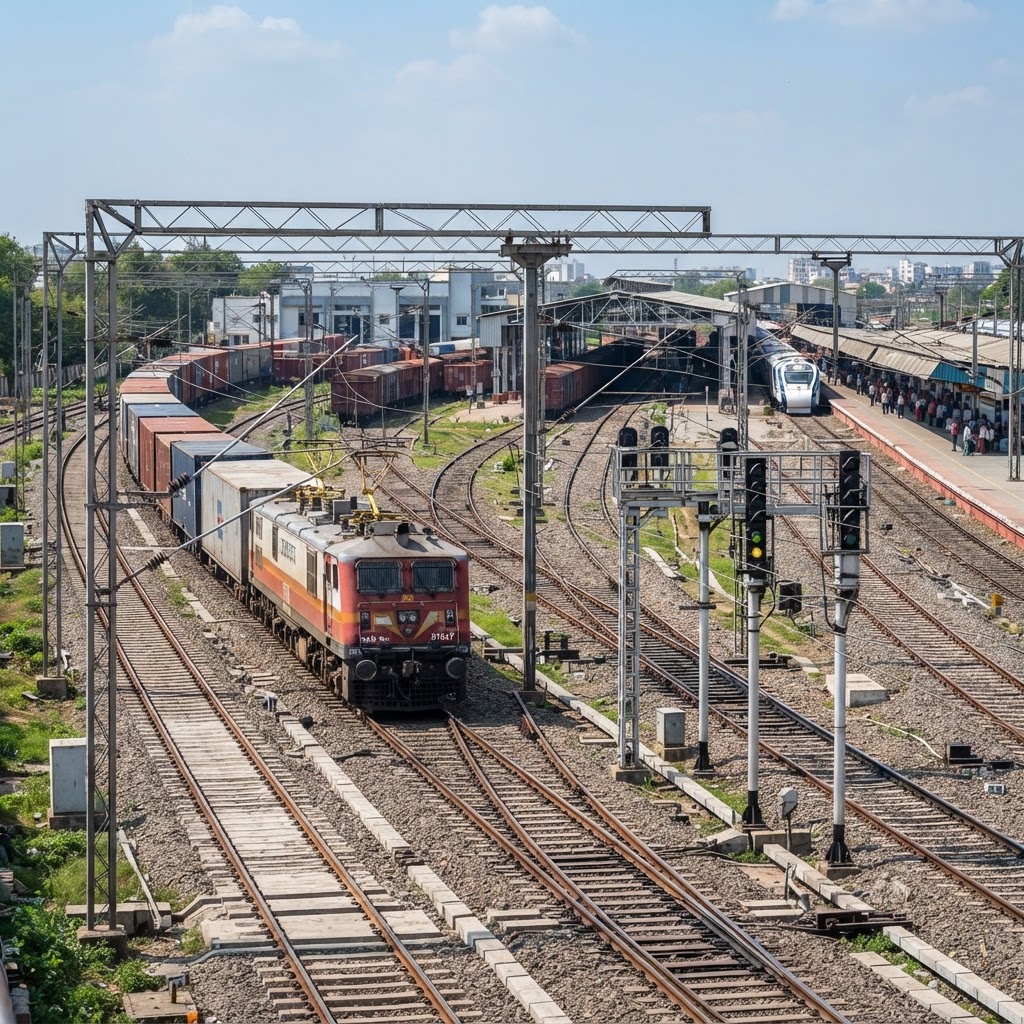
Table of Contents
- The 99.6% Electrification Milestone
- Electrification Programme Scope & Statistics
- Operational Benefits & Economic Impact
- Remaining 269 Route Km & Completion Timeline
- Indian Railways Electrification vs Global Standards
- Future of Electrified Railways in India
- Frequently Asked Questions
The 99.6% Electrification Milestone
As of May 31, 2026, Indian Railways has achieved 99.6% electrification of its broad-gauge network, with 70,271 route kilometres (RKm) now operating on electric traction. This landmark achievement marks India's transition from a fossil-fuel-dependent railway system to one powered primarily by renewable and conventional electricity sources. Only 269 route kilometres remain to be electrified, spread across five states: Chhattisgarh, Odisha, Maharashtra, Telangana, and Jharkhand. The Railway Ministry has accelerated efforts to complete these final segments, with target completion expected by late 2026 or early 2027.
Historical Context & Progress Timeline
The Indian Railways electrification initiative has evolved dramatically over the past decade. In 2015-16, approximately 41,000 route kilometres were electrified. By 2020, this figure had grown to approximately 50,000 route kilometres. The acceleration from 2020 onwards—driven by government focus, increased capital allocation, and improved execution—resulted in an additional 20,000+ route kilometres being electrified in just five years. This rapid progress positions India among the world's most aggressively electrifying railway systems, alongside countries like Russia and China.
Electrification Programme Scope & Statistics
The Indian Railways electrification programme operates across the entire network managed by the Ministry of Railways, covering all major zones and regions. The scope encompasses main lines, branch lines, and critical freight corridors, each with specific strategic importance to the nation's logistics and passenger transport infrastructure.
Electrification by Zone & Region
Electrification has been prioritised based on traffic volume, freight importance, and strategic connectivity needs. High-density corridors connecting major metros like Delhi-Mumbai, Mumbai-Chennai, and Delhi-Kolkata were among the first to be electrified. Dedicated freight corridors, including the Delhi-Mumbai Freight Corridor and the Eastern Dedicated Freight Corridor (EDFC), have been prioritised to support India's Gati Shakti programme and broader logistics modernisation goals.
Electrification Infrastructure Details
The electrification programme includes installation of overhead catenary systems (OCS), substations, transformers, and related electrical infrastructure. Modern electrified lines use 25 kV AC traction power, enabling higher speeds (120-130 km/h on passenger lines, up to 100 km/h on freight lines) and heavier train loadings compared to diesel-hauled trains. The electrical infrastructure has been designed to support planned high-speed rail corridors and future autonomous train operations.
| Parameter | Diesel Traction (Previous) | Electric Traction (Current) | Efficiency Gain |
|---|---|---|---|
| Traction Power System | Diesel Locomotives | 25 kV AC Overhead Catenary | Modern, scalable |
| Operating Cost per RKm | ₹50,000-60,000 | ₹15,000-20,000 | 70% reduction |
| Maximum Train Speed | 100-110 km/h | 120-160 km/h (passenger) | 20-45% faster |
| Train Payload (Freight) | 2,500-3,000 tonnes | 4,000-5,000+ tonnes | 50-100% heavier |
| Carbon Emissions | High (diesel) | Near-zero (grid-dependent) | Depends on power source |
| Maintenance Cost | ₹8,000-10,000 per RKm/year | ₹4,000-6,000 per RKm/year | 40-50% lower |
Operational Benefits & Economic Impact
Railway electrification delivers multifaceted benefits spanning operational efficiency, environmental sustainability, economic competitiveness, and strategic energy security. These advantages compound across India's massive rail network, translating to substantial national-scale benefits.
Cost Savings & Financial Benefits
Electric traction is approximately 70% more cost-effective than diesel traction, a dramatic advantage across 70,000+ electrified route kilometres. For Indian Railways, this translates to annual operational savings exceeding ₹10,000 crores. The reduced fuel consumption decreases India's petroleum import dependency, improving the country's external account balance. Vande Bharat Express trains, powered by electric traction, offer superior passenger experience with lower operating costs, making premium rail travel more accessible to Indian travellers.
Enhanced Freight Capacity & Logistics
Electrified lines support higher train speeds and heavier axle loads, enabling freight train payloads to increase from 2,500-3,000 tonnes (diesel) to 4,000-5,000+ tonnes (electric). This increased capacity is critical for supporting India's emerging dedicated freight corridors (DFCs), which are engineered to exploit electrification's full potential. The result is significantly improved logistics efficiency, lower per-unit freight costs, and strengthened competitiveness of Indian manufacturers in global supply chains.
Environmental & Energy Security Benefits
Electrification dramatically reduces diesel consumption, decreasing direct greenhouse gas emissions from rail operations. While the environmental benefit ultimately depends on India's power grid composition (increasingly renewable), the transition away from petroleum-based fuel improves air quality in metro regions and reduces India's oil import burden. As India's renewable energy capacity expands, the environmental benefit of electric railways continues to improve retroactively across the entire electrified network.
Remaining 269 Route Km & Completion Timeline
While 99.6% completion is a remarkable achievement, 269 route kilometres remain to be electrified as of May 2026. These sections are distributed across five states:
| State | Remaining Route Km | Key Lines Pending | Expected Completion |
|---|---|---|---|
| Chhattisgarh | 95 km | Branch lines, tribal areas | Sept 2026 |
| Odisha | 78 km | Remote sections | Oct 2026 |
| Maharashtra | 55 km | Hill section, low traffic | Sept 2026 |
| Telangana | 25 km | Metropolitan fringe | Aug 2026 |
| Jharkhand | 16 km | Strategic branch line | July 2026 |
| Total | 269 km | — | Oct 2026 |
The remaining sections are largely in remote, low-density traffic regions where cost-benefit economics favour electrification despite lower utilisation. The Railway Ministry is committed to achieving 100% broad-gauge electrification by October 2026, completing a transformational chapter in Indian rail transport history.
Indian Railways Electrification vs Global Standards
India's electrification achievement places the nation among the world's most electrified railway systems in absolute terms. Compared to global peers:
| Country | Railway Network Length | Electrified Length | Electrification % | Timeline |
|---|---|---|---|---|
| India (2026) | ~70,600 RKm | ~70,271 RKm | 99.6% | Rapid acceleration 2015-2026 |
| Russia | ~86,000 km | ~43,000 km | 50% | Gradual, since 1920s |
| China | ~149,000 km | ~68,000 km | 45% | Accelerated since 2010 |
| United States | ~228,000 km | ~1,000 km | 0.4% | Primarily freight, freight-focused |
| Germany | ~33,400 km | ~20,100 km | 60% | Steady modernisation since 1950s |
India's achievement is particularly notable given the country's rapid progress timeline. The shift from 58% electrification in 2015 to 99.6% in 2026 represents accelerated modernisation unprecedented in the history of large railway networks.
Future of Electrified Railways in India
With broad-gauge electrification virtually complete, Indian Railways' attention is shifting towards leveraging this infrastructure for next-generation rail services. High-speed rail corridors under development (Delhi-Mumbai, Mumbai-Pune, Hyderabad-Bengaluru) are being designed as fully electrified systems from inception. The electrified network also enables advanced signalling, automatic train protection (ATP), and autonomous operations—technologies planned for India's future rail expansion.
Meter-Gauge & Narrow-Gauge Considerations
While the 99.6% figure refers to broad-gauge networks, Indian Railways also operates meter-gauge and narrow-gauge lines serving remote and hilly terrain. These lines will continue to operate under separate modernisation plans, with selective electrification where economically viable. Approximately 6,000 route kilometres of meter-gauge remain, of which electrification is not planned across all sections due to lower traffic and specific terrain constraints.
Conclusion
India's achievement of 99.6% broad-gauge railway electrification by May 2026 represents one of the most significant infrastructure milestones in the nation's history. This transformation has positioned Indian Railways as a modern, efficient, and environmentally conscious railway system capable of supporting the nation's ambitious economic growth targets. With only 269 route kilometres remaining and completion expected by October 2026, India is poised to become one of the few countries with near-universal railway electrification. The electrified network is already delivering substantial cost savings, improved freight capacity, and enhanced passenger experience. Looking ahead, this electrified foundation will support India's high-speed rail ambitions, strengthening the country's position in the global rail transport landscape and supporting broader economic and sustainability objectives.
You May Also Like: Indian Railways 2026: Vande Bharat & Modernisation, Mumbai-Ahmedabad Bullet Train, and Metro & Urban Transit in India
Frequently Asked Questions
What percentage of Indian Railways is electrified as of 2026?
As of May 31, 2026, Indian Railways has achieved 99.6% electrification of its broad-gauge network, with 70,271 route kilometres now operating on electric traction. Only 269 route kilometres remain to be electrified.
How much has Indian Railways electrification improved since 2015?
In 2015-16, approximately 41,000 route kilometres were electrified (around 58%). By 2026, this has grown to 70,271 route kilometres (99.6%), representing an addition of nearly 29,000 kilometres in just over a decade.
What are the main benefits of railway electrification?
Railway electrification delivers 70% lower operating costs compared to diesel traction, enables 20-45% higher speeds, supports 50-100% heavier freight loads, reduces maintenance costs by 40-50%, and significantly lowers carbon emissions and diesel dependency.
Which states still have unelectrified railway lines?
As of July 2026, only five states have remaining unelectrified broad-gauge lines: Chhattisgarh (95 km), Odisha (78 km), Maharashtra (55 km), Telangana (25 km), and Jharkhand (16 km). Expected completion is by October 2026.
How does electric traction compare to diesel traction in terms of train capacity?
Electric traction supports significantly higher payloads. Freight trains on electrified lines can carry 4,000-5,000+ tonnes compared to 2,500-3,000 tonnes on diesel lines—a 50-100% capacity increase enabling much more efficient logistics operations.
What is the cost difference between electric and diesel train operations?
Electric traction costs approximately 30% of diesel traction costs for equivalent distance and tonnage. Annual operational savings across India's electrified network exceed ₹10,000 crores, providing substantial fiscal benefits to Indian Railways.
Will meter-gauge and narrow-gauge railways also be electrified?
Meter-gauge and narrow-gauge lines serve specific mountain and remote terrain regions. Selective electrification is planned where economically viable, but universal electrification of all gauges is not targeted due to lower traffic volumes and specific operational requirements.