India's Dedicated Freight Corridors: Transforming Rail Logistics in 2026
India has achieved a remarkable milestone in railway logistics—dedicated freight corridors now carry over 10 per cent of the nation's total freight traffic, with the Indian Railways joining the elite club of countries operating heavy-haul railway systems. This transformation represents one of the most significant infrastructure developments in India's transport history. The Dedicated Freight Corridor Corporation of India Limited (DFCCIL) has revolutionised cargo movement by creating high-speed, high-capacity rail corridors exclusively for freight operations. Unlike traditional mixed-use railways where freight and passenger trains compete for track access, dedicated freight corridors prioritise cargo movement, delivering faster transit times, lower logistical costs, and reduced road congestion. According to the Ministry of Railways' 2026 data, these corridors have generated substantial economic benefits whilst simultaneously easing pressure on India's congested rail network and supporting the nation's growing manufacturing and export sectors.
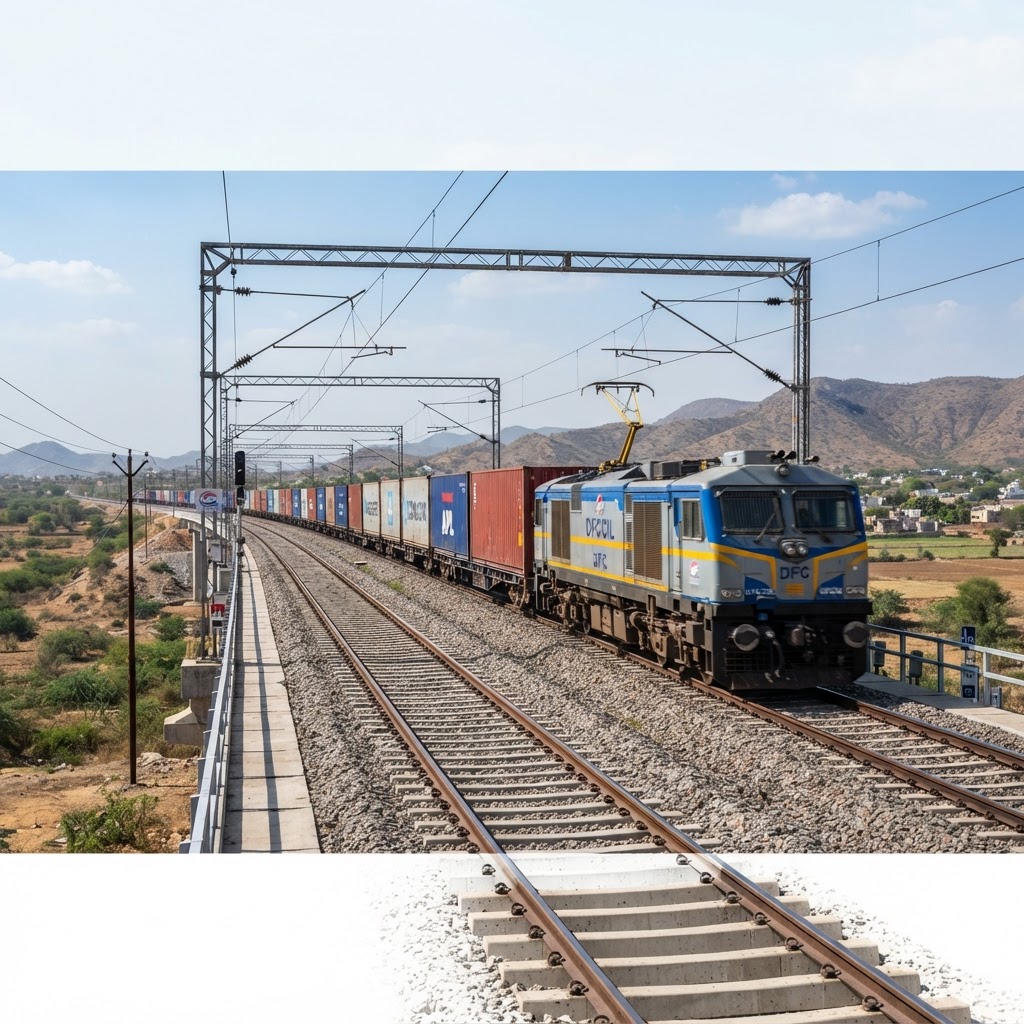
Table of Contents
- Understanding India's Freight Corridor Network
- How Dedicated Freight Corridors Operate
- Economic Impact and Cost Reduction
- Current Projects and Expansion Plans
- Global Performance Benchmarking
- Future Challenges and Strategic Initiatives
Understanding India's Freight Corridor Network
India's dedicated freight corridor programme represents a fundamental restructuring of railway infrastructure strategy. The concept originated from a simple yet powerful insight: separating freight and passenger operations dramatically improves efficiency for both. The DFCCIL, established in 2006, has since developed a network of dedicated corridors spanning over 2,000 kilometres, with approximately 2,100 kilometres of double-tracked, high-capacity infrastructure currently operational or under advanced stages of construction.
The first major project, the Western Dedicated Freight Corridor (WDFC), connecting Dankuni in West Bengal to Dadri in Uttar Pradesh, fundamentally changed freight logistics across eastern and central India. This 1,863-kilometre corridor now handles substantial portions of coal, container, and multimodal traffic. The Eastern Dedicated Freight Corridor (EDFC), another major artery, extends approximately 1,350 kilometres and links critical manufacturing and port centres. Together, these corridors form the backbone of India's modern freight transport infrastructure.
The strategic importance of these corridors extends beyond mere logistics. They facilitate India's integration into global supply chains, support port development initiatives, and reduce road traffic congestion. According to DFCCIL data, freight movement on dedicated corridors has grown from negligible volumes in 2010 to over 10 per cent of national rail freight by 2026—a remarkable transformation in just 16 years.
How Dedicated Freight Corridors Operate
Dedicated freight corridors operate on fundamentally different principles than traditional railways. The infrastructure is specifically engineered for heavy-haul operations with heavier axle loads (typically 25 tonnes per axle compared to 20 tonnes on conventional lines), higher track-class specifications, and modern signalling systems. These technical enhancements permit heavier and longer freight trains—often 1,200 metres or longer—to operate at higher speeds than conventional freight services.
The operational model prioritises cargo movement. Train scheduling, maintenance windows, and operational protocols all centre on freight efficiency rather than balancing freight and passenger services. This separation eliminates the traditional bottleneck where slower freight trains occupied track capacity needed for express passenger services. On dedicated corridors, freight trains operate with predictable scheduling, enabling logistics planners to integrate rail transport into just-in-time supply chain management.
Modern signalling and control systems provide real-time tracking of freight movements. Locomotives equipped with GPS and communication systems allow operators to monitor train status continuously. This technological integration reduces transit time variability—a critical factor for industrial supply chains requiring schedule predictability. Container trains on dedicated corridors now regularly achieve average speeds of 80-90 kilometres per hour, substantially faster than mixed-traffic railway operations.
Comparison Table: Dedicated vs. Conventional Freight Rail
| Parameter | Dedicated Freight Corridor | Conventional Mixed Traffic |
|---|---|---|
| Train Length | 1,200+ metres | 600-900 metres |
| Average Speed | 80-90 km/h | 40-60 km/h |
| Transit Time (Delhi-Kolkata) | 36-40 hours | 60-72 hours |
| Cost per Tonne-km | ₹1.20-1.50 | ₹2.00-2.50 |
| Track Axle Load | 25 tonnes | 20 tonnes |
| Operational Flexibility | Cargo-focused, scheduled | Balancing freight and passengers |
Economic Impact and Cost Reduction
The economic benefits of dedicated freight corridors extend far beyond the railways themselves. By offering cost-competitive, predictable freight services, these corridors have fundamentally altered India's logistics landscape. Railway freight on dedicated corridors costs approximately 30-40 per cent less than equivalent road transport for bulk commodities, generating substantial savings for industries ranging from steel and cement manufacturing to automotive and FMCG sectors.
These cost reductions have cascading effects throughout the economy. Industrial competitiveness improves as production costs decrease. Export-oriented industries gain price advantages in global markets. Domestic consumption patterns shift as goods become more affordable. For bulk commodities like coal, iron ore, and limestone—which together comprise nearly 70 per cent of rail freight—dedicated corridors have generated transformative value.
Port-connected dedicated corridors have been particularly impactful. Connectivity from inland production centres to coastal ports via reliable, fast rail transport has reduced port handling delays and reduced the need for expensive inland warehousing. Containerised trade has emerged as a growth area, with container traffic on dedicated corridors growing 25-30 per cent annually.
Current Projects and Expansion Plans
Building on the success of existing corridors, India's Ministry of Railways has announced substantial expansion plans. In the 2026-27 Union Budget, significant allocation was provided for advancing dedicated freight corridors. Current projects under development include extensions to existing corridors and entirely new routes targeting emerging industrial clusters.
The North-South Dedicated Freight Corridor, under construction, will connect northern manufacturing centres to southern ports. The Central Dedicated Freight Corridor will link central Indian mineral-rich regions to ports and manufacturing hubs. Each new corridor undergoes rigorous feasibility analysis assessing commodity volumes, transport distance advantages, and economic returns on invested capital.
The Indian Railways' integrated modal approach also connects dedicated freight corridors with road networks and port infrastructure, creating seamless logistics chains. This multimodal integration is particularly critical for container and automotive trade.
Major Dedicated Freight Corridor Projects (2026 Status)
| Project Name | Route | Length (km) | Status |
|---|---|---|---|
| Western DFC | Dankuni-Dadri | 1,863 | Operational |
| Eastern DFC | Eastern Zones | 1,350 | Operational |
| North-South DFC | Northern-Southern Ports | 2,500 | Under Construction |
| Central DFC | Central Minerals-Ports | 1,800 | Planned |
Global Performance Benchmarking
India's dedicated freight corridor achievements rank alongside global best practices. Countries like Russia, Australia, and China operate extensive heavy-haul freight rail systems. India's integration into this group represents recognition of technical capability and operational sophistication. The DFCCIL has successfully implemented international standards whilst adapting them to Indian conditions—a complex engineering and management challenge.
Comparative analysis shows Indian dedicated freight corridors achieving competitive cost and service levels. Average freight costs of ₹1.20-1.50 per tonne-kilometre on Indian corridors compare favourably with equivalent services globally. Service reliability metrics—on-time delivery rates, cargo damage ratios, train completion rates—meet international standards.
The experience curve effect is particularly evident. As volumes have grown, unit costs have declined through operational learning and efficiency improvements. Technological upgrades—modern signalling, automated level crossings, digital train management—have progressively enhanced operational capability.
Future Challenges and Strategic Initiatives
Whilst dedicated freight corridors have proven successful, challenges remain. Seasonal commodity availability creates capacity utilisation variability. Return loading remains problematic—many empty trains operate in one direction. Regulatory harmonisation across state boundaries can delay operations. Competition from road transport, whilst reduced through cost advantages, remains significant for shorter distances and specialized commodities.
Future strategic initiatives focus on addressing these challenges. Integrated logistics clusters are being developed to aggregate cargo, improving capacity utilisation. Digital platforms are being deployed to match freight supply with available corridor capacity. Regulatory harmonisation efforts aim to create seamless operations across state boundaries.
The broader Indian Railways modernisation programme complements dedicated freight corridor development. Autonomous train technologies, AI-based predictive maintenance, and advanced analytics are being trialled on freight operations, promising further efficiency improvements in coming years.
Conclusion
India's dedicated freight corridors represent a transformative shift in railway logistics. By separating freight and passenger operations, India has created a high-efficiency, cost-competitive cargo transport system that strengthens industrial competitiveness and integrates India into global supply chains. The achievement of over 10 per cent modal share in just 16 years demonstrates remarkable operational success. With planned expansions and technological upgrades, dedicated freight corridors will play an increasingly central role in India's sustainable, efficient transport future.
You May Also Like: Indian Railways in 2026: Vande Bharat and Modernisation, National Highways in India: NHAI and Expressways, and Mumbai-Ahmedabad Bullet Train: High-Speed Rail Revolution.
Frequently Asked Questions
What is a dedicated freight corridor?
A dedicated freight corridor is a railway line exclusively designed and operated for cargo movement, separated from passenger services. These lines are engineered for heavier loads, longer trains, and higher speeds than conventional mixed-traffic railways, delivering faster transit times and lower costs.
How much faster are dedicated freight corridors compared to conventional railways?
Dedicated freight corridors achieve average speeds of 80-90 km/h, compared to 40-60 km/h on conventional mixed-traffic lines. This results in 40-50 per cent faster transit times—for example, Delhi to Kolkata via dedicated corridor takes 36-40 hours versus 60-72 hours via conventional routes.
What types of cargo are transported on dedicated freight corridors?
Dedicated corridors primarily carry bulk commodities including coal, iron ore, limestone, and containers. Coal and iron ore together comprise over 60 per cent of traffic, reflecting India's mining and steel industry demands. Container traffic for manufactured goods and automotive products represents the fastest-growing segment.
How has the dedicated freight corridor improved India's economic competitiveness?
By reducing logistics costs 30-40 per cent compared to road transport, dedicated corridors have improved industrial competitiveness. Export-oriented industries benefit from cost advantages in global markets. Domestic consumers benefit from lower product prices. Port connectivity has enhanced India's trade position.
What percentage of India's freight traffic now uses dedicated corridors?
As of 2026, dedicated freight corridors carry over 10 per cent of India's total railway freight traffic—a remarkable achievement given these corridors represent only 5-6 per cent of the total rail network. This reflects high-utilisation operations and substantial cargo volumes.
What are the environmental benefits of dedicated freight corridors?
By shifting cargo from roads to rail, dedicated corridors significantly reduce carbon emissions—rail freight produces 4-5 times lower emissions per tonne-kilometre than road transport. This shift supports India's climate commitments and air quality objectives whilst reducing road congestion.
What new dedicated freight corridors are planned?
The North-South Dedicated Freight Corridor and Central Dedicated Freight Corridor are under active development. Additional corridors connecting emerging industrial clusters are at planning and feasibility stages. The 2026-27 Budget allocation supports accelerated development of these projects.