The Signature Bridge in Delhi stands as one of India's most celebrated engineering marvels, spanning 675 metres across the Yamuna River to connect Wazirabad directly with East Delhi and Trans-Yamuna neighbourhoods. Inaugurated in November 2018 after an intricate construction process costing 1,575 crore rupees, the bridge features India's tallest asymmetric cable-stayed pylon tower at a towering height of 154 metres—more than double the height of the historic Qutub Minar. Constructed to replace the overburdened, narrow Wazirabad barrage crossing built in the 1960s, this architectural masterpiece carries over 150,000 vehicles daily while cutting commute times between North Delhi and Ghaziabad from 45 minutes to just 5 minutes. Crowned with a state-of-the-art glazed steel viewing gallery offering 360-degree panoramic vistas of the National Capital Region, the bridge serves as both a crucial transit artery and a premier tourist destination. This complete 2026 guide explores the bridge's structural design, traffic impact, viewing gallery access, lighting displays, and visitor travel tips.
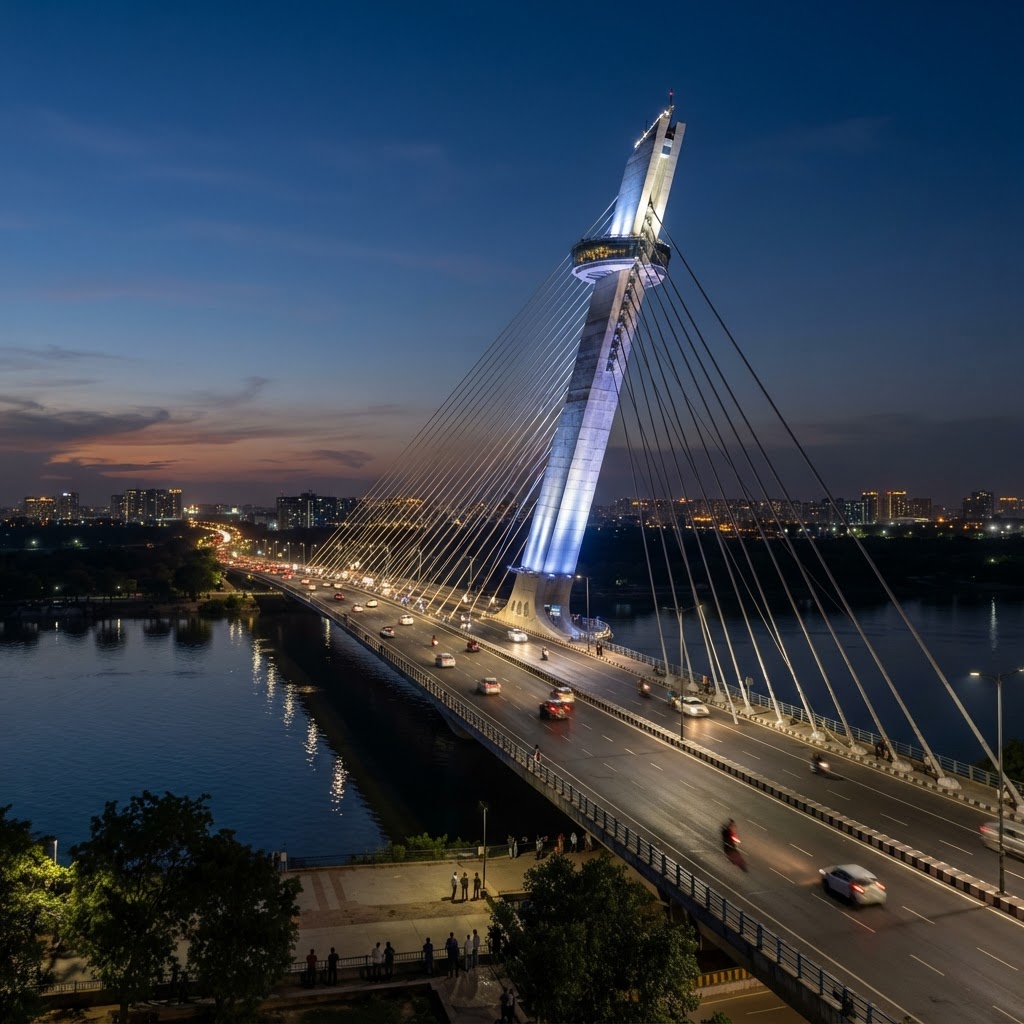
Table of Contents
- Signature Bridge Delhi: Overview & Historical Background
- Evolution of Yamuna Crossings in Delhi: From Colonial Loha Pul to Cable-Stayed Marvels
- Architectural & Structural Engineering Highlights
- Construction Milestones & Complex Civil Engineering Challenges
- The 154-Metre Inclined Pylon & High-Altitude Viewing Gallery
- De-Congesting Wazirabad: Connectivity & Traffic Management Impact
- Signature Bridge vs Major Delhi Bridges: Structural Comparison
- Signature Bridge vs International Cable-Stayed Landmarks
- Visitor Information: Access, Timings, Photography & Viewing Gallery Tips
- Maintenance, Architectural Lighting & Structural Health Monitoring
- Yamuna Riverfront Development & Urban Infrastructure Vision
- Conclusion
- You May Also Like
- Frequently Asked Questions
Signature Bridge Delhi: Overview & Historical Background
The conceptual origin of the Signature Bridge dates back to 2004, when the Government of National Capital Territory of Delhi (GNCTD) and the Delhi Tourism and Transportation Development Corporation (DTTDC) recognized the critical need for a high-capacity bridge over the Yamuna River at Wazirabad. For decades, vehicular traffic travelling between NH-44 (Grand Trunk Road), Outer Ring Road, and East Delhi had been forced to rely on the narrow, two-lane Wazirabad Barrage bridge. Constructed originally in 1963, the barrage bridge was severely inadequate for modern traffic volumes, causing chronic gridlock, frequent multi-kilometre traffic jams, and severe air pollution across North Delhi.
To deliver a world-class infrastructure solution, DTTDC commissioned an international joint venture comprising German bridge design specialists schlaich bergermann partner (sbp), engineering firm Construtora Aterpa M.Martins, and Gammon India. The design brief mandated a landmark structure that would not only handle heavy eight-lane traffic but also serve as an iconic visual symbol for the national capital. Construction commenced in 2007, facing formidable complex engineering challenges including deep riverbed foundation drilling, monsoon flooding, high wind forces, and intricate steel fabrication. Following comprehensive structural load testing, the bridge was officially opened to traffic in November 2018, transforming urban transit across North and East Delhi.
Today, the Signature Bridge is recognized as an urban landmark that seamlessly bridges civil mobility with aesthetic public art. By integrating advanced cable-stayed structural principles with cultural design elements, the structure has redefined Delhi's northern entry gateway along the Yamuna riverfront corridor.
Evolution of Yamuna Crossings in Delhi: From Colonial Loha Pul to Cable-Stayed Marvels
To fully appreciate the significance of the Signature Bridge, it is essential to trace the history of bridge engineering across the Yamuna River in Delhi. For centuries, crossing the Yamuna during monsoon months presented a major geographical barrier separating Old Delhi from the fertile plains of Uttar Pradesh. During the Mughal era, temporary pontoon bridges (bridges of boats) were erected during dry winter months and dismantled before summer monsoon floods arrived.
The era of permanent, heavy-duty river engineering began in 1866 with the construction of the Old Yamuna Bridge, popularly known as the Loha Pul (Iron Bridge). Built by the East India Railway Company, this double-deck steel lattice truss structure carried railway tracks on its upper deck and road traffic below. As Delhi expanded rapidly in the post-independence era, additional reinforced concrete bridges were constructed, including the ITO Bridge (Vikas Marg) in 1964, the Wazirabad Barrage bridge in 1963, the Nizamuddin Bridge in 2001, and the ISBT Bridge (Yudhisthir Setu) in 1998.
However, conventional concrete girder bridges required numerous underwater piers situated directly in the river channel. These piers restricted river flow, accumulated silt, and created environmental degradation during flood cycles. The Signature Bridge introduced a revolutionary paradigm shift: an asymmetrical cable-stayed structure that spans the river channel with a single main span of 251 metres, drastically minimizing riverbed obstructions while maximizing aesthetic elegance.
Architectural & Structural Engineering Highlights
From a structural engineering perspective, the Signature Bridge is India's first asymmetrical cable-stayed bridge. Unlike symmetrical bridges that feature vertical towers on both riverbanks, the Signature Bridge relies on a single, dramatically inclined steel pylon that balances the weight of the entire 675-metre bridge deck through a complex network of high-tensile steel cables. The main span stretching across the active Yamuna riverbed measures 251 metres, supported by 192 high-strength stay cables arranged in an elegant fan configuration.
The bridge deck measures 35.2 metres in total width, accommodating eight traffic lanes (four lanes in each direction) separated by a central concrete crash barrier, along with dedicated pedestrian footpaths and maintenance corridors. To withstand seismic forces characteristic of Delhi's earthquake zone (Zone IV) and high wind velocities during monsoon storms, the bridge structure utilizes high-performance steel-concrete composite girders and hydraulic shock transmission units. The inclined pylon transfers massive gravitational loads into deep pile foundations drilled up to 60 metres beneath the Yamuna riverbed into bedrock, ensuring structural stability for over a projected 100-year design lifespan.
Detailed aerodynamic wind tunnel testing was conducted at specialized fluid dynamics laboratories in Wacker Ingenieure, Germany. Models of the inclined pylon and stay cables were subjected to simulated hurricane-force winds to ensure that vortex-induced vibrations would be completely dampened by internal mechanical dampers housed inside the cable anchorages.
Construction Milestones & Complex Civil Engineering Challenges
Building India's tallest cable-stayed bridge presented civil engineers with unprecedented technical hurdles during its 14-year development cycle. The primary engineering challenge lay in anchoring a 154-metre steel pylon weighing thousands of metric tonnes into the loose alluvial silt of the Yamuna floodplains.
| Engineering Parameter | Specification / Dimension | Structural Detail |
|---|---|---|
| Bridge Type | Asymmetrical Cable-Stayed Bridge | Single inclined pylon with fan cable arrangement |
| Total Length | 675 metres (2,215 feet) | Continuous multi-span composite deck structure |
| Main Span Length | 251 metres (823 feet) | Suspended across the Yamuna River channel |
| Pylon Tower Height | 154 metres (505 feet) | More than double Qutub Minar (73 metres) |
| Pylon Inclination Angle | 22 degrees backward tilt | Designed for counterbalancing deck loads |
| Number of Stay Cables | 192 high-tensile stay cables | Enclosed in protective weather-resistant sheathing |
| Bridge Deck Width & Lanes | 35.2 metres wide (8 traffic lanes) | 4 lanes northbound, 4 lanes southbound |
| Project Investment Cost | 1,575 crore rupees | Executed by DTTDC and international contractors |
To overcome soil instability, engineers constructed deep foundation caissons and bored concrete piles extending up to 60 metres deep into solid rock strata. Furthermore, because the pylon segments were fabricated in Germany using high-precision structural steel, transporting these massive steel sections from Indian seaports to landlocked Delhi required specialized heavy-haul transport trailers and route clearances across multiple states.
Erecting the inclined steel pylon required a custom-built 1,200-tonne crawler crane—one of the largest in Asia at the time. Each steel segment was hoisted into position, laser-aligned to millimeter tolerances, and welded using non-destructive ultrasonic testing methods. Cable tensioning was executed in carefully calculated stages using hydraulic jacks, ensuring that equal load distribution was maintained across all 192 stay cables as the bridge deck was incrementally constructed outward over the river channel.
The 154-Metre Inclined Pylon & High-Altitude Viewing Gallery
The most striking architectural feature of the Signature Bridge is its 154-metre high steel pylon, which leans backward at an angle of 22 degrees toward the riverbank to counterbalance the main bridge deck. Fabricated in Germany using high-grade structural steel sections, the hollow pylon segments were shipped to India and assembled onsite using giant high-capacity crawler cranes and precision laser alignment systems. The pylon's boomerang-like shape symbolizes folded hands in a traditional Indian Namaste greeting, blending modern industrial engineering with Indian cultural motifs.
At the apex of the 154-metre pylon sits a 30-metre-tall glass and steel structure known as the High-Altitude Viewing Gallery. Enclosed in double-glazed thermal glass, the viewing gallery functions as a high-elevation observation deck capable of accommodating up to 50 visitors simultaneously. Access to the gallery is provided by two high-speed glass elevators operating inside the inclined pylon legs at a 60-degree incline. From the viewing box, visitors enjoy unmatched 360-degree panoramic views across the Delhi skyline, the Yamuna floodplains, the Red Fort, and the greenery of North Delhi.
The glass elevators themselves are an engineering attraction: featuring transparent panoramic glass walls, they offer passengers a thrilling ride up the inclined pylon leg, climbing at 2 metres per second while providing changing perspectives of the river below.
De-Congesting Wazirabad: Connectivity & Traffic Management Impact
The operational opening of the Signature Bridge has delivered immense socio-economic and traffic management benefits to the National Capital Region. Prior to its construction, commuting between North Delhi (including Delhi University North Campus, Timarpur, and Model Town) and East Delhi (including Bhajanpura, Yamuna Vihar, Karawal Nagar, and Loni) was a daily nightmare. Motorists were routinely trapped in gridlock on the narrow Wazirabad barrage crossing for over 45 to 60 minutes during peak hours.
With eight wide traffic lanes and smooth grade-separated approach ramps, the Signature Bridge slashed travel time across the Yamuna at Wazirabad down to just 5 minutes. The bridge handles an estimated 150,000 Passenger Car Units (PCUs) daily, smoothly diverting heavy commercial and commuter traffic away from Outer Ring Road congestion points. Furthermore, the bridge provides an efficient link connecting national highway NH-44 with the Delhi-Saharanpur Highway and the upcoming Northern Peripheral Expressway corridor, facilitating rapid freight and passenger transit across northern India.
The reduced idle time in traffic translates to significant reductions in vehicular fuel consumption and carbon monoxide emissions across North Delhi, improving air quality for surrounding residential neighborhoods.
Signature Bridge vs Major Delhi Bridges: Structural Comparison
Delhi features several major bridges spanning the Yamuna River, each constructed during different eras of civil engineering. Comparing the Signature Bridge with other prominent Delhi river crossings highlights the dramatic evolution in structural capacity, aesthetic design, and engineering technology.
| Bridge Name | Bridge Type / Design | Total Length | Pylon Height / Feature | Number of Lanes | Year Opened |
|---|---|---|---|---|---|
| Signature Bridge | Asymmetrical Cable-Stayed | 675 metres | 154 m (India's Tallest Pylon) | 8 Traffic Lanes | 2018 |
| Nizamuddin Bridge (NH-19) | Prestressed Concrete Box Girder | 552 metres | Standard Piers (No Pylon) | 8 Traffic Lanes | 2001 |
| Old Yamuna Bridge (Loha Pul) | Double-Deck Steel Truss | 1,429 metres | Historic Steel Framework | 2 Rail Tracks + 2 Road Lanes | 1866 |
| ITO Bridge (Vikas Marg) | Reinforced Concrete Girder | 560 metres | Standard River Piers | 6 Traffic Lanes | 1964 |
| ISBT Bridge (Yudhisthir Setu) | Concrete Cantilever Box Girder | 580 metres | Low-Profile River Piers | 8 Traffic Lanes | 1998 |
As demonstrated in Table 2, while older structures like the historic Old Yamuna Bridge (Loha Pul) relied on heavy steel truss frameworks and conventional piers, the Signature Bridge utilizes long-span cable suspension to minimize riverbed obstructions. By eliminating multiple underwater piers, the Signature Bridge preserves the natural ecological flow of the Yamuna River during monsoon flood surges, reducing hydraulic scour and environmental disruption.
Signature Bridge vs International Cable-Stayed Landmarks
To place the Signature Bridge in global context, it is informative to compare its engineering metrics with world-renowned asymmetrical cable-stayed bridges around the globe:
1. Erasmusbrug (Rotterdam, Netherlands): Known as "The Swan", this 802-metre asymmetrical cable-stayed bridge features a 139-metre bent pylon. The Signature Bridge's 154-metre pylon surpasses Erasmusbrug in height while serving a significantly wider eight-lane traffic deck.
2. Golden Horn Metro Bridge (Istanbul, Turkey): A cable-stayed bridge supporting Istanbul's metro network over the Golden Horn. While built primarily for rail transit, Delhi's Signature Bridge accommodates heavy highway traffic volumes exceeding 150,000 vehicles daily.
3. Bandra-Worli Sea Link (Mumbai, India): Spanning Mumbai's Mahim Bay with twin symmetrical cable-stayed towers (128 metres high), the Sea Link handles open-sea wave dynamics, whereas the Signature Bridge features a taller single asymmetrical pylon engineered specifically for riverbed alluvial foundation conditions.
4. Chenab Bridge (Jammu & Kashmir, India): While Chenab Bridge holds the record as the world's highest railway arch bridge (359 metres above riverbed), the Signature Bridge holds the record for India's tallest cable-stayed pylon tower at 154 metres.
Visitor Information: Access, Timings, Photography & Viewing Gallery Tips
In addition to serving as a vital traffic artery, the Signature Bridge has emerged as one of Delhi's top architectural attractions for tourists, photography enthusiasts, and sightseers. The bridge is particularly popular during late afternoon and evening hours, when the sun sets over the Yamuna River and the structure's architectural lighting system is activated.
How to Reach: The nearest Delhi Metro station is Vidhan Sabha or Kashmiri Gate on the Yellow Line, located approximately 5 to 7 kilometres from the bridge. Visitors can easily hire auto-rickshaws or app-based taxis from the station. For commuters driving private vehicles, access ramps connect directly from Outer Ring Road near Majnu ka Tilla.
Viewing Gallery Timings & Access: The High-Altitude Viewing Gallery operates between 10:00 AM and 06:00 PM. Visitors are advised to check local DTTDC announcements for elevator ticketing schedule updates and maintenance slots.
Photography Points: The best photographic vantage points for capturing the entire illuminated bridge deck are located along the western banks of the Yamuna near the Yamuna Biodiversity Park and Majnu ka Tilla promenade. Visitors are reminded that stopping vehicles on the main bridge lanes for selfies is strictly prohibited by Delhi Traffic Police for safety reasons; designated parking bays and pedestrian walkways must be utilized.
Maintenance, Architectural Lighting & Structural Health Monitoring
Maintaining a major cable-stayed bridge subjected to extreme temperature variations (ranging from 4°C in winter to 48°C in summer) requires cutting-edge maintenance infrastructure. The Signature Bridge is monitored 24/7 by an automated Structural Health Monitoring System (SHMS) developed in partnership with international bridge inspection agencies. Sensor nodes installed across the stay cables, pylon base, and composite deck continuously record structural vibration frequencies, stay cable tension, wind velocity, and thermal expansion metrics.
A visual highlight of the Signature Bridge is its dynamic LED architectural lighting system. Controlled by centralized computerized lighting software, hundreds of color-changing LED floodlights illuminate the 154-metre steel pylon and stay cables at night. On special national occasions such as Independence Day, Republic Day, and Diwali, the bridge is lit up in vibrant tricolor (saffron, white, and green) patterns, creating a mesmerizing spectacle visible for miles across the national capital.
Yamuna Riverfront Development & Urban Infrastructure Vision
The Signature Bridge serves as the anchor point for the broader Yamuna Riverfront Rejuvenation Plan envisioned under the Delhi Master Plan 2041. The Delhi Development Authority (DDA) and Delhi Tourism are developing eco-tourism parks, wetlands conservation zones, walking trails, and water sports hubs along the Yamuna floodplains surrounding the Wazirabad bridge complex.
By integrating sustainable flood management, eco-tourism, and modern rapid transit corridors, the Signature Bridge demonstrates how urban infrastructure can harmonize functional utility with architectural beauty. As Delhi expands its transport network with new peripheral expressways and elevated rail corridors, the Signature Bridge remains a proud symbol of India's engineering prowess and modern urban ambition.
Conclusion
The Signature Bridge in Delhi is far more than a river crossing—it is an iconic symbol of modern Indian engineering and urban transformation. Spanning 675 metres over the Yamuna with its record-breaking 154-metre inclined pylon, the bridge has permanently relieved traffic bottlenecks between North and East Delhi while providing the city with an architectural landmark. For commuters and visitors alike in 2026, the Signature Bridge stands as a testament to world-class design, structural innovation, and progressive urban planning.
You May Also Like: Chenab Bridge, Atal Setu, and Ring Roads.
Frequently Asked Questions
How tall is the Signature Bridge tower?
The central inclined pylon tower of the Signature Bridge is 154 metres tall, making it India's tallest cable-stayed bridge tower—more than double the height of Delhi's Qutub Minar (73 metres).
How long is the Signature Bridge?
The total length of the Signature Bridge is 675 metres, featuring an asymmetrical main cable-stayed span of 251 metres suspended across the active bed of the Yamuna River.
When was the Signature Bridge inaugurated?
The Signature Bridge was officially inaugurated and opened to public vehicular traffic in November 2018 after a comprehensive construction process executed by DTTDC and international engineering partners.
How much did the Signature Bridge cost?
The total construction investment for the Signature Bridge project was approximately 1,575 crore rupees.
Can visitors go to the top of the Signature Bridge?
Yes, the top of the 154-metre pylon features a 30-metre-tall glazed High-Altitude Viewing Gallery accessible via glass elevators, offering 360-degree panoramic views of Delhi and the Yamuna River. General visiting hours run from 10:00 AM to 06:00 PM.
How many cables does the Signature Bridge have?
The bridge is supported by 192 high-tensile steel stay cables arranged in an asymmetrical fan design connected directly from the 154-metre inclined pylon to the eight-lane bridge deck.