Delhi Metro Phase 4 is one of India’s most watched urban transport programmes in 2026. The expansion is intended to add new corridors, connect underserved parts of Delhi and the National Capital Region, improve interchange with existing lines and give commuters alternatives to congested roads. The first priority packages include the Majlis Park–Maujpur corridor, the Janakpuri West–RK Ashram Marg corridor and the Aerocity–Tughlakabad corridor, while the wider phase includes additional extensions approved for later delivery. Delhi Metro Rail Corporation is coordinating a technically complex programme involving elevated viaducts, underground sections, road traffic management, land constraints and interfaces with an already busy network. This guide explains the corridors, likely passenger benefits, engineering challenges, accessibility, environmental issues, fares and the practical questions travellers should ask as Phase 4 moves from construction to operations.
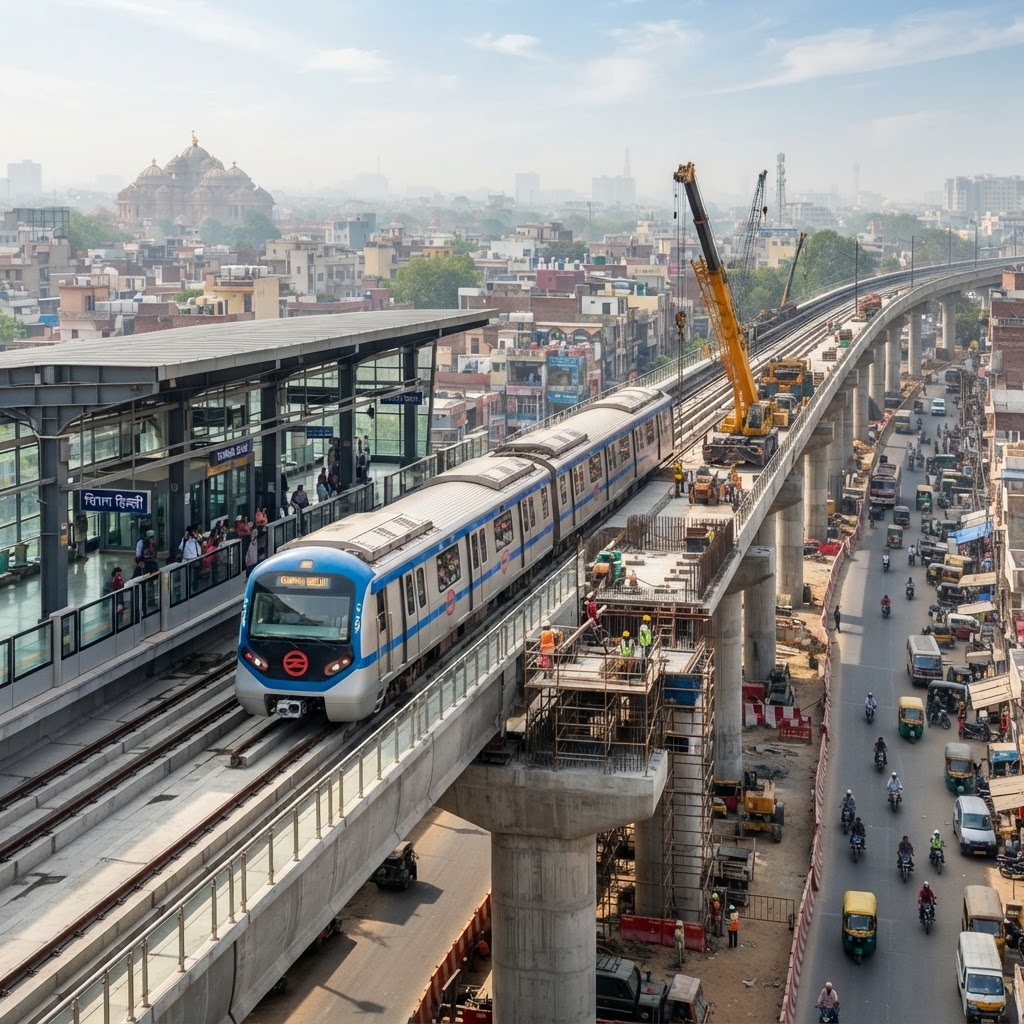
Table of Contents
- Project overview and 2026 status
- Route, design and passenger experience
- Capacity, connectivity and local impact
- Delivery, funding and governance
- Safety, accessibility and sustainability
- How it compares with other transport projects
- Practical guide and what happens next
Delhi Metro Phase 4: scope and 2026 status
Phase 4 is not one single line but a package of corridors designed to close gaps in the existing network. The three priority corridors commonly identified in public project information cover roughly 65 kilometres and around 45 stations, subject to package-level changes and commissioning schedules. Further approved corridors expand the programme beyond the initial priority works. The key planning idea is to connect areas where road congestion is severe or where passengers currently need multiple indirect transfers to reach the main metro network.
The Majlis Park–Maujpur corridor strengthens the northern and north-eastern network and creates new interchange opportunities with existing lines. The Janakpuri West–RK Ashram Marg corridor extends connectivity through west and central Delhi, while Aerocity–Tughlakabad links important employment, airport and southern areas. Each corridor has its own mix of elevated and underground construction, station constraints and utility diversions. Therefore, a headline completion date should not be treated as a guarantee that every station opens on the same day.
In 2026, passengers should expect a transition period. Construction may be substantially advanced while testing, signalling integration, safety certification, staff training and trial operations continue. Metro systems cannot safely move directly from civil completion to public service. Trains must be tested under different operating conditions, platform systems checked, emergency procedures rehearsed and interfaces with existing lines validated. The final opening sequence will depend on approvals and readiness, not only on visible construction progress.
The programme’s success will be measured by more than kilometres added. A useful Phase 4 corridor must offer frequent trains, convenient interchanges, accessible stations and reliable first- and last-mile connections. If passengers still need long auto-rickshaw rides to reach a station, the line will not deliver its full potential. Planning around bus routes, walking paths, cycle access and interchange management is therefore as important as laying track.
Priority corridors and station-level connectivity
The three priority corridors address different travel markets. Aerocity–Tughlakabad has a strong airport, employment and southern-suburban role. Janakpuri West–RK Ashram Marg improves the west-to-central connection and can reduce pressure on existing corridors. Majlis Park–Maujpur creates a new north-east link and is especially important for passengers who currently depend on crowded roads or lengthy transfers. Together, they extend the practical reach of Delhi Metro into areas where demand is already high.
Station placement determines whether a line becomes a convenient daily service or merely a route on a map. Stations near markets, schools, hospitals, offices and high-density housing can attract regular users, but they also require careful pedestrian design. Footpaths must handle large flows without forcing passengers into traffic. Crossings, bus bays and auto-rickshaw stands should be organised so that interchange is safe and predictable. A station entrance on one side of a divided road can be far less useful than one with direct access to both sides.
Interchange design is another major factor. Passengers tolerate a change of line when the route is direct, well signed and reasonably short. Long underground walks, confusing exits or repeated security checks can make a nominally integrated network feel fragmented. Phase 4 should use consistent maps, multilingual signs, real-time information and accessible routes between platforms. Interchange capacity must also account for future demand; a corridor that opens comfortably but becomes crowded after nearby development may need expensive retrofits.
The effect on existing lines will be closely watched. New corridors can distribute passengers, but they can also create sudden pressure at interchange stations. Timetable planning, train frequency, platform circulation and crowd-control systems must be tested together. The best result is a network in which Phase 4 gives passengers several viable routes rather than simply moving congestion from one line to another.
| Priority corridor | Approx. role | Key passenger benefit | Delivery consideration |
|---|---|---|---|
| Aerocity–Tughlakabad | Airport, south Delhi and employment access | Faster cross-city and airport-area journeys | Urban utilities, road interfaces and mixed construction |
| Janakpuri West–RK Ashram Marg | West-to-central connectivity | More direct trips and interchange options | Dense built-up areas and traffic management |
| Majlis Park–Maujpur | North and north-east connection | New access to existing metro network | Interchange capacity and community access |
| Wider Phase 4 packages | Network extensions and gap filling | Broader NCR connectivity over time | Phased approvals, funding and commissioning |
Engineering, construction and technology
Delhi Metro construction takes place in one of the world’s most complicated urban environments. Elevated viaducts must be built above or beside busy roads while keeping traffic moving. Underground sections require station boxes, tunnelling, utility relocation and careful management of groundwater and existing structures. Every pier, launch area and barricade can affect buses, pedestrians, businesses and emergency access. This is why construction speed must be balanced with safety and neighbourhood disruption.
Modern metro delivery relies on more than concrete and steel. Signalling and train-control systems determine how frequently trains can operate and how safely they can be separated. Platform equipment, communications, power supply, ventilation and fire systems must be integrated before opening. Digital asset management and condition monitoring can improve maintenance after commissioning, while predictive tools may help identify faults before they cause passenger disruption. The public sees the train and station, but reliability depends on a much larger technical ecosystem behind the scenes.
Construction staging is especially important around interchanges. Work may need to proceed while existing metro services remain open, limiting access to platforms and restricting working hours. Temporary routes must be accessible and clearly signed. The experience of passengers during construction can shape public confidence in the project, so authorities should publish changes in advance and provide practical alternatives rather than relying on general notices.
Testing and commissioning will be a decisive 2026 activity. Trial runs check braking, signalling, platform alignment, communications, power resilience and emergency response. Integration tests examine what happens when a train is delayed, a lift fails, a passenger alarm is activated or a station becomes crowded. These scenarios are not signs of failure; they are how a safe railway is proven before opening. The final phase can appear quiet to the public while intensive technical work continues behind the scenes.
Funding, governance and economic impact
Phase 4 is a public transport investment with benefits that extend beyond ticket sales. It can reduce travel time, improve access to jobs, support commercial activity around stations and make the capital more attractive to employers and residents. It can also reduce fuel use and road congestion when passengers shift from private vehicles. Measuring those benefits requires a long-term view because ridership grows as people change homes, workplaces and travel habits around the new network.
Governance is shared between DMRC, central and Delhi governments, urban agencies, local bodies, utilities and traffic authorities. Land acquisition, permissions, road diversions and utility relocation can influence the schedule as much as the railway work itself. Clear accountability is therefore essential. Public updates should distinguish between civil construction, system installation, trial running and commercial opening so that residents understand what each milestone means.
Station-area development can create both opportunity and risk. Shops, offices and housing may benefit from better access, while small businesses may face disruption during construction or rising rents after opening. Good planning protects pedestrian space, provides accessible public areas and avoids excessive dependence on private parking. The metro should support compact, mixed-use development rather than simply encouraging more traffic at station approaches.
The programme also has an employment and skills dimension. Construction, systems engineering, operations and maintenance create demand for specialised labour. Lessons from Phase 4 can strengthen India’s wider metro supply chain, provided procurement encourages quality, local capability and maintainability rather than focusing only on the lowest upfront cost.
Safety, accessibility and environmental performance
Metro safety depends on coordinated systems: platform management, signalling, fire protection, emergency exits, CCTV, public announcements and trained staff. Phase 4 stations must be designed for ordinary peak crowds as well as exceptional events such as severe weather, medical emergencies or power interruptions. Evacuation routes should be intuitive, visible and usable by people with different mobility needs.
Accessibility includes lifts, ramps, tactile paving, audible information, suitable gate widths and staff assistance. It also includes the route outside the station. A step-free platform is not enough if a passenger cannot cross the road safely or reach the entrance from a bus stop. Universal design improves the experience for older people, children, travellers with luggage and anyone carrying goods, not only wheelchair users.
Environmental benefits depend on actual ridership and construction practices. Electrified metro trains can reduce tailpipe pollution and offer lower emissions per passenger when well used. During construction, however, dust, noise, tree loss, traffic diversion and waste need active management. Tree transplantation and replacement planting should be monitored transparently, while drainage and heat mitigation should be considered in station design.
Climate resilience is increasingly important in Delhi. Stations and electrical equipment need protection from intense rainfall, flooding and extreme heat. Shade, ventilation, efficient cooling and durable materials can improve comfort and reduce operating costs. A metro line designed only for average conditions may face reliability problems as weather becomes less predictable.
Comparing Phase 4 with other urban transport options
Metro is highly effective on dense corridors where demand is strong and road space is limited, but it is expensive and slow to build compared with bus improvements. Delhi’s existing network shows the value of a high-capacity rail spine, while buses and intermediate public transport remain essential for neighbourhood coverage. Phase 4 should therefore be judged as part of a multimodal system rather than as a replacement for every bus or road journey.
Compared with a new flyover, metro can move more people through a constrained corridor without adding as many private vehicles. Compared with a bus rapid transit scheme, it offers a fixed, high-capacity right of way but requires greater capital investment and longer construction. Compared with a suburban railway, it can provide more frequent urban stops but may have less regional reach. The correct choice depends on demand, land, travel patterns, budget and the ability to operate the system reliably.
The strongest case for Phase 4 is where it creates a connected network effect. A passenger benefits most when a new line links smoothly to existing routes and local services. If interchange is difficult or fares are not integrated, the theoretical coverage will overstate the real benefit. Transport authorities should track door-to-door travel times, crowding, interchange penalties and access by low-income communities, not only passenger entries at each station.
| Mode | Capacity and coverage | Typical strength | Limitation compared with Phase 4 |
|---|---|---|---|
| Delhi Metro Phase 4 | High corridor capacity with network interchange | Reliable urban rail on dense routes | High cost and long construction period |
| City bus network | Flexible, broad neighbourhood coverage | Can be rerouted and expanded quickly | Traffic congestion affects reliability |
| Bus rapid transit | Dedicated corridor where road space allows | Lower cost than metro in suitable streets | Needs protected lanes and enforcement |
| Suburban railway | Longer-distance regional movement | High capacity over existing rail routes | Station spacing and route coverage differ |
| Private car/taxi | Door-to-door flexibility | Useful where public transport is absent | Congestion, fuel cost and emissions |
How to follow progress and plan journeys
Travellers should rely on official DMRC service notices and station information rather than unofficial opening claims. Construction progress can be visible months before a corridor is ready for passengers. Look for clear confirmation of trial running, safety authorisation, commercial service and the exact stations included in the opening phase. A corridor may open in sections, and an interchange may become available later than the first trains.
During construction, allow extra time around barricaded roads and check whether bus routes or station entrances have moved. People travelling to hospitals, examinations, airports or appointments should keep a backup route. Once a new section opens, compare the complete journey with existing options: walking time, interchange distance, train frequency, fare, crowding and the reliability of the final connection.
Residents can also evaluate the project through practical indicators. Are footpaths continuous? Can an older passenger cross the approach road safely? Are buses timed to meet trains? Is cycle parking secure? Are station exits connected to the destinations people actually use? These questions reveal whether the line is functioning as public transport infrastructure or simply as a new rail alignment.
Over time, Phase 4 should be integrated with land-use planning, electric buses, pedestrian improvements and unified passenger information. A metro network cannot solve urban mobility alone, but it can provide the high-capacity backbone around which cleaner and more efficient journeys are organised. The quality of the surrounding system will determine how much value Delhi receives from every kilometre built.
Conclusion
Delhi Metro Phase 4 is a major 2026 expansion designed to extend high-capacity public transport into important gaps across the capital. Its priority corridors connect north-east Delhi, west and central districts, airport-area employment zones and southern parts of the city, while wider packages promise a broader network effect. The engineering challenge is substantial because construction must coexist with dense roads, utilities and an operating metro. The passenger benefit will ultimately depend on safe stations, reliable trains, short interchanges, accessible approaches and strong bus and walking connections. For commuters, the best approach is to follow official opening notices, compare door-to-door routes and plan for phased commissioning. For planners, the lesson is clear: a metro line succeeds when the whole journey works.
You May Also Like: Metro Rail in India 2026 comparison, Namo Bharat RRTS guide, and Best apps for train travel in India.
Frequently Asked Questions
What is Delhi Metro Phase 4?
Delhi Metro Phase 4 is a programme of new metro corridors and extensions intended to improve connectivity across Delhi and the National Capital Region.
Which are the main priority corridors?
The main priority packages are commonly described as Majlis Park–Maujpur, Janakpuri West–RK Ashram Marg and Aerocity–Tughlakabad, with additional approved corridors planned in later stages.
How many stations will Phase 4 add?
The three priority corridors are commonly associated with about 65 kilometres and around 45 stations, although final commissioning details can vary by package.
When will Delhi Metro Phase 4 open?
Opening dates depend on construction, systems testing, safety certification and operational readiness. Check official DMRC announcements for the exact corridor and station opening.
Will Phase 4 reduce Delhi traffic?
It can shift some trips from cars and two-wheelers to metro, especially where stations are close to homes and workplaces, but the effect depends on frequency and last-mile connections.
Is Delhi Metro Phase 4 accessible?
New stations are designed to include accessibility features such as lifts, ramps, tactile guidance and accessible passenger routes. The surrounding footpath and road crossing are also important.
How should passengers track Phase 4 progress?
Use official DMRC notices and journey information, and distinguish between civil completion, trial running, safety approval and the start of passenger service.