Okehampton Interchange has opened on Devon’s Dartmoor Line, giving the east side of Okehampton a new, accessible rail gateway beside the A30. Passenger services began on 1 August 2026 after an investment of about £15 million, creating a practical connection for West Devon while also supporting wider ambitions for sustainable travel across Devon and Cornwall. This guide explains what the station changes for passengers, how it fits alongside the existing Okehampton station, why the location matters, and what the project says about reopening and expanding local rail in Britain. It also considers parking, buses, walking and cycling, accessibility, resilience, tourism, construction lessons and the case for future stations such as Cullompton.
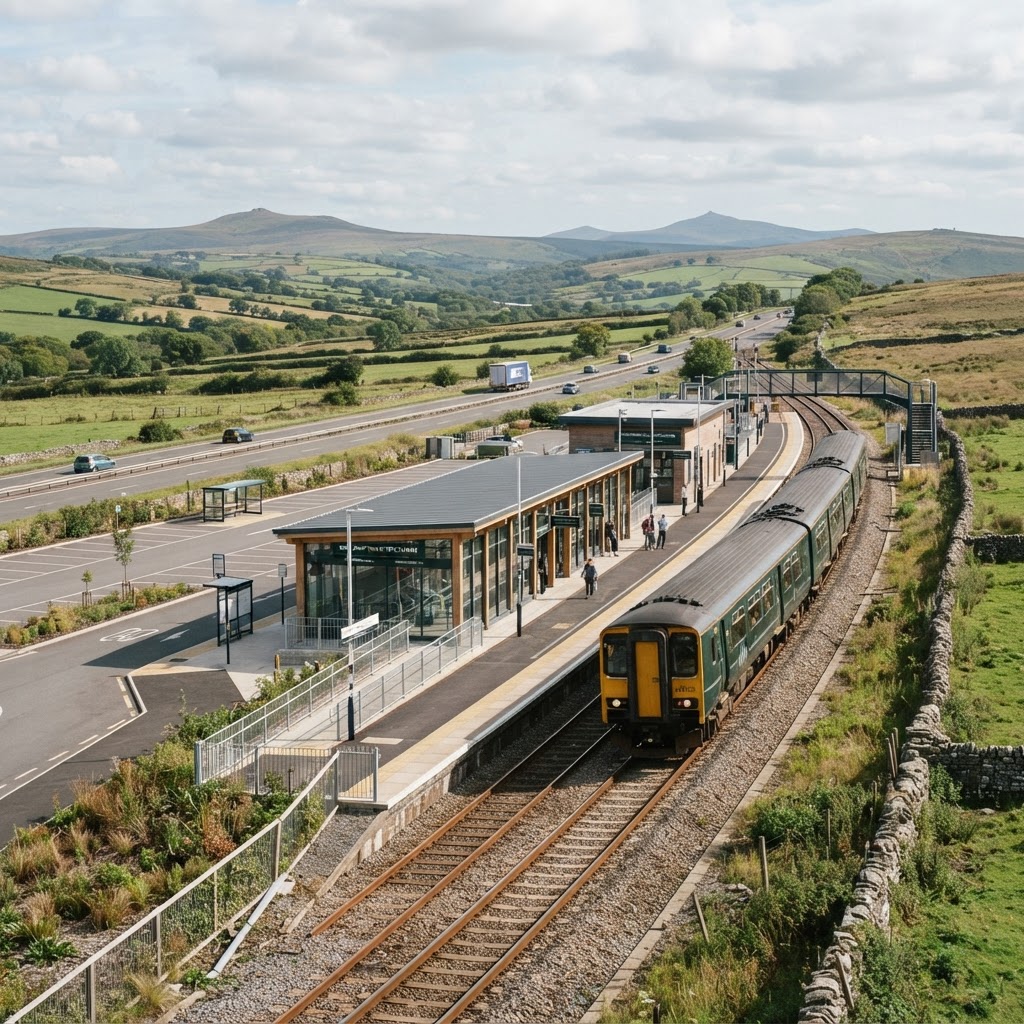
Table of Contents
- What opened on 1 August 2026
- Why the A30 location matters
- Accessibility and interchange design
- Passenger services and practical travel
- West Devon, tourism and local growth
- Construction and funding lessons
- Future rail potential across Devon
What opened on 1 August 2026
Okehampton Interchange is the newest station on the Dartmoor Line and opened to passengers on 1 August 2026. Official local information describes it as a station on the east side of Okehampton, positioned for straightforward access from the A30. It complements rather than replaces the established Okehampton station, giving the town and surrounding communities another point of access to the railway.
The word “interchange” is important. A modern station is not only a platform beside a track; it is a transfer point between rail, car, bus, taxi, walking and cycling. The new site has been planned to make those connections easier for people who do not live within a short walk of the town-centre station. Its success will depend on how naturally passengers move from a car park or bus stop to a train, and how clear information is when they arrive.
The opening also represents a wider change in the Dartmoor Line’s role. Regular passenger services returned between Okehampton and Exeter in 2021, demonstrating demand for a route that had previously lacked regular public passenger operation. The new station extends the usefulness of that service by serving a different catchment and making rail more convenient for A30-side communities.
Passengers should check the current timetable and ticketing arrangements before travelling, particularly during the early months. A new station can have different stopping patterns, parking procedures and walking routes from the established station. Network Rail, train operators and Devon authorities remain the best sources for live information.
Why the A30 location matters
Okehampton is a gateway to Dartmoor and an important centre for West Devon. The A30 is the principal east–west road through the region, so a station close to it can capture journeys that would otherwise begin with a car trip into town. That is especially relevant for residents in dispersed rural settlements, where distance to a station—not distance by rail—is often the barrier to public transport.
A strategically placed interchange can help visitors reach Dartmoor without driving all the way across the moor. That matters for congestion, parking pressure and the environmental impact of tourism. Rail cannot replace every car journey in a rural area, but it can provide a credible alternative for Exeter commuters, leisure visitors and people making longer journeys by connecting with the wider Great Western network.
Location brings trade-offs. A site beside a major road is visible and convenient for drivers, but walking and cycling routes must be safe, direct and comfortable. A large car park can support rail use while also encouraging car dependency if bus connections are weak. The design challenge is to offer choice: reliable bus interchange, step-free paths, secure cycle parking, taxi access, electric-vehicle charging where appropriate and clear pedestrian links.
Okehampton’s two-station arrangement may affect how the town develops. The town-centre station remains valuable for local access, while the interchange can serve longer-distance arrivals and people approaching from the A30. Together they create a network rather than a single catch-all site.
The project can be read alongside our coverage of the TransPennine Route Upgrade, although the scale is very different: one is a major inter-city programme, while Okehampton demonstrates how a focused local station can unlock network value.
Accessibility and interchange design
Network Rail describes Okehampton Interchange as a fully accessible station. Passengers should expect step-free movement between the arrival area and platform, accessible parking or drop-off arrangements, appropriate tactile surfaces and facilities designed for people with mobility, visual or hearing needs. Accessibility determines whether a station can be used independently by disabled passengers, older people, families with buggies and travellers carrying luggage.
Good interchange design also reduces uncertainty. Signage should show the platform, ticket facilities, bus stops, taxi area, car-park payment arrangements and walking routes in a consistent visual language. Real-time information needs to be visible before a passenger commits to a platform. Seating, shelter and lighting matter too, especially in a rural station where the next service may not arrive for some time.
Cycle access is another test. A station near the A30 can attract drivers, but a well-connected local cycle route can extend the catchment without adding traffic. Secure stands, weather protection and safe junctions make cycling more practical. Walking links should avoid long detours and feel safe in darkness and poor weather. The most accessible route is usually obvious, continuous and maintained.
Interchange quality is measured at the edges of the railway as much as on it. A punctual train cannot compensate for a bus that leaves before the doors open or a car park that is confusing at peak time. Operators and councils should review passenger feedback during the first year and adjust signs, bus coordination and operating procedures where necessary.
Passenger services and practical travel
The station’s opening adds a new boarding point to the Dartmoor Line, but passengers should distinguish the existence of a station from the frequency of service. The number of trains, first and last departures, calling patterns and connections at Exeter will determine whether the facility works for commuters as well as weekend visitors. Long-term success will be measured by ordinary journeys on wet Tuesday mornings in winter.
For a commuter, the key questions are simple: Is there a train at the right time? Can I reach the station without a car? Is parking reliable? Can I buy a ticket easily? If a connection is missed, is there another option? These practical details should guide evaluation. Passenger counts are useful, but surveys should also record suppressed demand from people who would travel if buses, walking paths or timetables improved.
For visitors, Okehampton Interchange can be a useful starting point for Dartmoor trips, provided onward information is clear. Maps should explain routes to local attractions, bus links, walking trails and weather-safe alternatives. Visitors should not assume mobile coverage, taxis or refreshments will be available exactly when needed; planning ahead remains sensible in a rural setting.
Fares and ticket acceptance should be checked through official operator channels. Railcards, contactless availability and permitted ticket types can change by route and operator. During engineering works, replacement buses may serve a different stop from the station entrance, so travellers should allow extra time and follow signs.
| Feature | Okehampton Interchange | Passenger value |
|---|---|---|
| Opening | 1 August 2026 | New access point on the Dartmoor Line |
| Location | East of Okehampton, near the A30 | Useful for road-side communities and visitors |
| Investment | Approximately £15 million | Purpose-built local rail infrastructure |
| Access | Fully accessible design | Step-free travel for a wider range of users |
| Role | Rail and road interchange | Supports parking, buses, taxis, walking and cycling |
West Devon, tourism and local growth
Transport investment can influence a rural economy in several ways. The most immediate is access to jobs and education: a reliable train can widen the area in which residents can work or study without moving house. Businesses benefit when employees and customers can reach them more easily. Over time, improved connectivity can support housing choices, reduce isolation and make local centres more resilient.
Tourism is particularly important around Dartmoor. Rail access can encourage visitors to arrive without a car, reducing pressure on narrow roads and popular car parks. It can also spread visitor spending beyond the busiest gateways if local bus links, walking routes and information encourage people to explore nearby communities. The environmental result depends on the whole trip; a train journey followed by a taxi-heavy itinerary may have different benefits from a train-and-walk visit.
There are risks to manage. New accessibility can increase visitor pressure at sensitive landscapes, and local residents may worry about parking, traffic or seasonal crowding. Authorities should monitor these effects and invest in footpath maintenance, public toilets, waste management and public transport capacity where demand grows. A station should support the landscape, not simply funnel more vehicles towards it.
Okehampton Interchange can demonstrate the value of modest rail projects. A £15 million station is substantial, but much smaller than a new inter-city railway. Its return will come through repeated everyday use, not a single spectacular engineering claim. That makes transparent evaluation important: passenger numbers, mode share, accessibility outcomes, local employment and carbon impacts should all be considered.
Construction, funding and lessons
Delivering a station beside an operating railway requires coordination between Network Rail, local authorities, train operators, contractors, landowners and the travelling public. The project included platform works, access arrangements, parking and interchange facilities, all of which must meet railway standards while fitting local planning and highway requirements. The opening date is the visible result of surveys, design decisions, approvals, procurement and testing.
Funding should be judged by what the station enables over its lifetime. A new platform is only part of the asset; drainage, lighting, accessibility equipment, information systems, parking surfaces and maintenance all create ongoing obligations. Local authorities need plans for cleaning, security, winter weather and repairs. Operators need to ensure accessibility equipment remains functional and staff can support passengers during disruption.
The Dartmoor Line experience shows why restored services and new stations should be planned together. A station can open successfully but underperform if its service pattern is too thin. Conversely, a strong timetable can be constrained if station access is poor. Integrated planning across infrastructure and operations is the lesson for other reopening proposals in England.
Early monitoring should be honest about what is and is not working. If buses do not connect, the answer may be a timetable change rather than a new car park. If the platform is crowded on summer weekends, crowd management may be more useful than permanent expansion. Evidence-led adjustments will protect the investment.
Future rail potential across Devon
Okehampton Interchange does not stand alone. The Dartmoor Line is part of a wider conversation about restoring local rail links, improving resilience and giving communities alternatives to congested roads. Devon authorities have discussed future opportunities including Cullompton station, while Network Rail’s work illustrates how infrastructure can be phased as demand and funding develop.
The next step should be to make the existing service as useful as possible. That means dependable frequency, coordinated connections at Exeter, clear disruption information and easy interchange between the two Okehampton stations. A network of useful local services can build the case for later investment more convincingly than a list of unfunded aspirations.
There is also a climate and resilience argument. Rail can reduce dependence on the A30 for some journeys, but it must remain reliable during extreme weather and engineering works. Stations need drainage, robust communications and emergency plans. Digital ticketing and real-time information can help, yet they should complement staffed support and clear printed information.
For the UK’s rail strategy, Okehampton is a reminder that connectivity is built from many layers: main lines, branch lines, stations, buses, footpaths and timetable decisions. The new interchange is valuable because it joins those layers in a place where previous access was inconvenient.
Conclusion
Okehampton Interchange is a practical piece of railway infrastructure with an important regional role. Opened on 1 August 2026 beside the A30, it gives West Devon a fully accessible station designed for rail-to-road interchange and strengthens the Dartmoor Line’s ability to serve residents and visitors. The approximately £15 million investment will deliver its greatest value if trains are frequent, buses connect well, walking and cycling routes are safe, and information is clear. Tourism benefits should be balanced with protection of Dartmoor and sensible management of parking and seasonal demand. The station also offers a useful test for future English rail projects: start with real passenger needs, connect infrastructure to operations, and measure success over years rather than opening-day headlines.
You May Also Like: TransPennine Route Upgrade, 5G connectivity on UK trains, and HS2 in 2026.
How the first year should be evaluated
The first year of Okehampton Interchange should be treated as a learning period rather than a final verdict. Passenger numbers will vary with school terms, holidays, weather and special events, so a single opening-month count cannot show the station’s full value. A sensible evaluation would compare weekday commuting, evening travel, weekend leisure use and seasonal tourism separately.
Authorities should also measure how people reach the station. If most users drive alone, the interchange is providing access but not yet delivering the full sustainable-transport ambition. Bus connections, walking and cycling improvements may unlock more demand without building extra parking. Surveys should ask residents who do not use the station what prevents them: timetable, fare, first-mile access, information or confidence.
Reliability matters on a rural line. Passengers need to know that a missed connection will not strand them for hours. Network Rail and operators should monitor cancellations, short formations, accessibility-equipment failures and disruption messaging. The goal is a service that people trust for routine appointments, not just one that looks attractive in launch photographs.
Tips for using the interchange responsibly
Travellers should plan the complete journey. Check the train timetable, allow time for parking or a bus transfer, and confirm whether tickets can be bought at the station or should be purchased before departure. For Dartmoor visits, check weather warnings, daylight, walking conditions and the availability of onward buses. Rural travel rewards preparation, particularly outside peak tourist periods.
Use marked walking and cycling routes, keep clear of railway boundaries and avoid leaving vehicles in nearby residential streets when the car park is busy. Visitors should take litter home or use provided facilities and respect signs protecting moorland habitats. These habits help ensure that better rail access remains acceptable to local communities and environmentally responsible.
Local businesses can make the station more useful by publishing clear directions from the platform, coordinating collection arrangements and displaying accurate opening times. Small improvements at the destination can convert a transport investment into a stronger local-economy asset.
Connecting the station to the wider network
Okehampton Interchange will work best when it is treated as part of a Devon mobility network. Timetable planners can examine connections at Exeter, bus operators can coordinate departures with rail arrivals, and local authorities can improve signs on routes from the A30 and nearby communities. These changes are relatively small compared with building a railway, but they determine whether the station feels convenient.
Information should be consistent across websites, station displays, printed timetables and journey-planning apps. During disruption, passengers need to know whether to use the old Okehampton station, a replacement bus, a local taxi or another route. Clear contingency information is particularly important for disabled passengers and visitors unfamiliar with the area.
The station may also support community partnerships. Local employers can promote rail commuting, schools can teach safe railway access, and tourism organisations can produce car-free Dartmoor itineraries. These initiatives turn physical connectivity into regular use and help the investment serve residents throughout the year.
Frequently Asked Questions
When did Okehampton Interchange open?
The new station opened on 1 August 2026, with passenger services starting on the Dartmoor Line on the same date.
Where is Okehampton Interchange?
It is on the east side of Okehampton in Devon, close to the A30, and complements the existing Okehampton station.
How much did the station cost?
Public local-authority information describes the investment as approximately £15 million.
Is Okehampton Interchange accessible?
The station has been described as fully accessible, with step-free access designed to support disabled passengers, older travellers and families.
Is it replacing the original station?
No. It is an additional station intended to serve a different catchment while the existing station continues to operate.
Can it help Dartmoor tourism?
It can make car-free visits easier, but visitors should check onward buses, walking routes, weather and seasonal facilities before travelling.
Will there be more stations in Devon?
Authorities continue to consider wider rail improvements, including proposals such as Cullompton, but each project depends on funding, planning and an operating case.