Indian Railways has unveiled its ambitious "Reform Express" initiative for 2026, announcing nine structural reforms that promise to reshape passenger convenience, cargo efficiency, and construction quality across the world's fourth-largest railway network. Union Minister Ashwini Vaishnaw confirmed that the railway budget has been increased from ₹32,000 crore in 2014–15 to ₹2.78 lakh crore in FY2026–27, reflecting the government's commitment to modernising the network that now spans 69,439 route kilometres. With nearly 97% of the ₹2.52 lakh crore capital expenditure for FY26 already utilised, these reforms come at a critical juncture in India's infrastructure transformation journey.
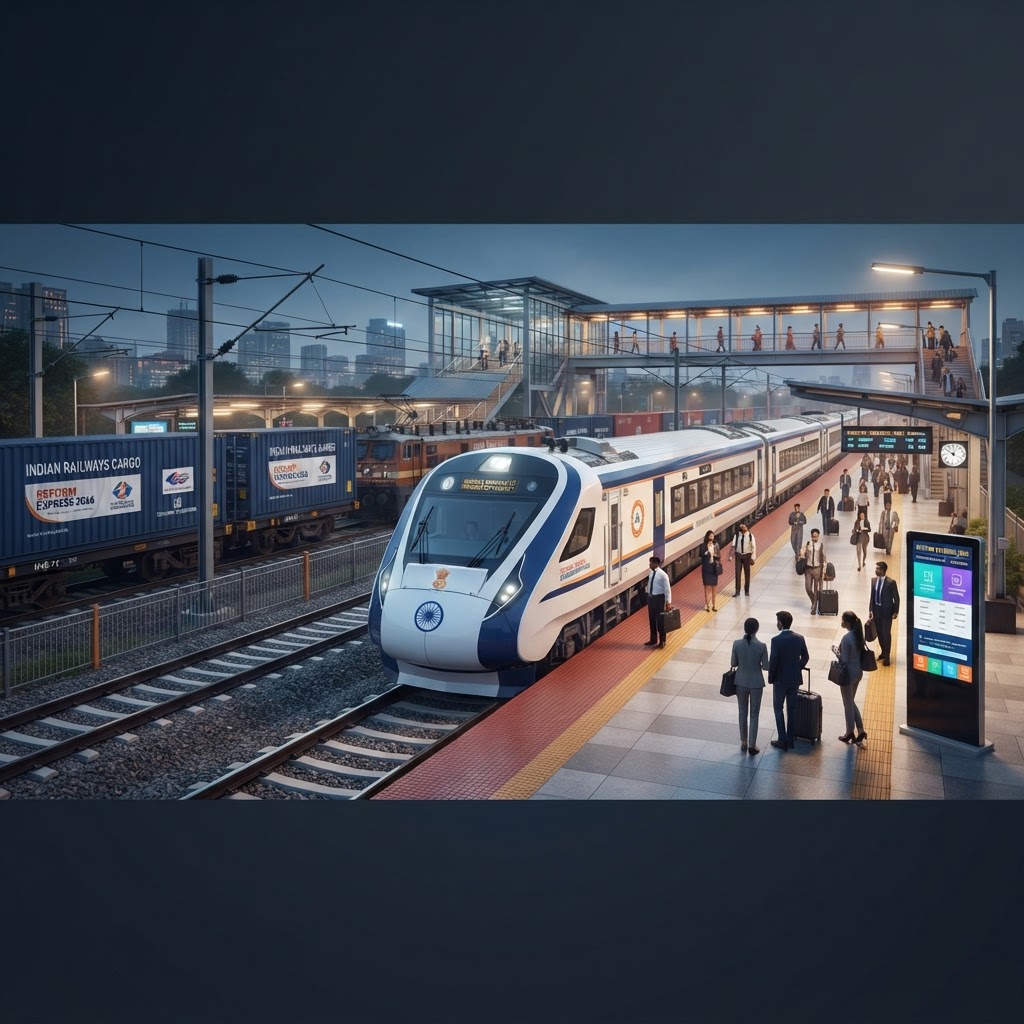
Table of Contents
- What Is the Reform Express Initiative?
- Passenger Convenience Reforms
- Salt Transportation Revolution
- Automobile Logistics Reforms
- Construction Quality Overhaul
- Economic Impact and Industry Response
- Challenges and Implementation Roadmap
- Future of Railway Reforms
- Conclusion
What Is the Reform Express Initiative?
The Reform Express is a structured reform programme launched by Indian Railways in early 2026 to transform railway operations in phases. The initiative began with four reforms introduced in the first quarter of the year, focusing on continuous on-board cleaning, digital service improvements, and operational efficiency. By March 2026, five additional reforms were approved, bringing the total to nine comprehensive changes spanning cargo, construction, and passenger services.
The programme reflects a broader effort to make Indian Railways more efficient, transparent, and user-friendly. Each reform was developed following detailed consultations with stakeholders, including salt producers, automobile manufacturers, transporters, and passenger associations. The reforms address long-standing issues in ticketing, logistics, and construction that have historically constrained the railway's performance and competitiveness.
What sets the Reform Express apart from previous modernisation attempts is its holistic approach. Rather than focusing on a single area, the initiative tackles multiple challenges simultaneously — from the way passengers board trains to how salt is transported across the country. As Indian Railways continues its broader 2026 modernisation push including the Vande Bharat expansion and freight corridor development, these reforms provide the regulatory and operational backbone to support that growth.
Passenger Convenience Reforms
Two of the nine reforms directly target passenger experience, addressing pain points that millions of travellers have faced for years. The first major change allows passengers to change their boarding station up to 30 minutes before train departure — a significant improvement from the previous rule that only permitted changes before chart preparation. This gives travellers far greater flexibility, particularly those whose plans change at short notice.
The second passenger reform revises the ticket cancellation and refund rules entirely. The new framework introduces tiered cancellation windows of 72, 24, and 8 hours before departure, replacing the earlier shorter and more confusing windows. This move specifically aims to curb last-minute speculative bookings that locked up berths without genuine travel intent. Under the new system, e-tickets receive automatic refunds, counter tickets can be cancelled from any station, and the cumbersome Ticket Deposit Receipt (TDR) filing requirement has been removed entirely.
These changes build on earlier passenger-focused improvements introduced in the first phase of the Reform Express, including AI-enabled continuous end-to-end cleaning of all coaches. For passengers who have struggled with the IRCTC login problems and booking issues, the simplified cancellation process removes one of the most frustrating aspects of Indian railway travel. The removal of TDR filing alone is expected to save millions of passengers significant time and effort each year.
Salt Transportation Revolution
India is one of the world's largest producers and exporters of salt, with annual production of approximately 35 million tonnes. The major producing states are Tamil Nadu, Gujarat, and Rajasthan. However, Indian Railways currently transports only about 9.2 million tonnes per annum of this salt, representing a significant untapped opportunity for modal shift from road to rail.
The reform identifies that the modal share of railways in salt transportation varies considerably by use — approximately 25% for industrial salt and around 65% for salt meant for human consumption. Critically, 62% of all rail-based salt traffic covers distances of 1,000 to 2,500 kilometres, making it a segment ideally suited for rail movement over road transport.
The key innovation is a new stainless steel, top-loading and side-discharge container system specifically designed for salt transportation. Detailed consultations with salt producers and transporters identified several long-standing problems: unsuitable wagon design, corrosion of wagons caused by salt, water seepage in open wagons despite tarpaulin covers, and multiple handling stages leading to higher costs and losses. The new containers address all these issues — they are made of stainless steel to prevent corrosion, equipped with top-loading flaps for easy filling at production sites, and feature a hydraulic side-discharge mechanism allowing direct unloading into trucks at destinations.
This container system enables seamless multimodal movement — containers can be placed at salt production sites for direct loading, lifted onto container trains, and then unloaded at warehouses or godowns as needed. The system reduces handling losses, provides greater flexibility, and has been well-received by the salt industry. This reform complements the broader transformation of India's freight logistics through dedicated freight corridors.
Comparison: Old vs New Salt Transport System
| Parameter | Old System | New Reform System |
|---|---|---|
| Container material | Standard steel (corrosion-prone) | Stainless steel (corrosion-resistant) |
| Loading method | Manual, open wagons with tarpaulin | Top-loading flaps, sealed containers |
| Unloading method | Manual, multiple handling stages | Hydraulic side-discharge into trucks |
| Water seepage risk | High (tarpaulin covers inadequate) | Eliminated (sealed container design) |
| Handling losses | Significant due to multiple stages | Minimised (single container, direct transfer) |
| Multimodal flexibility | Limited | Full (container to train to warehouse) |
Automobile Logistics Reforms
The Indian automobile market produces approximately 31 million units annually, of which passenger vehicles account for around 5 million units. Despite this massive volume, the rail coefficient in passenger vehicle transport stands at only about 24%, meaning that a large majority of automobile movement still happens by road. The Reform Express aims to significantly increase this rail share through a new flexible container design for automobile transport.
The major automobile production hubs currently served by railways include Mahesana in Gujarat, Chinchpad and Bidadi in Maharashtra and Karnataka, Penukonda in Andhra Pradesh, Melpakkam and Walajabad in Tamil Nadu, and Farakhanagar in Gurugram, Haryana. Feedback from the industry highlighted key design and operational constraints with existing wagon designs, which were either suited for single-stack or double-stack configurations, limiting flexibility on routes with tunnel and bridge restrictions governed by the Schedule of Dimensions (SOD).
The new reform introduces a flexible container design that can adapt to different route constraints. This means the same container can operate on routes with varying clearance profiles, removing a major barrier to shifting automobile traffic from road to rail. The reform also allows the automobile industry to design specialised containers tailored to specific vehicle types, from compact cars to SUVs, improving efficiency and reducing damage during transit.
Construction Quality Overhaul
Perhaps the most structurally significant reform is the overhaul of construction quality norms for railway projects. Seven major changes have been introduced to address persistent issues with project execution quality, delays, and cost overruns. These changes fundamentally alter how railway construction contracts are awarded and managed.
The key changes include higher eligibility criteria for contractors bidding on railway projects, a fixed bid security deposit set at 2% to ensure only serious bidders participate, and mandatory bid capacity checks to prevent overcommitment. Crucially, the permissible subcontracting limit has been reduced from 70% to 40%, ensuring that the primary contractor retains direct control over the majority of the work rather than passing it down the chain.
Additionally, penalties have been introduced for unrealistic bids — a practice where contractors bid very low to win contracts and then either fail to deliver or seek cost revisions. This reform ensures that only contractors with genuine capacity and realistic pricing expectations are awarded railway projects. The combined effect of these seven changes is expected to significantly improve construction quality, accountability, and timely completion of railway infrastructure projects across the network.
Comparison: Old vs New Construction Norms
| Parameter | Old Norms | New Reform Norms |
|---|---|---|
| Contractor eligibility | Lower thresholds | Higher eligibility criteria |
| Bid security | Variable percentages | Fixed at 2% |
| Bid capacity check | Not mandatory | Mandatory for all projects |
| Subcontracting limit | Up to 70% | Reduced to 40% |
| Unrealistic bids | No specific penalty | Penalties introduced |
| Project accountability | Diluted through subcontracts | Primary contractor retains control |
Economic Impact and Industry Response
The economic implications of the Reform Express are substantial. With Indian Railways' budget having grown from ₹32,000 crore in 2014–15 to ₹2.78 lakh crore in FY2026–27, the effective deployment of these funds depends heavily on the construction quality reforms. By ensuring that contractors deliver what they promise at the price they bid, the reforms could save the exchequer significant sums that were previously lost to cost overruns and quality issues.
The cargo reforms are equally significant. By improving the rail share in salt transportation and automobile logistics, Indian Railways can capture freight revenue currently lost to road transport. The shift from road to rail also delivers environmental benefits — rail transport produces significantly lower carbon emissions per tonne-kilometre compared to road transport. This aligns with India's broader climate commitments and the push towards sustainable transport. The reforms also support the improvement of passenger services by freeing up capacity and reducing freight congestion on passenger corridors.
Industry response has been broadly positive. Salt producers have welcomed the new container design, noting that it addresses problems they have raised for years. Automobile manufacturers have similarly praised the flexible container approach, which removes the route restrictions that previously limited rail transport options. Construction firms, while adjusting to the stricter norms, have acknowledged that the changes will level the playing field and reward quality over price undercutting.
Challenges and Implementation Roadmap
Despite the promise of the Reform Express, several implementation challenges remain. The transition to new container designs requires investment in manufacturing and deployment — the stainless steel salt containers, for instance, need to be produced at scale and distributed to production sites across Gujarat, Tamil Nadu, and Rajasthan. Similarly, the flexible automobile containers require coordination with multiple manufacturers and logistics companies.
The construction quality reforms, while well-designed on paper, will need robust enforcement to be effective. Indian Railways will need to strengthen its project monitoring capabilities and ensure that penalties for unrealistic bids are consistently applied. The reduction in subcontracting limits from 70% to 40% may also face resistance from the existing contractor ecosystem, where subcontracting has been a common practice for decades.
On the passenger side, the new boarding point change facility requires real-time coordination between ticketing systems and train operations. The 30-minute window is tight from a technical standpoint, and the success of this reform will depend on the reliability of the underlying digital infrastructure. Similarly, the automatic refund system for e-tickets needs to handle high volumes without errors or delays, particularly during peak travel seasons.
Future of Railway Reforms
The Reform Express is expected to continue beyond the initial nine reforms announced in 2026. According to government sources, additional reforms are being considered in areas such as private freight terminal operations, container train operations, and station redevelopment. The success of the first nine reforms will likely determine the pace and scope of future changes.
The initiative also sets a precedent for other infrastructure sectors in India. The structured, phased approach to reform — combining stakeholder consultation, targeted interventions, and measurable outcomes — could be replicated in highway construction, port operations, and urban transport systems. As the Indian Railways modernisation programme continues to expand, the Reform Express provides the operational and regulatory framework to support that growth sustainably.
For passengers, the reforms mean a more predictable and user-friendly travel experience. For the logistics industry, they offer new opportunities to shift traffic from road to rail with better service quality. And for the construction sector, they promise higher standards of project delivery and accountability. Taken together, the Reform Express represents one of the most comprehensive railway reform programmes in India's history.
Conclusion
The Indian Railways Reform Express 2026 represents a bold and comprehensive attempt to address long-standing operational, commercial, and construction challenges. With nine reforms now approved, the initiative touches nearly every aspect of railway operations — from how passengers change their boarding points to how salt is transported across the country and how construction contracts are awarded. The ₹2.78 lakh crore budget allocation for FY2026–27 provides the financial backing needed to implement these changes, while the 97% capex utilisation rate demonstrates the railway's ability to deploy funds effectively.
As these reforms take hold over the coming months, passengers, logistics companies, and construction firms will all need to adapt to new ways of working. But if implemented successfully, the Reform Express could mark a turning point in the modernisation of Indian Railways — making it more efficient, transparent, and responsive to the needs of a rapidly growing economy.
You May Also Like: IRCTC Tatkal Booking Guide, How Indian Railways Uses AI and Big Data, and How India's Freight Corridors Are Reshaping Logistics.
Frequently Asked Questions
What is the Reform Express initiative of Indian Railways?
The Reform Express is a structured reform programme launched by Indian Railways in 2026 to modernise operations across passenger services, cargo transport, and construction quality. A total of nine reforms have been approved so far, covering areas including boarding point changes, cancellation rules, salt and automobile logistics, and construction norms.
How does the new boarding point change rule work?
Passengers can now change their boarding station up to 30 minutes before train departure, compared to the previous rule that only allowed changes before chart preparation. This gives travellers greater flexibility when plans change at short notice.
What are the new ticket cancellation rules under Reform Express?
The new rules introduce tiered cancellation windows of 72, 24, and 8 hours before departure. E-tickets receive automatic refunds, counter tickets can be cancelled from any station, and the TDR filing requirement has been removed entirely.
How does the new salt transport container system work?
The reform introduces stainless steel containers with top-loading flaps and hydraulic side-discharge mechanisms. These containers prevent corrosion, eliminate water seepage, and allow direct loading at salt production sites and unloading into trucks at destinations, reducing handling losses.
What changes have been made to railway construction norms?
Seven construction quality changes include higher contractor eligibility, fixed 2% bid security, mandatory bid capacity checks, reduced subcontracting from 70% to 40%, and penalties for unrealistic bids. These ensure better project quality and accountability.
How will the automobile logistics reform benefit the industry?
The reform introduces flexible container designs that can adapt to different route constraints, removing barriers caused by tunnel and bridge clearance issues. This is expected to increase the rail share in automobile transport, which currently stands at only 24%.
What is the total railway budget for 2026-27?
The Indian Railways budget has been increased to ₹2.78 lakh crore for FY2026–27, up from ₹32,000 crore in 2014–15. Nearly 97% of the ₹2.52 lakh crore capital expenditure for FY26 has already been utilised.