Airport metro express lines have transformed airport connectivity across Indian cities, reducing transit times from city centres to airport terminals by up to 70 per cent. According to the Ministry of Civil Aviation and urban transit authority data, India now features six operational and near-complete airport metro corridors across major metropolitan hubs including Delhi, Mumbai, Bengaluru, Hyderabad, Kochi, and Kolkata. The Delhi Airport Express Line pioneered high-speed airport transit in 2011 with operating speeds reaching 120 km/h, while newer underground systems like Mumbai's Metro Line 3 (Aqua Line) and Bengaluru's Airport Metro (Blue Line) are redefining seamless intermodal travel for millions of air passengers. Rapid urbanization and surging air travel demand—projected to reach over 400 million domestic passengers annually by 2030—have made dedicated airport metro networks a vital pillar of India's national infrastructure vision. This comprehensive guide covers all operational and upcoming airport metro lines in India, detailed route maps, ticket fares, station amenities, city check-in facilities, and insider travel tips for 2026.
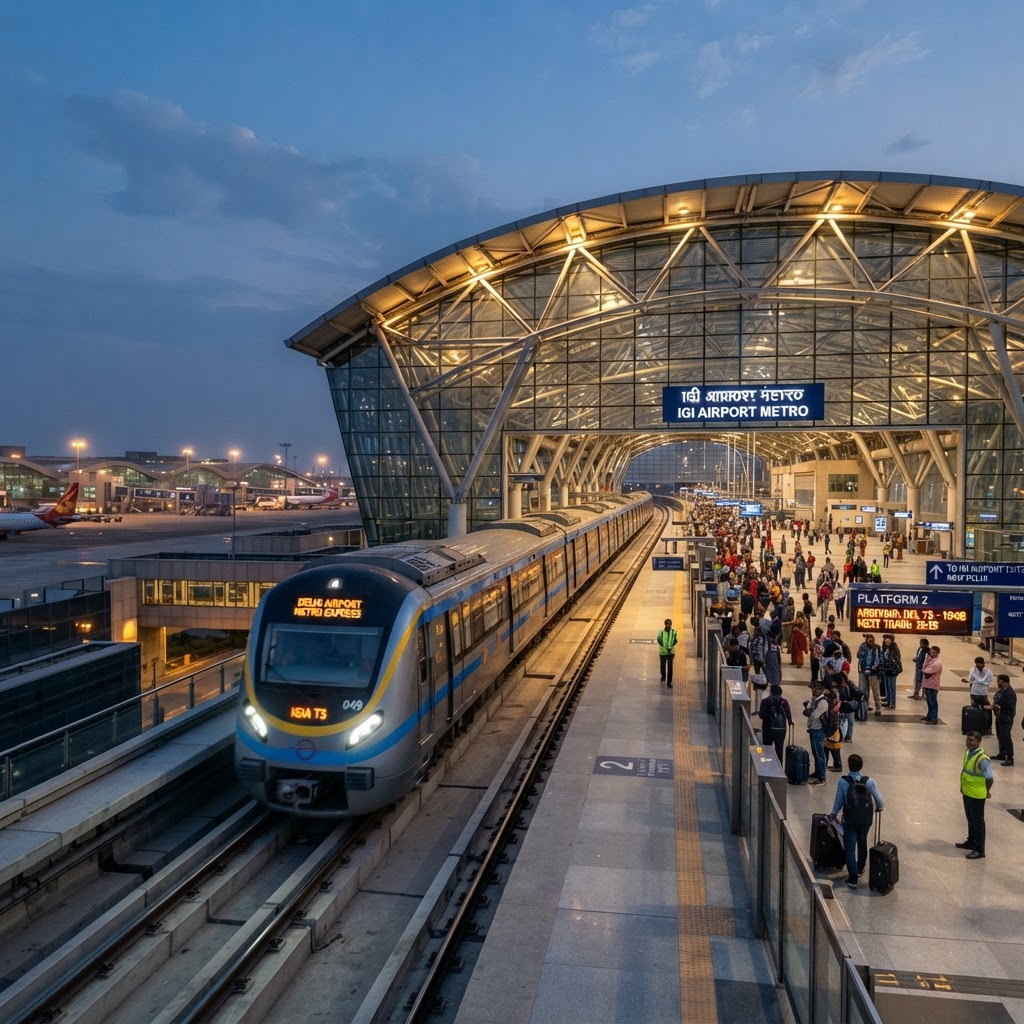
Table of Contents
- Evolution of Airport Metro Express Lines in India
- Delhi Metro Orange Line (Airport Express): Benchmark High-Speed Rail
- Station Breakdown & Route Analysis of Delhi Airport Express
- Mumbai Metro Line 3 (Aqua Line): Underground Connectivity to T1 & T2
- Bengaluru Airport Metro (Blue Line): Connecting Silk Board to KIA
- Hyderabad, Kochi, Chennai and Kolkata Airport Metro Connections
- Signalling, Rolling Stock & Engineering Innovations
- Passenger Experience, City Check-In & Baggage Handling Facilities
- Fares, Timings, Ticketing & Digital Integration
- Step-by-Step Passenger Guide & Essential Travel Tips
- Future Airport Metro Expansions & Urban Mobility Impact
- Conclusion
- You May Also Like
- Frequently Asked Questions
Evolution of Airport Metro Express Lines in India
The growth of airport metro express lines in India reflects a fundamental shift in urban transportation planning over the past two decades. Historically, major Indian airports were located on the periphery of metropolitan cities, reliant almost entirely on clogged road networks, state buses, or expensive private taxis. As air traffic expanded exponentially following civil aviation deregulation, highway access points quickly became bottlenecks, resulting in severe gridlock and unpredictable transit times for travelers. To resolve this structural issue, Indian transit planners turned to dedicated rail-based airport express lines, modeled after successful global benchmarks such as London's Heathrow Express, Hong Kong's Airport Express, and Tokyo's Haneda Monorail.
The flagship breakthrough occurred in Delhi with the launch of the Orange Line (Airport Express) by Delhi Metro Rail Corporation (DMRC) in 2011. Designed to operate at elevated speeds significantly higher than standard urban metro corridors, the line demonstrated that dedicated rapid rail could reliably carry travelers from central business districts to airport departure gates in under 20 minutes. Following the success of Delhi, urban transit authorities in Mumbai, Bengaluru, Hyderabad, Chennai, Kochi, and Kolkata integrated airport connectors directly into their master mobility plans. Modern airport metros in India are designed not merely as point-to-point transit services, but as multi-modal integration hubs that link national railway stations, interstate bus terminals (ISBTs), and suburban metro networks under unified ticketing systems.
In addition to relieving highway congestion, airport metro express lines contribute significantly to national economic productivity. By guaranteeing precise transit times, business travelers and international tourists can schedule flights without adding excessive buffer hours for potential traffic jams. Urban planners estimate that every operational airport metro line saves millions of commuter hours annually, while cutting fuel consumption and urban carbon emissions across India's fastest-growing metropolitan corridors.
Delhi Metro Orange Line (Airport Express): Benchmark High-Speed Rail
The Delhi Metro Orange Line, universally known as the Airport Express Line, stands as the benchmark for high-speed urban rail transit across South Asia. Stretching 22.7 kilometres from New Delhi Railway Station to Yashobhoomi Dwarka Sector 25, the corridor serves Indira Gandhi International Airport (IGIA) Terminal 3. In 2023, DMRC achieved an engineering milestone by raising the operational speed of trains on the Orange Line from 110 km/h to 120 km/h. This speed upgrade reduced total travel time between New Delhi Station and IGIA Terminal 3 to just 19 minutes, making it by far the fastest metro line in India.
The line features seven strategically positioned stations: New Delhi (interchange with Yellow Line and Indian Railways), Shivaji Stadium, Dhaula Kuan (interchange with Pink Line via a 130-metre moving walkway), Delhi Aerocity, Airport Terminal 3, Dwarka Sector 21 (interchange with Blue Line), and Yashobhoomi Dwarka Sector 25. Built using advanced concrete slab track technology and equipped with overhead catenary electrification, the Orange Line utilizes six-coach trainsets manufactured with specialized noise-dampening interiors and expansive luggage racks. Daily ridership on the Orange Line exceeds 65,000 passengers, driven by frequent international travelers, exhibition attendees visiting the Yashobhoomi Convention Centre, and daily commuters utilizing the high-speed link across the National Capital Region (NCR).
The operational reliability of the Orange Line is maintained through automated train operation (ATO) systems and rigorous preventative maintenance schedules executed during non-operational night hours. The track bed utilizes heavy-duty tension pads and dampening fasteners that eliminate wheel vibration, delivering a remarkably smooth and silent ride for air travelers even at maximum cruising speed.
Station Breakdown & Route Analysis of Delhi Airport Express
To fully appreciate the convenience of the Delhi Airport Express Line, it is helpful to examine the specific role played by each of its seven stations along the 22.7-kilometre route:
1. New Delhi Station: Serving as the northern terminus, this multi-modal hub offers direct underground connectivity to the main New Delhi Railway Station (Northern Railways) and the Delhi Metro Yellow Line. It features full city check-in facilities, luggage counters, and premium waiting lounges.
2. Shivaji Stadium Station: Located in Connaught Place, this station serves central Delhi's business district. It includes city check-in counters, retail outlets, airline customer service desks, and ample parking facilities.
3. Dhaula Kuan Station: Situated near key diplomatic enclaves and defense establishments, Dhaula Kuan is connected to the Pink Line's Durgabai Deshmukh South Campus station via a skywalk featuring travelators (moving walkways).
4. Delhi Aerocity Station: Serving Delhi's thriving hospitality and commercial district, this station provides direct access to luxury hotels, corporate headquarters, and retail centers. It is also designed to integrate with the upcoming Delhi-Alwar Regional Rapid Transit System (RRTS).
5. Airport Terminal 3 Station: Connected directly to Indira Gandhi International Airport Terminal 3 via an air-conditioned subterranean walkway, passengers can walk straight into international or domestic departure check-in gates in less than 3 minutes.
6. Dwarka Sector 21 Station: A major suburban interchange station connecting the Orange Line with the Delhi Metro Blue Line, facilitating seamless transit for residents of western Delhi and NCR sub-cities.
7. Yashobhoomi Dwarka Sector 25 Station: The newest extension on the Orange Line, serving the India International Convention and Expo Centre (IICC). The station features underground subway links directly into the convention halls.
Mumbai Metro Line 3 (Aqua Line): Underground Connectivity to T1 & T2
Mumbai's Metro Line 3, designated as the Aqua Line, represents a monumental engineering achievement as the financial capital's first fully underground metro corridor. Spanning 33.5 kilometres from Aarey Colony in the northern suburbs to Cuffe Parade in South Mumbai, the line passes directly beneath some of the most densely populated urban real estate in the world. Crucially, Line 3 incorporates dedicated underground stations servicing both domestic Terminal 1 (Santacruz) and international Terminal 2 (Sahar) of Chhatrapati Shivaji Maharaj International Airport (CSMIA).
| City | Line Name & Colour | Corridor Length | Top Speed | Travel Time to Airport | Primary Stations / Terminals Served | Status / Operational Year |
|---|---|---|---|---|---|---|
| Delhi NCR | Orange Line (Airport Express) | 22.7 km | 120 km/h | 19 minutes | New Delhi, Shivaji Stadium, Aerocity, IGIA Terminal 3 | Operational (2011 / Upgraded 2023) |
| Mumbai | Line 3 (Aqua Line) | 33.5 km | 80 km/h | 10 min (from BKC) | CSMIA Domestic T1, CSMIA International T2, BKC | Operational Phase 1 / Phase 2 (2024-2026) |
| Bengaluru | Blue Line (Phase 2B) | 38.0 km | 90 km/h | 45 minutes | Silk Board, KR Puram, Hebbal, KIA City & T2 | Near Completion (2026) |
| Hyderabad | Airport Express Corridor | 31.0 km | 120 km/h | 20 minutes | Raidurg (HITEC City), Shamshabad RGIA Terminal | Under Construction / Phase 2 |
| Chennai | Blue Line (Line 1) | 25.0 km | 80 km/h | 35 minutes | Chennai Central, Guindy, Chennai International Airport | Operational (2018) |
| Kolkata | Line 6 (Orange Line) | 29.8 km | 80 km/h | 30 minutes | New Garia, Salt Lake Sector V, NSCBI Airport Dum Dum | Phase-wise Operational (2025-2026) |
Prior to Line 3, transit to CSMIA was notoriously susceptible to severe delays on the Western Express Highway (WEH), where peak-hour traffic jams frequently extended travel times from South Mumbai or Bandra-Kurla Complex (BKC) to over 90 minutes. With the Aqua Line operating at peak frequencies of 3 to 4 minutes, passengers can travel from BKC to Terminal 2 in approximately 10 minutes, or from Cuffe Parade in under 35 minutes. The underground stations at T1 and T2 feature direct sub-surface pedestrian tunnels equipped with escalators, elevators, and luggage carts that lead straight into airport arrivals and departure halls. Built with heavy-duty air conditioning and platform screen doors (PSDs) for passenger safety, Line 3 is projected to divert over 300,000 daily vehicular trips away from Mumbai's surface roads.
The construction of Line 3 required 17 massive Tunnel Boring Machines (TBMs) operating simultaneously through complex basalt geology under Mumbai's congested streets. The airport stations at CSMIA T1 and T2 were engineered with multi-level underground concourses, ensuring clear segregation between arriving metro commuters and departing flight passengers.
Bengaluru Airport Metro (Blue Line): Connecting Silk Board to KIA
Bengaluru, India's technology hub, has long suffered from highway congestion along the Hebbal flyover and Bellary Road (NH-44), the primary vehicular arterial leading to Kempegowda International Airport (KIA) in Devanahalli. To permanently address this mobility bottleneck, Namma Metro (Bangalore Metro Rail Corporation Limited - BMRCL) is constructing the 38-kilometre Phase 2B Blue Line extension. Connecting Central Silk Board and KR Puram to KIA, this elevated and grade-separated corridor traverses the city's key IT belts along the Outer Ring Road (ORR) before heading north toward the airport.
The Blue Line airport corridor comprises 17 modern stations, ending at two dedicated airport terminals within the KIA campus (Airport City and Terminal 2). Designed to handle train speeds up to 90 km/h, the line will cut transit time from central Bengaluru to KIA to under 45 minutes, compared to 90 to 120 minutes by road during peak hours. Furthermore, BMRCL is integrating the airport metro station with KIA's Multi-Modal Transport Hub (MMTH), enabling seamless transfers between metro rail, airport shuttle buses (Vayu Vajra), long-distance interstate coaches, and private passenger vehicles. The project is expected to cater to over 250,000 passengers daily upon full commercial operation.
A key highlights of Bengaluru's Airport Metro is its architectural alignment along the ORR technology corridor, allowing tech workers in Electronic City, Sarjapur, Marathahalli, and Whitefield to board a single rapid transit train straight to the airport without navigating highway traffic chokepoints.
Hyderabad, Kochi, Chennai and Kolkata Airport Metro Connections
Beyond Delhi, Mumbai, and Bengaluru, major regional metropolitan hubs across India have implemented or advanced high-capacity airport metro connectors to strengthen regional mobility networks.
In Hyderabad, the Hyderabad Airport Express Metro corridor is planned as a 31-kilometre elevated and underground express link from Mindspace Junction (Raidurg) in the HITEC City IT hub to Rajiv Gandhi International Airport in Shamshabad. Designed for speeds of up to 120 km/h, the line will feature express trains covering the distance in 20 minutes, serving tech professionals and international business travelers. In Kochi, the Kochi Metro network—already famous for introducing India's first integrated Water Metro—is expanding its Phase 2 alignment to link the mainline from Aluva directly to Cochin International Airport (CIAL) in Nedumbassery, providing clean, eco-friendly transit for Kerala's active NRI aviation sector.
In Chennai, Chennai Metro Rail Limited (CMRL) operates direct Blue Line services connecting Chennai Central Railway Station to Chennai International Airport in Meenambakkam. Passengers can disembark at the elevated Airport Metro station, which is connected directly to the domestic and international departure terminals via air-conditioned skywalks equipped with travelators. Meanwhile, in Kolkata, Metro Railway Kolkata is completing Line 6 (Orange Line), connecting Kavi Subhash (New Garia) through the IT hub of Salt Lake Sector V to Netaji Subhash Chandra Bose International Airport in Dum Dum. This 29.8-kilometre line provides the eastern metropolis with its first direct rapid rail airport link.
Signalling, Rolling Stock & Engineering Innovations
Airport metro express lines require advanced engineering standards distinct from standard urban subway lines. Because these trains operate at elevated speeds carrying passengers with heavy luggage, rolling stock manufacturers incorporate aerodynamic train noses, reinforced lightweight stainless steel or aluminium carbodies, and specialized suspension systems.
Modern airport metros utilize Communications-Based Train Control (CBTC) signalling systems, enabling automated train operation (ATO) with moving block technology. CBTC permits precise headway management down to 90 seconds while maintaining strict safety margins. Furthermore, airport metro trains are powered by 25 kV AC overhead catenary systems (or third-rail DC power in underground sections like Mumbai Line 3). Energy efficiency is maximized through regenerative braking systems, which feed up to 30 per cent of kinetic braking energy back into the electrical grid to power station lighting and air conditioning systems.
Passenger Experience, City Check-In & Baggage Handling Facilities
To attract air travelers away from private cars and ride-hailing taxis, airport metro express lines incorporate specialized passenger amenities tailored specifically for long-distance travelers with heavy luggage. Unlike standard urban commuter trains, airport express rolling stock features wider gangways, dedicated luggage storage racks in every coach, padded reclining seats, individual power charging sockets, dynamic flight departure display screens, and free high-speed Wi-Fi access onboard.
A flagship convenience offered on select airport metro networks is City Check-In and Remote Baggage Transfer. On the Delhi Airport Express Line, DMRC in collaboration with major domestic and international airlines (including Air India, Vistara, and IndiGo) operates full city check-in facilities at New Delhi and Shivaji Stadium metro stations. Passengers can check in their flight baggage, obtain boarding passes, and drop off heavy suitcases up to 2 hours prior to flight departure. Checked baggage is securely sealed, loaded into dedicated freight compartments on metro trains, and transferred directly to airport luggage handling systems at IGIA Terminal 3. Similar city check-in hubs are being established along Bengaluru's Blue Line and Mumbai's Line 3, allowing travelers to explore the city unencumbered by heavy luggage prior to evening flights.
Fares, Timings, Ticketing & Digital Integration
Affordability, predictability, and ease of payment are core advantages of airport metro systems compared to conventional taxi travel. Across Indian airport metro networks, ticket fares are kept heavily subsidized and structured to offer exceptional value for money. On the Delhi Airport Express Line, a single journey from New Delhi Station to IGIA Terminal 3 costs just 60 rupees—roughly one-tenth the cost of an app-based cab. In Mumbai and Chennai, fares range between 40 and 110 rupees depending on travel distance.
| Transport Mode | Average Cost (INR) | Travel Time Predictability | Comfort & Air Conditioning | Frequency / Headway | Luggage Capacity |
|---|---|---|---|---|---|
| Airport Metro Express | ₹40 – ₹120 | 100% On-Time (Guaranteed) | High (Climate Controlled) | Every 10 to 15 minutes | Dedicated Overhead & Floor Racks |
| App-Based Taxi (Ola/Uber) | ₹500 – ₹1,200 | Variable (High Traffic Risk) | High (Private Vehicle) | On-Demand (Surge Pricing) | Trunk Storage (Limited) |
| State/Airport Bus (DTC/BMTC) | ₹25 – ₹250 | Moderate to Low | Medium (Varies by Route) | Every 30 to 60 minutes | Limited Floor Space |
| Private Car / Self-Drive | ₹300+ Fuel + Parking | Variable (High Traffic Risk) | High | Personal Schedule | Vehicle Trunk Capacity |
Operating schedules across Indian airport metros are designed around early morning and late night flight waves. Most lines begin operations at 04:45 AM or 05:00 AM and run until 11:30 PM or 00:00 midnight, maintaining train frequencies of 10 to 12 minutes during peak morning and evening hours. Ticketing has been fully digitized across all networks through National Common Mobility Cards (NCMC), open-loop contactless debit/credit card tapping, WhatsApp QR code ticket generation, and official metro mobile apps. Commuters no longer need to wait in physical token queues; they can scan digital QR passes on their smartphones directly at automatic fare collection (AFC) turnstiles.
Step-by-Step Passenger Guide & Essential Travel Tips
Navigating an airport metro express line in India is straightforward, but keeping a few essential travel tips in mind ensures a smooth and stress-free journey:
Step 1: Check Airline Check-In Deadlines: If you plan to utilize city check-in services at New Delhi or Shivaji Stadium stations, ensure you arrive at least 2 to 4 hours before your domestic or international flight departure time.
Step 2: Purchase Digital QR Tickets: Avoid queueing at ticket counters by generating a digital QR ticket via WhatsApp or the official metro mobile app. Alternatively, tap any National Common Mobility Card (NCMC) or contactless bank card at the turnstiles.
Step 3: Boarding with Heavy Luggage: Utilize the designated wide gates at AFC turnstiles when carrying large rolling suitcases. Onboard the train, stow large luggage on the floor-mounted racks located near train doors.
Step 4: Station Skywalks & Travelators: At airport terminal stations (such as IGIA T3 or CSMIA T2), follow the clear overhead signage toward departure gates. Air-conditioned skywalks equipped with moving walkways lead directly into terminal check-in halls.
Step 5: Last-Mile Connectivity: If heading into the city from the airport, disembark at major interchange stations (such as New Delhi, Dhaula Kuan, or BKC) to connect seamlessly to other metro lines or national railway networks.
Future Airport Metro Expansions & Urban Mobility Impact
As India advances its civil aviation infrastructure under the PM Gati Shakti National Master Plan, airport metro connections are shifting from luxury amenities to mandatory statutory requirements for all greenfield and brownfield airport developments. Upcoming projects include the direct metro link connecting Noida International Airport (Jewar) to Greater Noida and the Delhi Metro network, as well as the proposed metro link connecting Navi Mumbai International Airport (NMIA) to CSMIA and the wider Mumbai Metro rail grid.
The environmental and urban economic impact of airport express metros is profound. By transferring tens of thousands of daily motorized road trips to zero-emission electric rail, airport metros substantially reduce urban carbon emissions, particulate pollution (PM2.5 and PM10), and highway congestion. Furthermore, transit-oriented development (TOD) around airport metro stations—such as Delhi Aerocity—has unlocked billions of dollars in commercial real estate investment, creating thriving hubs for hotels, corporate headquarters, retail centers, and convention spaces seamlessly connected to global trade routes.
Conclusion
Airport metro express lines have fundamentally altered the landscape of urban transportation in India. By bridging the gap between central metropolitan districts and airport terminals with high-speed, affordable, and punctual electric rail, systems like the Delhi Airport Express, Mumbai Line 3, and Bengaluru Blue Line set new global standards for sustainable transit. Whether you are a business traveler seeking a guaranteed 19-minute transfer in Delhi or a tourist navigating Mumbai's underground Aqua Line, Indian airport metros offer unmatched efficiency and value in 2026 and beyond.
You May Also Like: Metro Rail in India, Namo Bharat RRTS, and Best Travel Apps.
Frequently Asked Questions
Which Indian cities have airport metro lines?
Delhi, Mumbai, Bengaluru, Kochi, Hyderabad, Chennai and Kolkata have operational or near-complete airport metro connections. Delhi's Orange Line and Chennai's Blue Line are fully operational, while Mumbai Line 3 and Bengaluru Blue Line are rapidly expanding service in 2026.
How much does airport metro cost?
Fares range from 40 to 120 rupees depending on the city and travel distance, making it by far the cheapest and most reliable airport transport option compared to private taxis or ride-hailing cabs.
How fast is the Delhi Airport Express?
Delhi's Orange Line operates at top speeds of 120 km/h, making it the fastest metro line in India. It covers the 22.7 km journey from New Delhi Railway Station to IGIA Terminal 3 in just 19 minutes.
Does Mumbai Metro Line 3 go to airport?
Yes, Mumbai's Aqua Line (Line 3) features direct underground stations connecting to both Chhatrapati Shivaji Maharaj International Airport Terminal 1 (Domestic) and Terminal 2 (International).
Can I check in luggage at airport metro stations?
Yes, Delhi Metro allows city check-in and baggage drop-off at New Delhi and Shivaji Stadium stations for participating airlines including Air India, Vistara, and IndiGo. Similar city check-in hubs are being rolled out along Bengaluru's and Mumbai's airport metro corridors.
What time do airport metros operate?
Most airport metro lines in India operate from 04:45 AM to 11:30 PM daily, with train frequencies of every 10 to 12 minutes during peak travel hours.