The Namo Bharat Rapid Rail Transit System (RRTS) represents a monumental paradigm shift in India's regional urban mobility architecture. As the nation's premier semi-high-speed regional commuter rail network, the RRTS project is specifically engineered to bridge major economic hubs located within a 100 to 150-kilometre radius of the National Capital Region (NCR). Spearheaded by the National Capital Region Transport Corporation (NCRTC)—a joint venture between the Government of India and the state governments of Delhi, Haryana, Uttar Pradesh, and Rajasthan—the network operates at a design speed of 180 km/h, an operational speed of 160 km/h, and an average commercial speed of 100 km/h. This high-velocity service effectively slashes commute times between central Delhi and surrounding satellite cities by more than 60 percent. The flagship 82.15-kilometre Delhi–Ghaziabad–Meerut corridor alone transforms the travel experience between Delhi and Meerut, compressing a tedious 150-minute highway journey into a swift 50-minute rail transit. With the entire Phase 1 network spanning 383 kilometres and a broader national vision encompassing over 2,900 kilometres of regional rail corridors across multiple metropolitan regions, Namo Bharat RRTS stands as one of the world's most ambitious regional rail infrastructure developments in 2026.
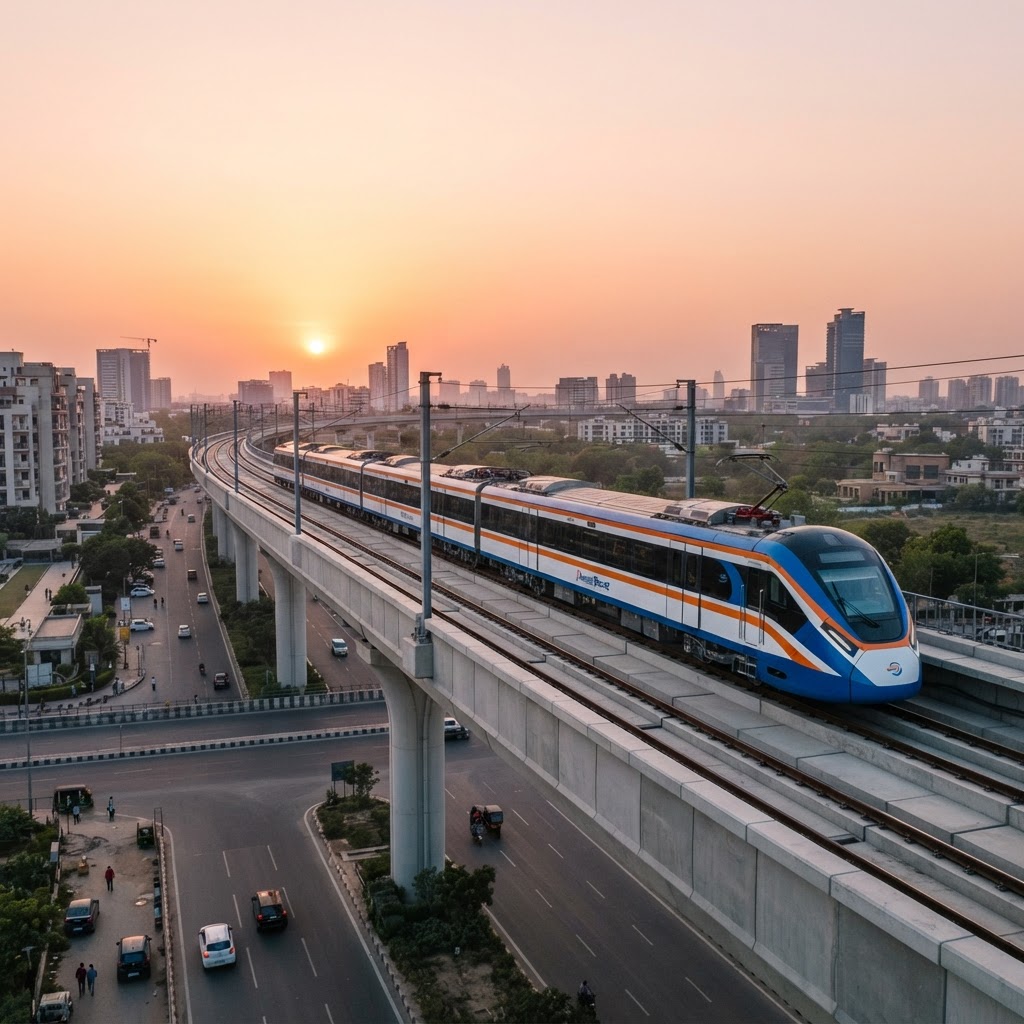
Table of Contents
- 1. Strategic Overview and Vision of Namo Bharat RRTS
- 2. Phase 1 Priority Corridors and Route Expansion Network
- 3. Rolling Stock Engineering, Aerodynamics, and Onboard Technology
- 4. Passenger Fares, Ticketing Digitalisation, and Travel Comfort
- 5. Project Capex, Financing Models, and Economic Return on Investment
- 6. Comparative Benchmark: RRTS vs Metro Rail vs Indian Railways Suburban Network
- 7. Global Regional Transit Benchmarking: India RRTS vs International Systems
- 8. Operational Progress 2026, Construction Milestones & Engineering Challenges
- 9. Transit-Oriented Development, Sustainability, and Urban Transformation
- 10. Conclusion and Mobility Outlook
- 11. You May Also Like
- 12. Frequently Asked Questions
1. Strategic Overview and Vision of Namo Bharat RRTS
The rapidly accelerating urbanisation of the National Capital Region has historically placed immense strain on existing transport infrastructure. Traditional suburban rail services and city bus networks operating across the NCR have struggled to keep pace with the exponential growth in inter-city commuting demand. The Namo Bharat RRTS was conceived as a high-capacity, high-frequency regional rapid transit backbone designed to decouple regional economic growth from road congestion and motor vehicle emissions. By offering high-speed, point-to-point regional connectivity, the network allows workers, students, and business travellers to commute seamlessly between regional industrial nodes and commercial centres without needing to relocate closer to the congested urban core of New Delhi.
Unlike urban metro systems that focus on short-distance, intra-city stopping patterns every 1 to 2 kilometres, the RRTS is optimized for regional trips with station spacing set between 5 and 10 kilometres. This structural difference enables trainsets to maintain sustained speeds of 160 km/h, making regional transit genuinely competitive with private automobiles and expressways. Furthermore, the system integrates fully with existing metro stations, inter-state bus terminals (ISBTs), and main line Indian Railways stations through multi-modal integration hubs, creating a unified transport ecosystem. By shifting millions of daily commuter trips from personal vehicles to zero-emission electric rail, Namo Bharat serves as a core pillar in India's national climate strategy and regional economic master plan for 2026 and beyond.
For additional context on regional rail growth across the country, see our detailed analysis on Namo Bharat RRTS Expansion and how regional transit is reshaping urban clusters.
2. Phase 1 Priority Corridors and Route Expansion Network
The master planning for the National Capital Region's regional rail system identified eight strategic rail corridors, among which three were designated as Phase 1 priority projects by the NCRTC. These three corridors radiate from Sarai Kale Khan in central Delhi—which serves as the primary multi-modal interchange node connecting all three routes—allowing passengers to seamlessly transfer between lines without exiting the station complex.
The first and most advanced priority line is the 82.15-kilometre Delhi–Ghaziabad–Meerut corridor. Starting from Sarai Kale Khan, the line passes through major urban centres including Anand Vihar, Sahibabad, Ghaziabad, Guldhar, Duhai, Muradnagar, Modi Nagar, and Meerut South, culminating at Modipuram in Meerut. Notably, this corridor incorporates a unique infrastructure-sharing arrangement within the city of Meerut, where RRTS trainsets share track infrastructure with the local Meerut Metro, eliminating redundant construction costs and optimizing urban land use.
The second priority route is the 164-kilometre Delhi–Gurugram–SNB (Shahjahanpur–Neemrana–Behror)–Alwar corridor. Designed to connect Delhi with the critical industrial hubs of Gurugram, Manesar, Rewari, and Neemrana, this line will serve millions of industrial workers and corporate personnel. The third Phase 1 route is the 103-kilometre Delhi–Panipat corridor, which connects key agricultural, educational, and manufacturing hubs in northern Haryana to central Delhi, passing through Sonipat and Murthal. Together, these Phase 1 lines encompass 349 kilometres of high-speed regional rail infrastructure.
| Corridor Name | Total Length | Key Stations / Interchange Hubs | Operational Target | Projected Daily Ridership |
|---|---|---|---|---|
| Delhi–Ghaziabad–Meerut | 82.15 km | Sarai Kale Khan, Anand Vihar, Sahibabad, Ghaziabad, Meerut South, Modipuram | Fully Operational 2026 | 800,000 passengers |
| Delhi–Gurugram–SNB–Alwar | 164.00 km | Sarai Kale Khan, Cyber City, IGI Airport, Manesar, Rewari, Neemrana, Alwar | Phase-1 Construction 2027–2028 | 850,000 passengers |
| Delhi–Sonipat–Panipat | 103.00 km | Sarai Kale Khan, Kundli, Murthal, Sonipat, Panipat North | Advanced Planning 2028–2029 | 650,000 passengers |
| Delhi–Faridabad–Ballabhgarh–Palwal | 60.00 km | Sarai Kale Khan, Faridabad City, Ballabhgarh, Palwal | Phase 2 Proposed | 400,000 passengers |
| Ghaziabad–Khurja / Bulandshahr | 83.00 km | Ghaziabad Central, Greater Noida, Khurja Junction | Phase 2 Proposed | 350,000 passengers |
| Delhi–Bahadurgarh–Rohtak | 70.00 km | Peeragarhi, Bahadurgarh, Sampla, Rohtak | Phase 2 Proposed | 300,000 passengers |
3. Rolling Stock Engineering, Aerodynamics, and Onboard Technology
The trainsets utilized on the Namo Bharat RRTS network represent a leap forward in indigenous rolling stock manufacturing under India's 'Make in India' initiative. Designed by Alstom and manufactured at its Savli plant in Gujarat, the lightweight stainless steel and aluminium body trainsets feature a distinct aerodynamic nose profile designed to minimize air resistance and energy consumption at operating speeds of 160 km/h. Each 6-coach trainset comprises four standard seating coaches, one premium coach, and one dedicated coach reserved for female commuters, with a total dynamic passenger capacity of over 1,500 passengers per train.
Technologically, the RRTS is the first rail network in India to adopt the European Train Control System (ETCS) Level 2 signalling over a Hybrid Level 3 framework, combined with Long Term Evolution (LTE) radio communication. This advanced signalling system provides continuous automatic train protection (ATP), enabling moving-block train control with headways as short as 180 seconds. Furthermore, the rolling stock features dynamic regenerative braking systems that feed up to 30 percent of brake energy back into the 25 kV AC overhead traction grid, drastically reducing overall operational power requirements.
Inside the passenger saloons, amenities match international aviation standards. Features include ergonomic transverse seating with ample legroom, overhead luggage racks, individual mobile charging sockets at every seat, onboard high-speed Wi-Fi, auto-dimming LED lighting, ambient temperature control, and real-time route display screens. The premium coach offers reclinable seats, footrests, coat hooks, and an exclusive lounge boarding zone at stations. Fully automated plug-in doors are synchronised with platform screen doors (PSDs) installed at all elevated and underground stations, ensuring absolute passenger safety and preventing accidental line falls.
4. Passenger Fares, Ticketing Digitalisation, and Travel Comfort
To ensure widespread adoption among daily commuters while maintaining economic viability, the NCRTC established a distance-based, tiered fare structure for Namo Bharat services. Fares are structured into two distinct classes: Standard Class and Premium Class. For Standard Class travel, ticket prices start at a minimum fare of ₹20 for short trips up to 5 km, scaling incrementally up to ₹110 for a full end-to-end journey along the 82 km Delhi–Meerut line. Premium Class tickets are priced at double the standard fare, ranging from ₹40 to ₹220, catering to business commuters seeking higher comfort levels during peak hours.
The ticketing matrix is fully digitalized and integrated into National Common Mobility Card (NMMC) standards. Commuters can pay using contactless smart cards, open-loop bank debit/credit cards, or mobile QR code tickets generated via the RAPIDX Connect mobile application. Additionally, paper QR tickets are available at station vending machines for non-digital users. Automatic Fare Collection (AFC) gates equipped with NFC sensors allow seamless entry and egress, handling high commuter throughput during rush hours without queue bottlenecks.
Travel comfort extends well beyond the train ride. Stations are designed as modern multi-story transit terminals offering climate-controlled concourses, step-free access via elevators and escalators, tactile paving for visually impaired passengers, dedicated medical first-aid rooms, baby care facilities, and integrated retail kiosks. Furthermore, last-mile connectivity is guaranteed through designated pick-up and drop-off zones for electric feeder buses, auto-rickshaws, and ride-hailing services, making daily travel effortless and efficient.
5. Project Capex, Financing Models, and Economic Return on Investment
The capital expenditure (Capex) required to execute high-speed regional rail infrastructure is substantial, but the long-term economic dividends are transformative. The total sanctioned cost for the 82.15 km Delhi–Ghaziabad–Meerut RRTS corridor stands at ₹30,274 crore (approximately USD 3.65 billion). The financing structure presents a benchmark model for public infrastructure funding in Asia, combining equity contributions from government stakeholders with multilateral development loans.
The Government of India contributed 20 percent of total funding, while the state governments of Uttar Pradesh and Delhi provided 3.35 percent and 3.35 percent respectively. The remaining 60 percent of project capital was secured through long-term multilateral debt financing, including major loans from the Asian Development Bank (ADB) (USD 1,000 million), the Asian Infrastructure Investment Bank (AIIB) (USD 500 million), and the New Development Bank (NDB) (USD 500 million). This blended finance architecture ensured steady cash flow throughout peak construction phases without straining annual municipal budgets.
Economic impact assessments conducted by urban transport planners indicate an Economic Internal Rate of Return (EIRR) exceeding 12.5 percent for the project. The economic dividends stem from reduced travel time, fuel savings, reduced road traffic accidents, lowered carbon emissions, and accelerated commercial land development along the transit corridor. By unlocking economic productivity in satellite cities like Ghaziabad and Meerut, the RRTS acts as a powerful economic catalyst across the entire National Capital Region.
6. Comparative Benchmark: RRTS vs Metro Rail vs Indian Railways Suburban Network
Understanding the precise operational role of Namo Bharat RRTS requires comparing its performance specifications against traditional urban rail modes, such as city metro systems and Indian Railways suburban train networks. While Metro rail networks excel at high-density intra-city transportation with frequent stops, and suburban trains provide basic regional connections, RRTS fills the high-speed regional express niche.
For more insights into urban rapid transit comparisons across India, read our overview of Metro Rail in India 2026 and our comprehensive guide on Indian Railways 2026.
| Feature / Parameter | Namo Bharat RRTS | Delhi Metro Rail | Suburban Rail (EMU) |
|---|---|---|---|
| Primary Objective | Inter-city Regional Commute (100+ km) | Intra-city Urban Commute (20–50 km) | Suburban / Peri-urban Commute |
| Design Speed | 180 km/h | 80–90 km/h | 100 km/h |
| Operational Speed | 160 km/h | 35–45 km/h | 45–50 km/h |
| Average Station Distance | 5.0 to 10.0 km | 0.8 to 1.5 km | 3.0 to 5.0 km |
| Signalling Standard | ETCS Level 2 over LTE (Hybrid L3) | CBAC / CBTC Driverless | Absolute / Automatic Block |
| Signalling Headway | 180 seconds (3 min) | 120 seconds (2 min) | 600–900 seconds (10–15 min) |
| Coaches per Trainset | 6 to 9 coaches | 6 to 8 coaches | 9 to 12 coaches |
| Platform Screen Doors | 100% Station Coverage | Selected Lines Only | None |
| Standard Fare Range | ₹20 to ₹110 | ₹10 to ₹60 | ₹5 to ₹35 |
7. Global Regional Transit Benchmarking: India RRTS vs International Systems
India's Namo Bharat RRTS was designed after evaluating world-class regional express rail networks operating across Europe and East Asia. Systems like Paris RER in France, London's Elizabeth Line (Crossrail) in the United Kingdom, Munich S-Bahn in Germany, and Tsukuba Express in Japan provided key architectural benchmarks for track gauge, overhead traction, and station design.
When benchmarked against these international systems, Namo Bharat matches or exceeds several technical parameters. For instance, while London's Elizabeth Line operates at a maximum speed of 145 km/h (90 mph), Namo Bharat operates at 160 km/h with a 180 km/h design envelope. Furthermore, the adoption of ETCS Level 2 signalling over LTE mobile radio networks places Namo Bharat at the technological forefront of digital regional rail operations globally.
| System Name | Country | Max Speed | Signalling Standard | Traction Power | Daily Ridership |
|---|---|---|---|---|---|
| Namo Bharat RRTS | India | 180 km/h (Design) / 160 km/h (Op) | ETCS Level 2 / LTE | 25 kV AC 50 Hz Overhead | 800,000 (Target Phase 1) |
| Paris RER | France | 140 km/h | SACEM / KVB / CBTC | 1.5 kV DC & 25 kV AC | 2,700,000 |
| London Elizabeth Line | United Kingdom | 145 km/h | ETCS Level 2 / CBTC / TPWS | 25 kV AC Overhead | 700,000 |
| Munich S-Bahn | Germany | 120–140 km/h | PZB / LZB / ETCS L2 | 15 kV AC 16.7 Hz | 840,000 |
| Tsukuba Express | Japan | 130 km/h | ATC / ATO Automatic | 1.5 kV DC & 20 kV AC | 390,000 |
8. Operational Progress 2026, Construction Milestones & Engineering Challenges
The construction and commissioning of the Delhi–Ghaziabad–Meerut RRTS corridor stands as a masterclass in urban megaproject execution in India. Following the inauguration of the initial 17-kilometre 'Priority Section' between Sahibabad and Duhai Depot in October 2023, NCRTC systematically expanded operations in phases. By mid-2024, the operational length reached 42 kilometres extending up to Meerut South. Subsequent construction milestones through 2025 and early 2026 saw the completion of complex underground tunneling sections beneath densely populated areas in Delhi, including Sarai Kale Khan, Yamuna River crossings, and Anand Vihar transit hub.
Engineering the alignment presented extraordinary civil construction challenges. Constructing multi-story elevated viaducts over congested arterial highways required the deployment of massive 1,700-tonne launching girders working during restricted night hours. In underground segments, dual-mode Earth Pressure Balance (EPB) Tunnel Boring Machines (TBMs) excavated twin tunnels while maintaining continuous real-time structural monitoring of historical surface structures. Additionally, building the massive Sarai Kale Khan station complex—which spans four levels and houses four elevated tracks alongside six platform faces—required intricate utility shifting and traffic management across surrounding expressways.
As of mid-2026, the entire 82.15-kilometre Delhi–Ghaziabad–Meerut corridor is 100 percent operational, serving 24 stations and reducing journey times between central New Delhi and Meerut to under 50 minutes. The rapid completion of this flagship line provides a proven engineering template for Phase 1 construction work currently commencing along the Delhi–Gurugram–Alwar corridor.
9. Transit-Oriented Development, Sustainability, and Urban Transformation
Beyond providing rapid transport, the Namo Bharat RRTS serves as a fundamental driver of Transit-Oriented Development (TOD) across the National Capital Region. Under state urban development policies, high-density Value Capture Financing (VCF) zones and commercial corridors are designated within a 1.5-kilometre radius around major RRTS stations. Higher Floor Area Ratios (FAR) are permitted in these zones, encouraging real estate developers to construct high-density residential towers, office parks, shopping plazas, and educational campuses within walking distance of rapid transit nodes.
From an environmental sustainability standpoint, the ecological benefits of the RRTS are staggering. According to environmental impact studies conducted by urban transport authorities, shifting regional passenger travel from road to electric rail along the Delhi–Meerut corridor prevents the release of over 250,000 tonnes of carbon dioxide (CO2) annually. Furthermore, solar PV panel arrays installed across station rooftops and Duhai depot buildings generate over 11 MW of clean renewable energy, fulfilling up to 30 percent of non-traction auxiliary power needs across the network.
By preventing urban sprawl, reducing private vehicular congestion, and promoting compact, walkable urban communities, Namo Bharat RRTS establishes a sustainable mobility paradigm for developing megacities globally, transforming the NCR into a connected, resilient, and green metropolitan region for future generations.
10. Conclusion and Mobility Outlook
The successful completion and operationalisation of the Namo Bharat RRTS Delhi–Ghaziabad–Meerut line marks a historic milestone in India's infrastructure evolution. By combining aerodynamic semi-high-speed rolling stock, cutting-edge ETCS Level 2 digital signalling, world-class passenger comfort, and multi-modal transit integration, NCRTC has delivered a gold standard for regional commuter rail. As Phase 1 expansion advances toward Gurugram, Alwar, Sonipat, and Panipat, the RRTS network will bind the 55-million-strong National Capital Region into a single, cohesive economic powerhouse, cutting commute times, boosting productivity, and cleaning urban skies for decades to come.
You May Also Like: Namo Bharat RRTS Expansion, Metro Rail in India 2026, and Indian Railways 2026.
12. Frequently Asked Questions
What is Namo Bharat RRTS?
A semi-high-speed regional rail network connecting cities within 100 km of Delhi at speeds up to 180 km/h.
When will Delhi-Meerut RRTS be complete?
The full 82 km corridor is expected to be operational by end of 2026, reducing travel time to under 1 hour.
How fast is the Namo Bharat train?
The design speed is 180 km/h with an operating speed of 160 km/h and average speed of 100 km/h.
What is the fare for Namo Bharat?
Fares range from 20 to 150 rupees depending on distance, comparable to premium metro fares.
How is RRTS different from Metro?
RRTS connects inter-city routes at much higher speeds (180 vs 80 km/h) with fewer stops, while Metro serves intra-city routes.
How many RRTS corridors are planned?
NCRTC has identified 8 corridors totalling 2,900 km across the National Capital Region.