Namo Bharat RRTS Expansion: 2,900 km of Rapid Rail Transit Corridors Across India
India's Regional Rapid Transit System (RRTS), branded as Namo Bharat, represents a revolutionary approach to inter-city connectivity. Operating at speeds 3 times faster than metro rail and offering journey times comparable to or better than road transport, RRTS corridors are fundamentally reshaping regional mobility patterns across India. The Delhi-Meerut corridor, operationalised in phases and now fully functional at 82 kilometres in its entirety, has demonstrated the transformative potential of this technology. With nearly 2,900 kilometres of RRTS corridors identified and at various stages of planning and development across India, this transport mode is positioned to become a cornerstone of India's regional connectivity infrastructure. The Economic Survey 2025-26 highlighted RRTS as a critical enabler of regional economic integration, supporting sustainable urban development, and facilitating seamless commuter flows between metropolitan areas and surrounding regions.
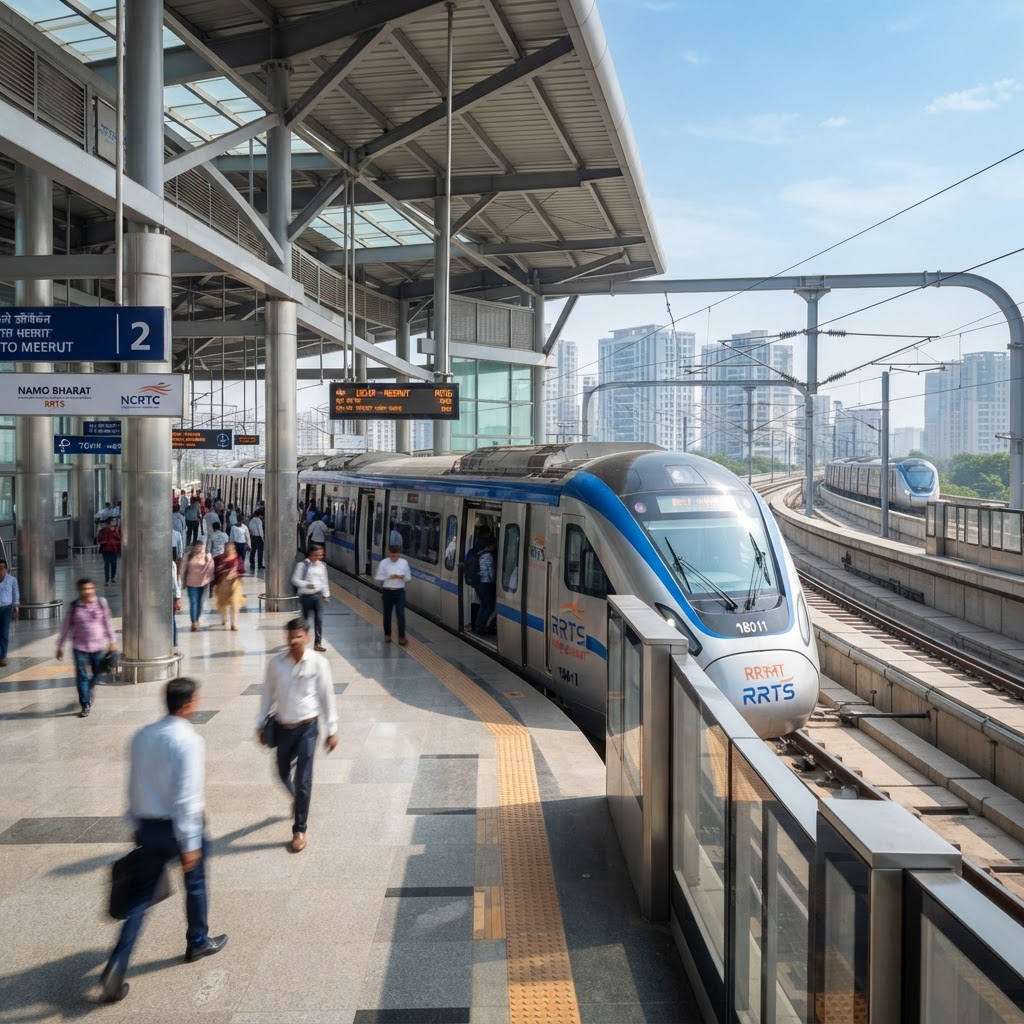
Table of Contents
- Understanding Namo Bharat RRTS Technology
- Delhi-Meerut: Operational Success Story
- Planned RRTS Corridors Across India
- Regional Connectivity and Economic Impact
- Passenger Experience and Technology Integration
- Timeline and Implementation Strategy
Understanding Namo Bharat RRTS Technology
The Regional Rapid Transit System represents a distinct category within India's public transport ecosystem—more capable than urban metro systems but more accessible than high-speed railways. Operating at 90 kilometres per hour cruise speed (with maximum speeds up to 130 km/h), RRTS corridors connect metropolitan areas with surrounding towns and cities, typically serving routes of 50-150 kilometres. The technology bridges the gap between urban commuting and inter-city travel, enabling integrated regional mobility networks.
RRTS infrastructure differs significantly from conventional railways and metro systems. Semi-grade-separated tracks incorporate elevated viaducts over urban areas, ground-level operations in suburban zones, and full segregation in outer regional segments. This hybrid approach balances construction costs with operational efficiency and environmental impact management. Stations are strategically positioned at regional transit hubs, commercial centres, and residential clusters rather than exclusively in city centres, reflecting RRTS's focus on connecting regions rather than serving intra-city transport.
Rolling stock design reflects regional service requirements. RRTS trains accommodate 1,200-1,500 passengers per train-set with superior comfort compared to metro operations—wider seats, better ventilation, luggage storage—reflecting longer average journey times. Dwell times at stations (10-15 seconds) are optimised for regional service patterns, faster than metro operations but allowing orderly boarding and alighting of regional passengers.
Delhi-Meerut: Operational Success Story
The Delhi-Meerut RRTS corridor, the inaugural operational system, commenced partial operations in October 2023 and achieved full 82-kilometre operational status in July 2026. The corridor directly connects India's national capital region with Meerut, a major industrial and commercial centre in western Uttar Pradesh. Journey time from Delhi Central to Meerut reduces to 55-60 minutes via RRTS compared to 90-120 minutes via road, making the railway service competitive with automobile travel for commuters.
Operational performance metrics demonstrate the system's success. Daily ridership has grown from 25,000-30,000 passengers during initial months to 80,000-100,000 passengers daily by mid-2026. This growth, achieved without extensive promotional campaigns, reflects strong market demand for fast, reliable inter-city connectivity. The economic significance extends beyond passenger volumes—Meerut's integration with Delhi metropolitan area has accelerated commercial development and industrial relocation, demonstrating the broader regional development impact of RRTS infrastructure.
Operational reliability has consistently exceeded initial projections. Average punctuality rates exceed 97 per cent, system availability exceeds 98.5 per cent, and passenger satisfaction surveys indicate 88-92 per cent of passengers rate their experience as "good" or "excellent." These metrics validate RRTS as a proven technology suitable for rapid rollout across India.
Planned RRTS Corridors Across India
Building on Delhi-Meerut success, the Economic Survey and Union Budget allocations have identified nearly 2,900 kilometres of RRTS corridors across India for development. These corridors strategically connect India's major metropolitan areas with surrounding cities and towns, creating integrated regional mobility networks. Corridors are categorised into phases based on feasibility, funding availability, and priority ratings.
Priority corridors identified include Bengaluru-Mysuru-Tumakuru-Hosur, Chennai-Vellore-Villupuram-Chengalpattu, Hyderabad-Warangal, Mumbai-Pune, Kolkata-Durgapur, and Ahmedabad-Vadodara corridors. These corridors reflect major metropolitan areas and significant urban/industrial clusters across India's geography. Each corridor addresses specific regional development objectives—industrial relocation, port connectivity, agricultural market integration, or metropolitan decentralisation.
Feasibility assessments for each corridor evaluate travel demand, traffic patterns, land acquisition requirements, environmental impacts, and economic viability. The multimodal integration aspect ensures RRTS corridors connect with existing and planned highway networks, creating seamless inter-modal connectivity and maximising economic impact of both transport systems.
Planned RRTS Corridors by Region (2026-2036)
| Corridor | Cities Connected | Length (km) | Phase |
|---|---|---|---|
| Bengaluru-Mysuru | Bengaluru-Tumakuru-Mysuru | 148 | Phase 1 (2024-2028) |
| Chennai-Vellore | Chennai-Vellore-Villupuram | 142 | Phase 1 (2024-2028) |
| Hyderabad-Warangal | Hyderabad-Warangal-Vijayawada | 185 | Phase 1 (2024-2028) |
| Mumbai-Pune | Mumbai-Pune | 190 | Phase 2 (2027-2031) |
| Kolkata-Durgapur | Kolkata-Durgapur | 165 | Phase 2 (2027-2031) |
| Ahmedabad-Vadodara | Ahmedabad-Vadodara | 103 | Phase 2 (2027-2031) |
Regional Connectivity and Economic Impact
RRTS development strategy explicitly targets regional economic integration. By providing fast, reliable connectivity between metropolitan areas and secondary cities, RRTS corridors facilitate industrial relocation, support emergence of new commercial centres, and integrate agricultural hinterlands with urban markets. The Delhi-Meerut corridor has demonstrated this effect—Meerut's commercial activity has increased 15-20 per cent since corridor commencement, manufacturing investment has accelerated, and residential property values have appreciated 10-15 per cent annually in RRTS-connected zones.
Labour market integration represents another significant impact. Previously, commuting from secondary cities to metropolitan employment centres was prohibitively time-consuming or expensive. RRTS corridors make such commuting feasible for service sector employment—IT, financial services, business process outsourcing—expanding metropolitan labour market access and enabling secondary cities to capture metropolitan employment opportunities without population concentration in congested city centres.
Agricultural market integration and food supply chains benefit significantly. Secondary cities and agricultural regions connected via RRTS can supply urban markets with perishable goods efficiently, reducing supply chain losses and improving farmer incomes. This effect is particularly important for ensuring food security and supporting agricultural communities within integrated regional economies.
Passenger Experience and Technology Integration
RRTS represents modern passenger experience design. Stations feature comfortable waiting areas, real-time information displays, integrated ticketing systems, and secure parking facilities. Rolling stock incorporates wi-fi connectivity, USB charging ports, climate control, and wheelchair accessibility—amenities expected in modern public transport systems. Passenger information systems provide real-time train tracking, connectivity information, and integrated journey planning.
Ticketing integration is particularly significant. The RRTS ticketing system is integrated with metro and bus systems in connected cities, enabling unified journey planning and ticketing across transport modes. This integration dramatically improves passenger convenience and encourages public transport adoption.
Safety and security systems incorporate CCTV surveillance, emergency communication systems, and trained security personnel. Emergency response protocols, developed from Delhi metro experience, ensure rapid response to incidents. These systems have contributed to RRTS achieving excellent safety records during operational phases.
Timeline and Implementation Strategy
RRTS development follows a phased timeline. Phase 1 (2024-2028) targets primary corridors: Bengaluru-Mysuru, Chennai-Vellore, and Hyderabad-Warangal. These corridors, selected based on travel demand analysis and economic feasibility, represent priority projects receiving accelerated fund allocation and approvals. Phase 1 completion would add approximately 500 kilometres of RRTS operational infrastructure.
Phase 2 (2027-2031) encompasses Mumbai-Pune, Kolkata-Durgapur, and Ahmedabad-Vadodara corridors, adding approximately 600 kilometres. Phase 3 (2030-2036) targets secondary corridors connecting smaller cities and towns to emerging economic zones, targeting nearly 1,800 kilometres of additional infrastructure.
Implementation challenges include land acquisition complexities across state boundaries, environmental compliance in ecologically sensitive zones, funding constraints, and technical coordination between multiple government agencies. Institutional mechanisms—NCRTC (National Capital Region Transport Corporation) model applied nationally, centralised project management offices, standardised procurement procedures—aim to address these challenges and ensure efficient project delivery.
Conclusion
Namo Bharat RRTS represents India's commitment to sustainable, efficient regional connectivity. The Delhi-Meerut operational corridor has validated the technology and demonstrated its transformative potential for regional economies. With nearly 2,900 kilometres of corridors identified and robust implementation strategies in place, RRTS is positioned to fundamentally reshape India's regional transport landscape over the next decade. By enabling fast, reliable connectivity between metropolitan and secondary cities, RRTS will support balanced regional development, integrate India's economy, and provide citizens with modern public transport experiences.
You May Also Like: Metro & Urban Transit in India: How Metro Rail, RRTS and Monorail Are Reshaping City Life, Indian Railways in 2026: Vande Bharat and Modernisation, and Delhi-Mumbai Expressway: India's Longest Highway Corridor.
Frequently Asked Questions
What is Namo Bharat RRTS?
Namo Bharat RRTS (Regional Rapid Transit System) is India's premium inter-city rapid transit technology, operating at 90 km/h cruise speeds—3 times faster than urban metro systems. It connects metropolitan areas with surrounding cities and towns, providing journey times comparable to or faster than road transport.
How is RRTS different from metro systems?
RRTS serves longer distances (50-150 km) at higher speeds (90 km/h vs 40-45 km/h for metro), with fewer stops and longer average journey times. Metro systems prioritise urban commuting over shorter distances. RRTS connects regions and cities rather than serving intra-city transport.
What is the current operational status of RRTS?
The Delhi-Meerut RRTS corridor is fully operational at 82 kilometres, carrying 80,000-100,000 passengers daily as of mid-2026. It demonstrates 97+ per cent punctuality and 98.5+ per cent system availability, validating RRTS technology for rapid expansion.
How many RRTS corridors are planned?
Nearly 2,900 kilometres of RRTS corridors have been identified across India, planned in three phases. Phase 1 (2024-2028) targets 500 km, Phase 2 (2027-2031) targets 600 km, and Phase 3 (2030-2036) targets remaining 1,800 km across secondary corridors.
What economic benefits does RRTS provide?
RRTS corridors facilitate regional economic integration by enabling commuting to metropolitan employment, supporting industrial relocation, integrating agricultural markets, and improving property values in connected areas. The Delhi-Meerut corridor shows 15-20 per cent increases in commercial activity in connected cities.
How much does RRTS travel cost compared to other transport modes?
RRTS fares are designed to be competitive with road transport. Delhi-Meerut fares range from ₹20-50 depending on travel distance, making it cost-competitive with taxis, buses, and personal vehicles for equivalent journey quality and time.
What passenger amenities are provided on RRTS trains?
RRTS rolling stock includes wi-fi connectivity, USB charging ports, climate control, comfortable seating, luggage storage, and wheelchair accessibility. Stations feature real-time information displays, comfortable waiting areas, secure parking, and integrated ticketing with metro and bus systems.