Green hydrogen trains represent the ultimate frontier in zero-emission sustainable rail locomotion, offering a viable, carbon-free alternative for routes where traditional overhead electrification remains technically or economically unfeasible. As part of its aggressive target to achieve Net Zero carbon emissions by 2030, Indian Railways has launched the visionary 'Hydrogen for Heritage' initiative—a ₹2,800 crore national programme dedicated to deploying hydrogen fuel cell technology across non-electrified scenic and regional rail corridors. Under this flagship project, Indian Railways is retrofitting 35 conventional diesel-electric locomotives into advanced 1,200-horsepower green hydrogen-powered trainsets, with the propulsion and fuel cell integration executed indigenously by Medha Servo Drives in partnership with international technology providers. The inaugural prototype, featuring eight modern passenger coaches powered by onboard hydrogen storage tanks and fuel cell stacks, is undergoing comprehensive operational trials along the 89-kilometre Jind–Sonipat section in Haryana. Benefiting over 2,600 daily regional commuters while discharging only pure water vapour as a byproduct, India's green hydrogen rail initiative places the country among an elite group of nations leading the global clean energy transition in transport for 2026 and beyond.
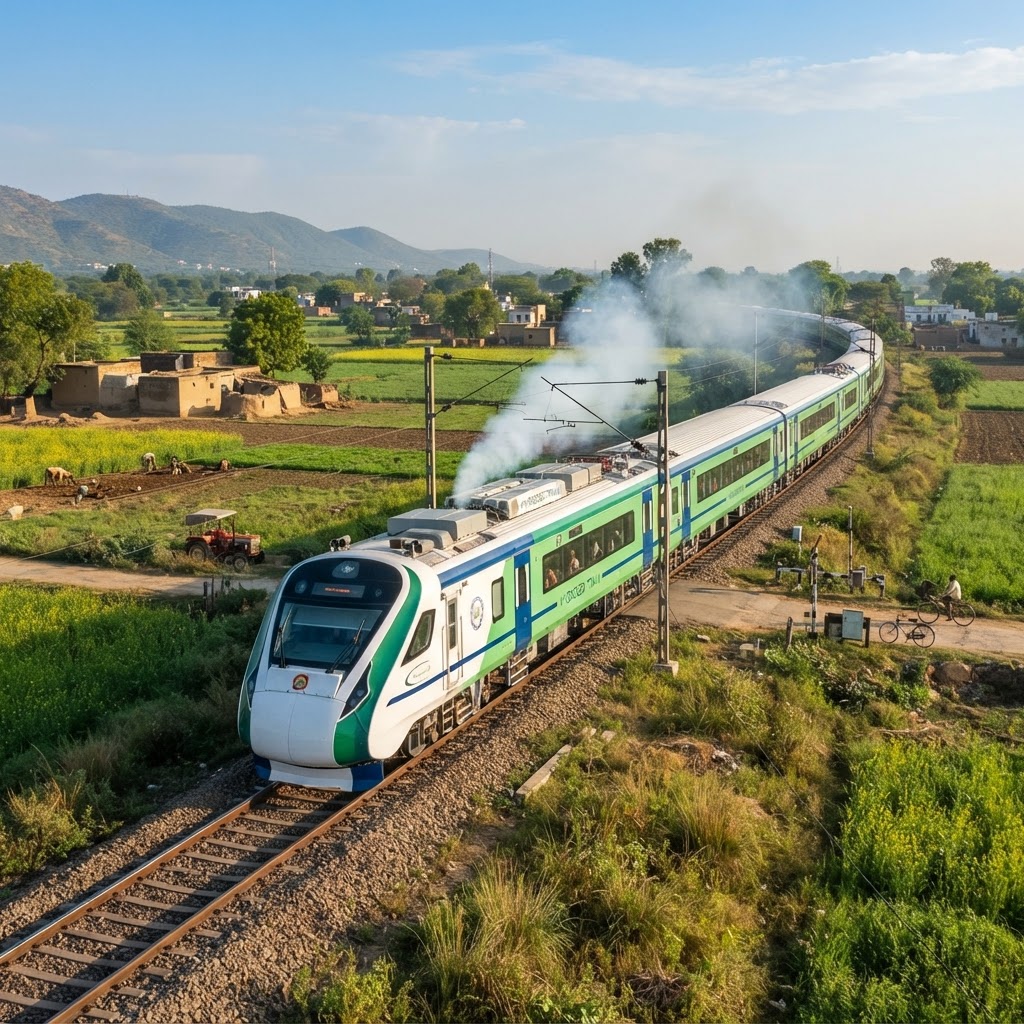
Table of Contents
- 1. Fundamental Principles of Green Hydrogen Fuel Cell Propulsion
- 2. India's 'Hydrogen for Heritage' Programme and Conversion Strategy
- 3. Detailed Technical Specifications of the Jind–Sonipat Pilot Train
- 4. Comparative Technology Assessment: Hydrogen vs Diesel vs Electric Traction
- 5. Global Benchmarking: India vs Germany, China, and the United Kingdom
- 6. Hydrogen Refuelling Infrastructure, Electrolysers, and Storage Logistics
- 7. Depot Maintenance Infrastructure, Safety Engineering, and Fuel Cell Life
- 8. Capital Costs, Operating Expenditure, and Environmental Decarbonisation Impact
- 9. Technical Challenges, Safety Standards, and Future Expansion Roadmap
- 10. Conclusion and Sustainable Mobility Outlook
- 11. You May Also Like
- 12. Frequently Asked Questions
1. Fundamental Principles of Green Hydrogen Fuel Cell Propulsion
To understand the revolutionary potential of hydrogen trains, it is essential to examine the underlying chemical and electrical engineering principles that govern fuel cell propulsion. A hydrogen train—technically categorized as a Hydrogen Fuel Cell Hybrid Multiple Unit (HMU)—does not burn hydrogen through internal combustion. Instead, it generates electrical energy onboard through an electrochemical reaction between compressed green hydrogen gas stored in fuel tanks and atmospheric oxygen supplied by filtered external air intake units.
This process takes place inside Proton Exchange Membrane (PEM) fuel cell stacks. Within the fuel cell, hydrogen molecules are split into protons and electrons at the anode catalyst layer. Protons pass through the membrane to the cathode, while electrons are forced through an external circuit, producing direct electric current (DC). At the cathode, electrons, protons, and oxygen recombine to form water (H2O), releasing heat and water vapour as the sole operational emissions. The generated electricity is routed through heavy-duty power converters and variable-frequency traction inverters to drive high-torque AC induction electric traction motors mounted on the train's bogies.
Furthermore, hydrogen trainsets incorporate advanced Lithium-ion energy storage battery banks. These traction batteries serve a dual purpose: they provide supplementary power output during rapid acceleration and steep gradient climbs, and they store regenerative braking energy recovered whenever the train decelerates. This hybrid energy management system optimizes fuel cell efficiency, prolongs component lifespan, and maximizes overall energy efficiency per seat-kilometre across varying track topographies.
2. India's 'Hydrogen for Heritage' Programme and Conversion Strategy
While Indian Railways has achieved rapid progress under its 100 percent main-line network electrification campaign, certain environmentally sensitive, mountainous, and tourist-centric heritage routes cannot support heavy overhead 25 kV AC catenary wires. Installing overhead electric wires along narrow-gauge hill railways and dense forest corridors involves prohibitive civil engineering costs, visual pollution, and severe ecological disruption. To solve this challenge, the Ministry of Railways conceptualized the 'Hydrogen for Heritage' initiative under the National Green Hydrogen Mission.
Rather than purchasing expensive fully imported hydrogen trainsets from overseas OEMs at ₹120–150 crore per train, Indian Railways opted for an innovative retrofitting strategy. Under this scheme, existing operational Diesel-Electric Multiple Unit (DEMU) trains and diesel locos are systematically converted into hydrogen fuel cell hybrids. The diesel engines, alternator sets, and fuel tanks are removed from the driving power car, replaced by PEM fuel cell stacks, hydrogen storage cylinder racks, power electronics, and lithium battery banks manufactured by Medha Servo Drives in Hyderabad.
The total sanctioned capital cost for converting 35 trains and setting up associated green hydrogen refuelling infrastructure stands at ₹2,800 crore. By leveraging existing rolling stock chassis and passenger coach bodies, Indian Railways reduced capital costs per trainset by nearly 40 percent compared to foreign acquisitions, creating a replicable manufacturing blueprint for green rail conversion across developing economies.
For additional insights into broader railway modernization and sustainability efforts, explore our coverage on Indian Railways 2026 and Railway Electrification.
5. Global Benchmarking: India vs Germany, China, and the United Kingdom
India's entry into hydrogen rail technology aligns with a global acceleration toward decarbonized rail transport. Germany became the world pioneer in 2018 when regional operator EVB deployed Alstom's Coradia iLint hydrogen trains in Lower Saxony, followed by full commercial fleet replacement on the Elbe-Weser line. Shortly thereafter, China Railway introduced its indigenous urban hydrogen tram and regional trainsets developed by CRRC, operating at 160 km/h with integrated automatic train operation (ATO).
In the United Kingdom, the HydroFLEX project converted Class 319 electric multiple units into hydrogen-electric hybrids, targeting non-electrified routes in Scotland and Wales. Comparing India's initiative against these global leaders reveals a distinct strategic emphasis on retrofitting existing rolling stock and utilizing locally produced green hydrogen generated from dedicated solar power arrays.
| Country / Project | Manufacturer / Integrator | Max Speed | Operational Status (2026) | Fleet Size Target | Primary Application |
|---|---|---|---|---|---|
| India ('Hydrogen for Heritage') | Medha Servo Drives / Indian Railways | 110 km/h | Active Trials (Jind–Sonipat) | 35 Trainsets by 2028 | Non-electrified & Heritage Regional Lines |
| Germany (Coradia iLint) | Alstom Transport | 140 km/h | Full Commercial Operation | 41+ Trainsets in service | Regional Passenger Lines (Lower Saxony / Taunus) |
| China (CRRC Hydrogen Train) | CRRC Changchun / Chengdu Rail | 160 km/h | Commercial Passenger Trials | 20+ Trainsets deployed | 20+ Trainsets deployed |
| United Kingdom (HydroFLEX) | Porterbrook / Univ. of Birmingham | 120 km/h | Prototype Mainline Certified | Pilot conversions | Regional Commuter Lines |
| Japan (HYBARI Train) | JR East / Toyota / Hitachi | 100 km/h | Testing & Validation Phase | Pilot Fleet | Suburban Branch Lines |
4. Comparative Technology Assessment: Hydrogen vs Diesel vs Electric Traction
Selecting the optimal rail traction technology requires analyzing technical performance, infrastructure capital requirements, operating costs, and lifecycle environmental emissions. While overhead 25 kV AC electric traction remains the most efficient choice for high-density mainline trunk routes, hydrogen fuel cells present a superior zero-emission solution for non-electrified regional, branch, and heritage lines.
To examine where hydrogen fits into the broader sustainable transport landscape, see our previous analysis on Green Hydrogen Trains.
| Parameter / Feature | Green Hydrogen Fuel Cell (HMU) | Diesel-Electric (DEMU / Loco) | Overhead 25 kV AC Electric (EMU) |
|---|---|---|---|
| Operational Tailpipe Emissions | Zero (Pure Water Vapour only) | High (CO2, NOx, Particulate Matter) | Zero Direct (Grid-dependent) |
| Primary Energy Source | Green Hydrogen via Water Electrolysis | Refined Diesel Fuel (Fossil) | National Electrical Power Grid |
| Track Infrastructure Needed | Standard Track (No Overhead Wires) | Standard Track (No Overhead Wires) | Continuous 25 kV AC Catenary & Substation Grid |
| Operational Range per Tank / Charge | 800 to 1,000 km | 1,200 to 1,500 km | Unlimited (Wired Connection) |
| Refuelling / Turnaround Time | 15 to 20 minutes | 10 to 15 minutes | N/A (Continuous power) |
| Traction Power Rating | 1,200 HP to 2,400 HP | 1,400 HP to 3,000 HP | 4,000 HP to 12,000 HP |
| Energy Conversion Efficiency | 50% to 60% (Fuel Cell) | 30% to 35% (Diesel Engine) | 85% to 90% (Direct Electric) |
| Infrastructure Capex per Km | Low (Refuelling Hubs only) | Lowest (Fuel Depots only) | High (₹1.5–2.5 crore/km for catenary) |
5. Global Benchmarking: India vs Germany, China, and the United Kingdom
India's entry into hydrogen rail technology aligns with a global acceleration toward decarbonized rail transport. Germany became the world pioneer in 2018 when regional operator EVB deployed Alstom's Coradia iLint hydrogen trains in Lower Saxony, followed by full commercial fleet replacement on the Elbe-Weser line. Shortly thereafter, China Railway introduced its indigenous urban hydrogen tram and regional trainsets developed by CRRC, operating at 160 km/h with integrated automatic train operation (ATO).
In the United Kingdom, the HydroFLEX project converted Class 319 electric multiple units into hydrogen-electric hybrids, targeting non-electrified routes in Scotland and Wales. Comparing India's initiative against these global leaders reveals a distinct strategic emphasis on retrofitting existing rolling stock and utilizing locally produced green hydrogen generated from dedicated solar power arrays.
| Country / Project | Manufacturer / Integrator | Max Speed | Operational Status (2026) | Fleet Size Target | Primary Application |
|---|---|---|---|---|---|
| India ('Hydrogen for Heritage') | Medha Servo Drives / Indian Railways | 110 km/h | Active Trials (Jind–Sonipat) | 35 Trainsets by 2028 | Non-electrified & Heritage Regional Lines |
| Germany (Coradia iLint) | Alstom Transport | 140 km/h | Full Commercial Operation | 41+ Trainsets in service | Regional Passenger Lines (Lower Saxony / Taunus) |
| China (CRRC Hydrogen Train) | CRRC Changchun / Chengdu Rail | 160 km/h | Commercial Passenger Trials | 20+ Trainsets deployed | }|
| United Kingdom (HydroFLEX) | Porterbrook / Univ. of Birmingham | 120 km/h | Prototype Mainline Certified | Pilot conversions | Regional Commuter Lines |
| Japan (HYBARI Train) | JR East / Toyota / Hitachi | 100 km/h | Testing & Validation Phase | Pilot Fleet | Suburban Branch Lines |
6. Hydrogen Refuelling Infrastructure, Electrolysers, and Storage Logistics
The success of hydrogen-powered rail depends as much on ground refuelling infrastructure as on rolling stock technology. To supply pure green hydrogen for the Jind–Sonipat pilot line, Indian Railways constructed a state-of-the-art green hydrogen generation and refuelling facility at Jind Junction. The plant houses a 1-Megawatt Proton Exchange Membrane (PEM) water electrolyser powered directly by a dedicated 3 MW solar photovoltaic power plant erected on railway land.
The electrolyser unit splits purified water into high-purity hydrogen gas (99.999% purity) and oxygen. The hydrogen gas is subsequently compressed through multi-stage booster compressors to high-pressure storage banks operating at 450 bar. The ground refuelling dispenser station utilizes automated high-flow fuel nozzles that transfer up to 400 kg of hydrogen into the train's roof tanks within 20 minutes, adhering to international ISO 19880-1 safety standards.
To support the broader rollout across 35 trainsets, Indian Railways plans to establish regional green hydrogen production hubs along identified heritage corridors. These hubs will utilize green power sourced from the national renewable energy grid, ensuring that the hydrogen fuel is 100 percent zero-carbon from well-to-wheel.
| Railway Zone | Route / Corridor Name | Distance | Track Gauge | Target Fleet Allocation |
|---|---|---|---|---|
| Northern Railway | Jind – Sonipat Section (Haryana) | 89 km | Broad Gauge (1676 mm) | 1 Pilot Trainset (Active) |
| Northern Railway | Kalka – Shimla Heritage Railway | 96 km | Narrow Gauge (762 mm) | 6 Heritage Trainsets |
| North Western Railway | Marwar – Mavli Junction Section | 152 km | Meter / Broad Gauge | 4 Regional Trainsets |
| Southern Railway | Nilgiri Mountain Railway (Ooty) | 46 km | Meter Gauge (Rack Rail) | 3 Heritage Trainsets |
| Central Railway | Matheran Hill Railway | 21 km | Narrow Gauge (610 mm) | 2 Heritage Trainsets |
| Northeast Frontier | Darjeeling Himalayan Railway | 88 km | Narrow Gauge (610 mm) | 4 Heritage Trainsets |
7. Depot Maintenance Infrastructure, Safety Engineering, and Fuel Cell Life
Operating and maintaining hydrogen-powered rolling stock requires specialized maintenance depot infrastructure equipped with advanced safety systems and environmental controls. Traditional maintenance sheds designed for diesel or electric locomotives are unsuited for hydrogen handling due to gas accumulation risks in enclosed spaces. Consequently, Indian Railways established purpose-built hydrogen maintenance bays featuring open-roof ventilation corridors, spark-proof electrical fixtures, and continuous gas monitoring arrays.
Inside the specialized maintenance bay, roof-level laser absorption sensors continuously monitor hydrogen concentrations. If ambient hydrogen levels exceed 1 percent of atmospheric volume (well below the 4 percent lower flammability limit), automated high-capacity exhaust fans initiate instantly to purge the air space. Additionally, maintenance personnel utilize specialized non-sparking beryllium-copper tools and anti-static protective wear during fuel cell servicing.
Fuel cell stack longevity represents another key maintenance consideration. PEM fuel cells operating in rail environments undergo cyclic loading as power demands fluctuate. Through advanced thermal management, precise deionised water coolant loops, and air intake filtration systems that eliminate fine dust and sulphur compounds, Medha Servo Drives has extended fuel cell stack operational life to over 20,000 hours before major overhaul, ensuring high fleet availability and reduced life-cycle maintenance costs.
8. Capital Costs, Operating Expenditure, and Environmental Decarbonisation Impact
The financial viability of green hydrogen rail systems is undergoing rapid evolution in 2026. While initial capital expenditure for fuel cell stacks and electrolysis infrastructure remains higher than conventional diesel systems, declining costs for renewable electricity and electrolyser manufacturing are rapidly improving the lifecycle economics of hydrogen transit.
At current production scales, green hydrogen in India costs approximately ₹300 to ₹350 per kilogram. A typical 89-kilometre round-trip journey on the Jind–Sonipat section consumes approximately 120 kilograms of hydrogen, resulting in a fuel cost of ₹36,000 to ₹42,000 per trip. In comparison, a diesel multiple unit consuming 350 litres of diesel fuel incurs an operational fuel cost of ₹31,500. However, as green hydrogen production scales under India's National Green Hydrogen Mission, green hydrogen costs are projected to decline below ₹150 per kg by 2030, making hydrogen trains significantly cheaper to operate than diesel locomotives.
From an environmental perspective, replacing 35 diesel trains with green hydrogen units eliminates over 11,000 tonnes of carbon dioxide (CO2) emissions and over 120 tonnes of toxic particulate matter and nitrogen oxides (NOx) annually. This provides immense public health and environmental benefits, particularly across sensitive Himalayan forest ecosystems and heritage mountain lines.
9. Technical Challenges, Safety Standards, and Future Expansion Roadmap
Despite its vast potential, scaling hydrogen rail technology presents distinct technical and operational challenges. The primary engineering hurdle involves fuel cell stack degradation and thermal management. PEM fuel cells generate substantial heat during high-power output, requiring high-capacity liquid cooling radiators and auxiliary cooling fans that add weight and consume auxiliary power.
Safety engineering represents another critical domain. Hydrogen possesses a wide flammability range (4% to 75% concentration in air) and a high diffusion rate. To mitigate safety risks, Indian Railways engineered triple-redundant safety protocols. Roof-mounted composite fuel cylinders feature automatic thermal pressure relief devices (PRDs), optical flame sensors, ultrasonic hydrogen leak detectors, and crash-worthy protective roll-cages capable of withstanding severe impacts. In the event of a detected leak, automated solenoid valves instantly isolate fuel banks and vent gas safely into the upper atmosphere.
Looking ahead to the 2028–2030 roadmap, Indian Railways aims to expand hydrogen locomotion to heavy freight shunting yards and non-electrified mining feeder lines. By establishing a robust domestic supply chain for fuel cells, carbon-fibre storage tanks, and megawatt-scale electrolysers, India is building a sustainable green rail ecosystem that will serve as a global benchmark for decades to come.
10. Conclusion and Sustainable Mobility Outlook
India's green hydrogen train programme on the Jind–Sonipat route marks a landmark milestone in the evolution of sustainable railway locomotion. By combining indigenous retrofitting innovation, solar-powered green hydrogen production, and uncompromising safety standards, Indian Railways has demonstrated that zero-emission regional transit is both technically achievable and economically viable. As the 'Hydrogen for Heritage' rollout expands across scenic mountain railways and non-electrified branch lines through 2026 and beyond, India reinforces its position as a global leader in clean energy transportation, preserving cultural heritage while pioneering the future of zero-carbon rail mobility.
You May Also Like: Indian Railways 2026, Railway Electrification, and Green Hydrogen Trains.
12. Frequently Asked Questions
Does India have hydrogen trains?
Not yet commercially, but the first prototype is expected to be tested in 2027 on the Jind-Sonipat section in Haryana.
How does a hydrogen train work?
Fuel cells combine hydrogen and oxygen to produce electricity, with water vapour as the only emission. No overhead wires needed.
How far can a hydrogen train travel?
A typical hydrogen train can travel approximately 1,000 km on a single tank of hydrogen fuel.
Why hydrogen instead of electric?
Hydrogen trains are ideal for non-electrified routes where installing overhead wires is expensive or impractical.
How many hydrogen trains will India have?
Indian Railways plans to convert 35 diesel locomotives to hydrogen by 2030.
Are hydrogen trains safe?
Yes, hydrogen storage tanks are designed with multiple safety layers including crash protection and automatic shut-off valves.