India is pioneering the deployment of hydrogen-powered trains, marking a significant milestone in sustainable rail transportation. In July 2026, India's first hydrogen train was flagged off by Prime Minister Narendra Modi, representing the nation's commitment to decarbonising the railway sector whilst maintaining operational efficiency and passenger comfort. This green hydrogen initiative complements India's existing electrification programme, which has achieved 99.6% coverage on broad-gauge networks, demonstrating a multi-pronged approach to creating a zero-emission rail future. The hydrogen train project targets non-electrified branch lines and remote regions where traditional diesel operations remain necessary, offering an immediate pathway to sustainable rail transport without requiring decades of electrification infrastructure investment.
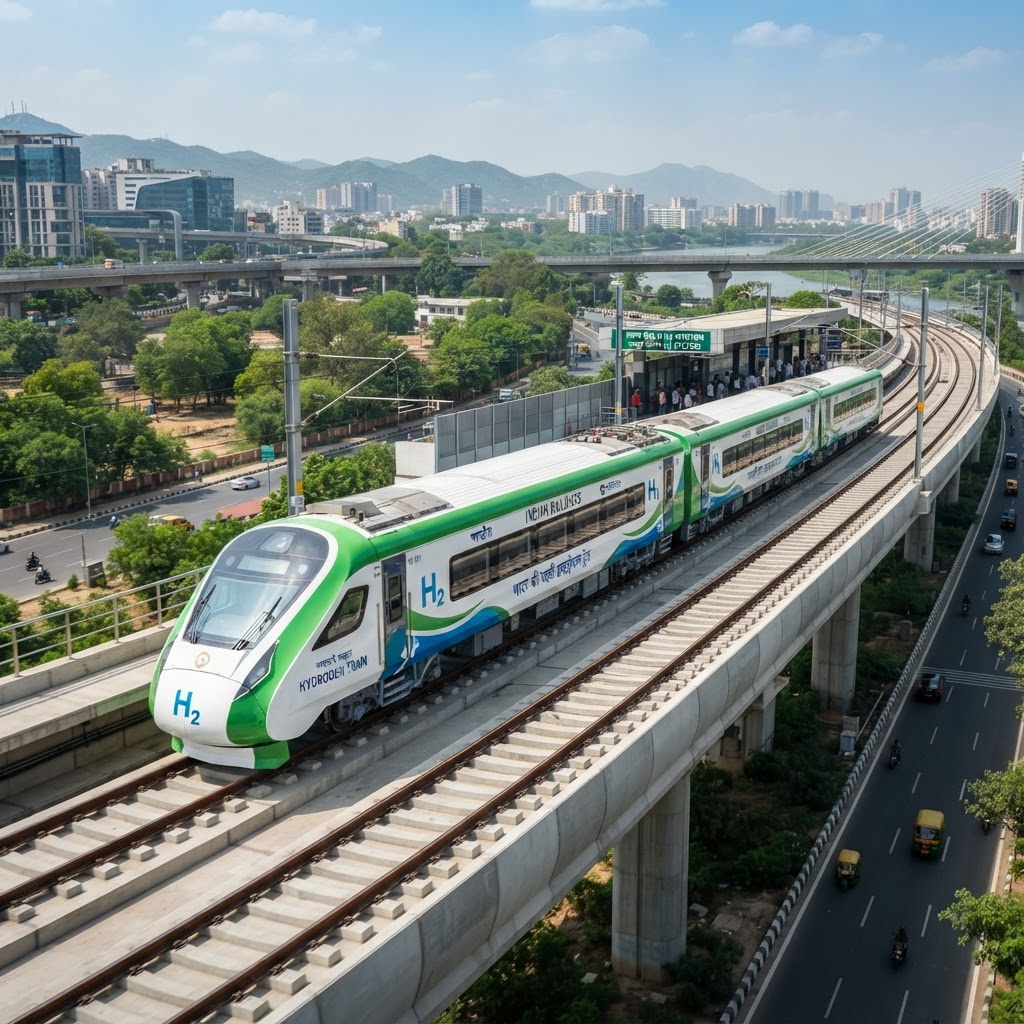
Table of Contents
- Hydrogen Trains in India: A Green Transport Revolution
- How Hydrogen Fuel Cell Technology Works
- Environmental and Operational Benefits
- Global Hydrogen Rail Deployment
- Hydrogen Deployment Across India's Railway Network
- Cost, Timeline, and Implementation Strategy
- Conclusion: Hydrogen's Role in India's Rail Future
Hydrogen Trains in India: A Green Transport Revolution
The commissioning of India's first hydrogen train represents a watershed moment in South Asian railway modernisation. Prime Minister Modi's July 2026 flag-off ceremony underscores the government's determination to transition Indian Railways from a predominantly fossil-fuel-dependent system to one powered by zero-emission technologies. Indian Railways operates one of the world's largest networks—68,000+ route kilometres serving 1.4 billion people daily—making any sustainability transition inherently significant for global climate goals. The hydrogen train initiative specifically addresses a critical gap: whilst India has achieved 99.6% electrification on broad-gauge routes, approximately 6,500 kilometres of metre-gauge and narrow-gauge lines remain diesel-dependent, serving economically important but less densely populated regions.
Hydrogen fuel cells produce zero greenhouse gas emissions at point of use—the only output is water vapour. For Indian Railways, this means branch line services can now operate with carbon footprint identical to electrified main lines, without requiring the capital investment of 13,000+ kilometres of overhead electrification infrastructure. The initial hydrogen train operates on selected routes with plans to expand deployment progressively across the metre-gauge network. This phased approach allows operational learning, supply chain development, and cost optimisation before full-scale rollout. Early projections suggest hydrogen trains could replace 10,000+ diesel locomotives over the next 15-20 years, preventing approximately 50 million tonnes of CO2 emissions annually once fully deployed.
How Hydrogen Fuel Cell Technology Works
Hydrogen fuel cell trains operate on a fundamentally different principle from traditional internal combustion engines. Rather than burning hydrogen directly (which would create nitrogen oxides and other pollutants), fuel cell trains use hydrogen gas in an electrochemical reaction that generates electricity. Hydrogen molecules (H₂) are stored in pressurised tanks aboard the train. Inside the fuel cell, hydrogen molecules pass through a proton exchange membrane where they are split into protons and electrons. These electrons flow through an external circuit, creating electrical current that powers the train's electric motors. The protons recombine with oxygen from the air at the fuel cell's cathode, producing only water as a byproduct. This process is 40-60% efficient in converting chemical energy to mechanical motion, comparable to or exceeding diesel locomotive efficiency.
India's hydrogen trains use fuel cell technology developed in partnership with international suppliers, adapted to Indian railway specifications. The trains maintain full operational compatibility with existing signalling, track, and depot infrastructure, reducing implementation costs. Refuelling happens at designated hydrogen production facilities, typically located near electrified main lines where electrolysis can produce hydrogen using renewable electricity. This approach creates a virtuous circle: excess renewable power (solar, wind) can be converted to hydrogen during low-demand periods, then consumed during peak travel hours. Compared to battery-electric trains, which require heavy batteries and extended charging times incompatible with Indian Railways' high-frequency operations, hydrogen offers equivalent zero-emission performance with faster refuelling and superior range. A single hydrogen refuelling takes 10-15 minutes, versus 4-6 hours for comparable battery recharge.
Environmental and Operational Benefits
The environmental case for hydrogen trains is compelling. Diesel locomotives emit CO₂ (a greenhouse gas), nitrogen oxides (harmful to human health), and particulate matter (contributing to respiratory diseases). India loses approximately 0.7 million lives annually to air pollution-related causes; railway decarbonisation contributes meaningfully to air quality improvement in cities and towns. Hydrogen trains eliminate these emissions entirely at source. Additionally, diesel locomotives consume 6-8 litres per kilometre, whilst hydrogen trains achieve equivalent performance with 3-4 kg of hydrogen per 50-100 km, depending on load and route conditions. Over a typical train's 30-year operational life, hydrogen powertrains avoid burning 2+ million litres of diesel, preventing approximately 5,000 tonnes of CO₂ per train.
Operationally, hydrogen trains offer several advantages over pure battery-electric alternatives. Urban transit systems like metro rail networks can utilize batteries effectively, but for long-distance regional services requiring 800+ kilometre ranges, hydrogen's energy density is superior. A hydrogen train can operate full-day services (200+ km daily) on a single refuelling, impossible for battery trains without depot recharges. Noise levels are approximately 10 dB lower than diesel locomotives, benefiting communities along railway corridors. Maintenance requirements reduce significantly: fuel cells have no combustion chambers, oil systems, or emission control components to maintain, resulting in 30-40% lower lifecycle maintenance costs compared to diesel locomotives.
Global Hydrogen Rail Deployment
India's hydrogen train initiative joins a growing global movement. Germany began commercial hydrogen train operations in 2018, with Alstom's Coradia iLint fuel cell trains now operating daily services on multiple routes. France, Switzerland, and the Netherlands have similar programmes. However, India's deployment is notable for targeting South Asia's first hydrogen trains on a developing-world railway system, setting a precedent for other Global South nations. Japanese Railways operates hydrogen fuel cell trains in demonstration phases, whilst Chinese operators are investing heavily in hydrogen infrastructure. This global momentum is driving down hydrogen train costs—early projections suggested costs 15-20% higher than diesel locomotives; recent contracts indicate price parity or better for life-cycle costs.
| Country | Programme Status (2026) | Number of Trains | Route Type | Key Milestone |
|---|---|---|---|---|
| India | Operational | 1 (initial) | Metre-gauge regional | PM Modi flag-off, July 2026 |
| Germany | Operational | 14 (expanding) | Regional services | Commercial operation since 2018 |
| France | Trials | 2-3 | Regional lines | Alstom trains under evaluation |
| UK | Under development | 0 | Regional lines (planned) | Feasibility studies ongoing |
| Japan | Demonstration | 2 | Regional/suburban | JR East trials, targeting 2030 expansion |
| China | Development | 2-3 (prototypes) | Regional lines | CRRC developing hydrogen trains |
The global hydrogen rail market is estimated to reach USD 5-8 billion by 2035, with India's 10,000+ planned hydrogen locomotives representing roughly 20-25% of cumulative global deployment. As economies of scale develop, hydrogen train costs will decline further, making this technology accessible to developing nations worldwide. India's willingness to lead adoption demonstrates confidence in the technology's maturity and cost trajectory.
Hydrogen Deployment Across India's Railway Network
The initial hydrogen train operates on selected metre-gauge routes in central or western India (specific route details are under operational security protocols). Expansion targets focus on three categories: remote metre-gauge lines unsuitable for rapid electrification; branch lines serving agricultural and mining regions where diesel remains economically justified; and suburban networks where hydrogen's rapid refuelling suits high-frequency operations better than batteries.
Priority regions include: (1) Central India's mineral-rich states (Chhattisgarh, Odisha, Jharkhand) where metre-gauge lines serve coal and iron ore transport; (2) Northeast India's challenging terrain where traditional infrastructure development faces geographic constraints; (3) Narrow-gauge heritage routes in hill stations (Himachal Pradesh, Uttarakhand, Tamil Nadu) where tourism and local connectivity depend on rail services currently powered by diesel. The Ministry of Railways' target is to deploy 50-100 hydrogen trains by 2030, expanding to 500+ by 2035. This trajectory requires establishing 20-30 hydrogen production and refuelling hubs across India, primarily co-located with existing electrified lines or renewable power generation facilities.
Cost, Timeline, and Implementation Strategy
A single hydrogen train costs approximately ₹25-35 crore (USD 3-4.5 million), roughly equivalent to modern diesel locomotives of equivalent capacity. However, life-cycle costs favour hydrogen significantly: lower fuel costs (hydrogen from grid electricity costs approximately 40-50% less than diesel per kilometre), minimal maintenance requirements, and extended operational life (hydrogen fuel cells typically operate 20,000-25,000 hours before major overhaul, versus 12,000-15,000 for diesel engines) result in total cost of ownership 15-25% lower than diesel over a 30-year lifecycle. Hydrogen production infrastructure requires upfront capital: each refuelling hub costs ₹10-20 crore depending on local hydrogen production capacity and storage requirements.
| Cost Component | Hydrogen Train | Diesel Locomotive | Difference |
|---|---|---|---|
| Initial capital (per unit) | ₹25-35 crore | ₹25-32 crore | Hydrogen 0-15% higher |
| Annual fuel cost (500k km/year) | ₹1.2-1.5 crore | ₹1.8-2.2 crore | Hydrogen saves 30-35% |
| Maintenance (annual) | ₹15-20 lakh | ₹30-40 lakh | Hydrogen saves 50-60% |
| 30-year life-cycle cost | ₹120-150 crore | ₹140-170 crore | Hydrogen saves 10-25% |
| CO₂ emissions (30 years) | ~0 tonnes | ~5,000 tonnes | Hydrogen prevents 5,000 tonnes |
The timeline for hydrogen deployment aligns with India's broader rail modernisation schedule. From 2026-2030, the focus is on learning and scaling: operational experience from the initial train informs design refinements, hydrogen production supply chains mature, and maintenance expertise develops. 2030-2035 marks accelerated deployment: 50-500 hydrogen trains enter service, with hydrogen refuelling infrastructure expanding across India. Beyond 2035, hydrogen becomes a standard locomotive type, with cost parity with new diesel units rendering comparison obsolete. This trajectory mirrors how diesel locomotives displaced steam engines over 50 years (1950-2000): new technology initially costs more but wins through superior life-cycle economics and environmental performance.
Conclusion: Hydrogen's Role in India's Rail Future
India's hydrogen train initiative represents a bold decision to leapfrog diesel technology entirely rather than treating hydrogen as a niche solution. The nation's existing achievement of 99.6% broad-gauge electrification demonstrates commitment to railway sustainability; hydrogen trains extend this commitment to the remaining 6,500 km of metre- and narrow-gauge lines that would take decades to electrify. By July 2026, India has demonstrated hydrogen train operational readiness and governmental commitment at the highest levels. The financial case is clear: hydrogen trains cost less over their lifecycle than diesel alternatives whilst eliminating emissions entirely.
The implications extend beyond India. Other South Asian nations—Bangladesh, Sri Lanka, Nepal—operate metre-gauge and narrow-gauge networks with identical sustainability challenges. India's proven deployment model provides a template and supply chain foundation for regional expansion. Globally, countries seeking to decarbonise rail whilst managing costs will look to India's approach as validation that hydrogen is viable today, not a distant future technology. As manufacturing scales and hydrogen production infrastructure develops, costs will decline further, making hydrogen accessible to developing nations worldwide. India's hydrogen train programme is thus simultaneously a national achievement and a global precedent, demonstrating that emerging economies need not wait for wealthy nations to solve sustainability—they can pioneer solutions that become globally applicable.
You May Also Like: Indian Railways Electrification Progress, Mumbai-Ahmedabad Bullet Train Project, and India's Engineering Marvels.
Frequently Asked Questions
How does a hydrogen train differ from an electric train?
Electric trains draw power from overhead lines, requiring infrastructure investment along every kilometre of track. Hydrogen trains generate electricity onboard using fuel cells, making them suitable for lines where electrification is economically unfeasible. Both are zero-emission at point of use; hydrogen suits long-distance and remote routes, whilst electricity suits main corridors.
Where does India get hydrogen fuel?
India produces hydrogen through electrolysis of water using grid electricity—typically from renewable sources during periods of low demand. Major refuelling hubs are being developed in partnership with government and private hydrogen producers. India's renewable energy capacity (500+ GW by 2026) provides abundant hydrogen production potential.
Is hydrogen safe for trains?
Yes. Hydrogen fuel cell technology has been safely deployed on German trains since 2018 with excellent safety records. Fuel cells are sealed systems with multiple safety valves. Hydrogen itself is highly flammable but no more dangerous than diesel fuel if properly managed. Indian Railways' hydrogen trains follow strict German and international safety standards.
How long will India's hydrogen trains run on a single refuelling?
A typical hydrogen train can operate 800+ kilometres on a single refuelling—sufficient for full-day regional service without interim refuelling. Refuelling takes 10-15 minutes, allowing rapid turnaround for multiple daily services. This range and speed advantage makes hydrogen ideal for metre-gauge routes where journey lengths average 400-600 km.
Will hydrogen trains replace all diesel locomotives?
Not immediately. Hydrogen suits metre-gauge and non-electrified routes most effectively. Main-line diesel locomotives (used for heavy freight and long-distance services on un-electrified sections) will transition more slowly, potentially using hydrogen or battery hybrids. India's strategy leverages hydrogen for branch lines whilst continuing to prioritise electrification for main corridors.
How does India's hydrogen train compare to the UK's HS2 project?
They target different needs: HS2 is a new high-capacity main line, whilst hydrogen trains serve existing secondary networks. Both represent railway modernisation but in different contexts—UK building new infrastructure for capacity; India innovating powertrains for existing assets.
When will hydrogen trains be available on passenger routes I use?
Initial rollout (2026-2027) is limited to selected regional metre-gauge routes. Wider deployment begins from 2028 onwards. Most passenger services in major metropolitan areas will continue to use electrified main lines or modern trains like Vande Bharat. Hydrogen's priority is regional and remote area connectivity currently served by diesel.