Project Reach — a groundbreaking partnership between Network Rail, Freshwave, and Neos Networks — is transforming mobile connectivity across the UK's busiest railways. Starting from 2026, this £411.7 million initiative aims to eliminate mobile signal blackspots and deliver consistent 5G coverage on trains and at stations. With major improvements targeting 57 critical tunnels and 1,000 km of high-capacity fibre deployment, the project represents a fundamental shift in how British rail passengers experience digital connectivity. Here's everything you need to know about 5G on UK trains in 2026 and beyond.
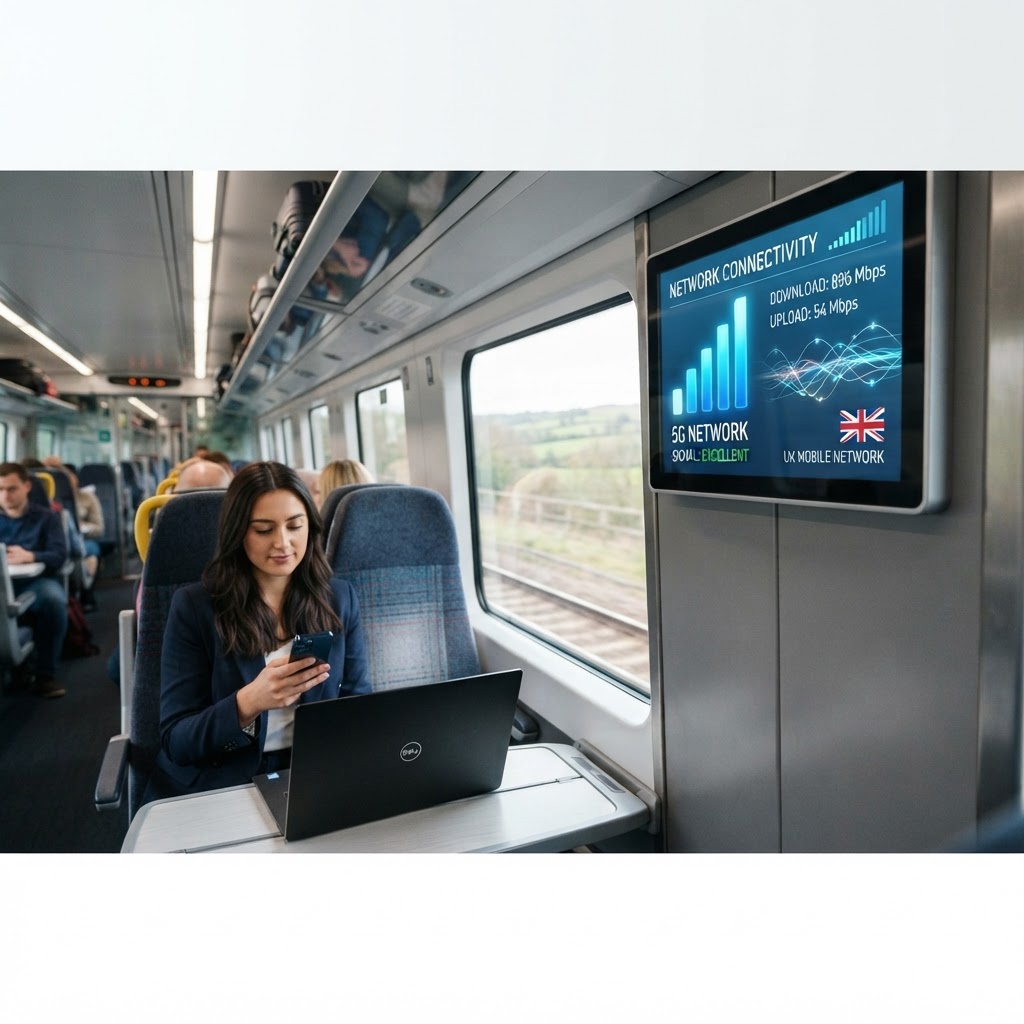
Table of Contents
- What is Project Reach? The 5G Revolution on UK Rails
- Why UK Train Signal is Struggling Today
- The Technology: Neutral Host Model and Fibre Deployment
- Which Mobile Networks Will Benefit?
- London Underground: The 4G/5G Blueprint
- Timeline and Rollout Schedule for 2026–2028
- What Passengers Can Expect: Real-World Improvements
- Economic Impact and Business Benefits
- How UK Rail 5G Stacks Up Against Europe and Asia
- Conclusion
- Frequently Asked Questions
What is Project Reach? The 5G Revolution on UK Rails
Project Reach is the UK government's flagship initiative to modernise mobile connectivity on the country's rail network. Launched in partnership with Network Rail (Britain's infrastructure company), Freshwave (a neutral host infrastructure provider), and Neos Networks (a fibre and digital infrastructure specialist), the project represents a £411.7 million investment in eliminating mobile blackspots and ensuring reliable 4G and 5G coverage across England and Wales.
Currently, Ofcom (the UK's communications regulator) has found that phone signal quality on trains falls significantly short of acceptable standards. According to 2026 data, major operators like Three remain predominantly 4G networks along rail corridors (68% of samples), with only limited 5G NSA (non-standalone) coverage. Project Reach directly addresses this gap by deploying next-generation infrastructure and working with all mobile network operators through a "neutral host" model — meaning infrastructure is shared across all networks, not proprietary to one operator.
The project targets the most critical problem areas: 57 tunnel sections totalling nearly 50 km, where signal typically drops to zero. By installing small cells (mini base stations) and deploying high-capacity fibre alongside tracks, Project Reach ensures continuous mobile coverage even in the deepest underground sections, transforming the passenger experience on journeys like the Midland Main Line, Great Western Railway, and other busy corridors.
Why UK Train Signal is Struggling Today
| Problem Area | Current Status (2026) | Impact on Passengers |
|---|---|---|
| Tunnel coverage | Complete signal loss in 57 major tunnels | No calls, texts, or data for up to 20+ minutes per journey |
| Rural sections | Patchy 4G, limited 5G | Unreliable streaming, video calls drop frequently |
| Train interiors | Signal degradation due to shielding | Bars show 4G but data speeds below 5 Mbps |
| Station coverage | Uneven across platforms and waiting areas | Passengers cannot download tickets before departing platforms |
| Wi-Fi reliance | Onboard Wi-Fi slowed intentionally by train operators | Average speeds 2–3 Mbps; insufficient for streaming |
The root causes are threefold: 1) infrastructure age — most UK rail infrastructure was built when mobile networks weren't a priority; 2) geography — tunnels and rural sections require expensive custom solutions; and 3) fragmentation — each mobile operator invested separately, leaving coverage gaps where investment wasn't profitable. Train operators also deliberately throttle onboard Wi-Fi to reduce bandwidth costs, leaving passengers with unusable connectivity despite paying fares of £50–£200+ per journey.
The Technology: Neutral Host Model and Fibre Deployment
Project Reach uses a neutral host model, which is a game-changing approach for rail connectivity. Rather than three or four competing mobile networks each building their own infrastructure (wasteful and expensive), Freshwave builds shared infrastructure — fibre, small cells, and distributed antenna systems (DAS) — that all mobile operators can access equally.
Key technical components:
- High-capacity fibre: Neos Networks is deploying 1,000 km of fibre-optic cable alongside tracks, providing the backbone for all wireless systems. Fibre offers unlimited bandwidth capacity and latency below 10ms — essential for 5G performance.
- Small cells and DAS: In tunnels and dense urban areas, tiny base stations (small cells) relay signal from trackside fibre down into train carriages and platforms. Distributed antenna systems (DAS) use multiple small antennas along tunnels to maintain continuous coverage.
- 5G standalone (SA) technology: Unlike Three's current 4G/NSA approach, Project Reach targets true 5G SA — higher speeds, lower latency, and better spectral efficiency. Early pilot deployments on London Underground show 5G SA speeds of 500+ Mbps.
- Network slicing: 5G technology allows operators to create dedicated "slices" for high-priority use cases (emergency services, CCTV, passenger Wi-Fi) without competing with consumer mobile data.
Modern railways are also investing in sustainable technologies, and reliable 5G connectivity is essential for operating autonomous train systems, predictive maintenance, and real-time signalling — all technologies coming to UK rail in the next decade.
Which Mobile Networks Will Benefit?
All four major UK mobile operators — EE, Vodafone, Three, and O2 — will gain access to Project Reach infrastructure. However, the timeline and 5G deployment speed may vary:
- EE (BT's mobile arm): Leading 5G SA deployment; expected early access to Project Reach tunnels from late 2026.
- Vodafone: Strong 5G network; similar rollout timeline to EE.
- Three: Currently 4G dominant; will benefit significantly, but 5G SA transition expected over 2026–2027.
- O2 (Virgin O2): Similar timeline to Three; expected to transition to 5G SA across rail corridors.
Train operators like First Great Western, National Express East Anglia, and TransPennine Express will also deploy onboard Wi-Fi using Project Reach's fibre backbone, replacing throttled systems with gigabit-capable Wi-Fi 6E, transforming the experience for rail commuters and business travellers who rely on connectivity during work.
London Underground: The 4G/5G Blueprint
London's entire Tube network is already receiving 4G and 5G coverage as part of a parallel rollout by Boldyn Networks — another neutral host provider. As of July 2026, comprehensive high-speed mobile coverage is now available across most London stations and tunnels, with full 5G planned by end of 2026.
| London Tube Coverage Metric | 2024 Baseline | Current (July 2026) | Target (Dec 2026) |
|---|---|---|---|
| Stations with 4G signal | ~40% | ~95% | 100% |
| 5G availability | 0% | ~60% | 100% |
| Tunnel coverage (Piccadilly line example) | 20% of route | 85% of route | 100% of route |
| Average passenger download speed | 1–2 Mbps | 50–150 Mbps | 200+ Mbps (5G) |
London's Tube success demonstrates that the neutral host model works at scale. The Piccadilly Line (used by 170 million passengers annually) now offers continuous coverage even in deep-level tubes. Project Reach will replicate this across mainline rail, with fibre deployment starting in Q1 2026 and small cell activation expected from Q3 2026.
Timeline and Rollout Schedule for 2026–2028
2026 (Current Year):
- Q1–Q2: Fibre duct design and ordering; contract finalisation with mobile operators.
- Q3–Q4: Small cell deployment begins in priority tunnels (Midland Main Line, Great Western Railway main line through Cotswolds).
2027:
- H1: Fibre deployment accelerates across 500+ km of rail corridors; DAS systems activated in first 20 major tunnels.
- H2: 5G SA rollout begins; first commercial 5G coverage announcements on National Express routes.
2028:
- Full rollout completion; all 57 target tunnels with continuous coverage; 1,000 km fibre fully operational.
- Post-launch: Optimisation and expansion to secondary rail routes.
It's worth noting that India's freight corridors are also modernising digital systems, showing that connectivity upgrades are a global priority for modern rail infrastructure.
What Passengers Can Expect: Real-World Improvements
Once Project Reach reaches full deployment, UK rail passengers will experience transformative improvements in daily connectivity:
- Seamless video calls: Working calls on trains will become normal, not miraculous. No more "I'll call you when we're out of the tunnel."
- Gigabit Wi-Fi on trains: Replacing current 2–3 Mbps throttled Wi-Fi, high-speed Wi-Fi will enable video streaming, cloud work, and large file downloads without interruption.
- Smart ticketing: Passengers can download contactless and mobile tickets just before boarding without signal anxiety.
- Real-time travel apps: Live tracking of train delays, passenger congestion data, and dynamic journey planning all require continuous connectivity — soon standard.
- Emergency services: Police, ambulances, and security services will have reliable communication even in tunnels — critical for passenger safety.
- Business productivity: Remote workers can genuinely work from trains, making rail more competitive with cars for business travel.
Economic Impact and Business Benefits
The £411.7 million investment is expected to generate significant economic returns through multiple mechanisms. According to rail industry analysts, improved connectivity increases rail's market share versus car and bus travel by an estimated 5–10% for business journeys and 2–3% for leisure travel. Over a 10-year period, this translates to approximately £2–3 billion in incremental passenger revenue and reduced road congestion.
For train operators, reliable mobile connectivity reduces onboard Wi-Fi capital costs (shared infrastructure) and increases ancillary revenue through premium connectivity packages. Network operators (EE, Vodafone, Three, O2) gain access to 30+ million new users in a high-value demographic (commuters, business travellers, students) with documented high data consumption.
For the UK digital economy, reliable rail connectivity improves competitiveness for distributed working, reduces London's transport bottlenecks, and supports Northern Powerhouse and Scottish rail investment strategies by making regional rail genuinely productive for remote workers.
How UK Rail 5G Stacks Up Against Europe and Asia
| Region | 5G Rail Coverage Status (2026) | Technology Standard | Key Difference |
|---|---|---|---|
| UK (Project Reach) | 10–15% (growing to 100% by 2028) | Neutral host (shared infrastructure) | Shared model; lower cost per operator |
| Germany (Deutsche Bahn) | ~60% (matured) | Operator-specific infrastructure | Each telecom invested independently; higher redundancy |
| France (SNCF) | ~50% | Mixed shared + dedicated | Moderate progress; limited 5G SA |
| South Korea (KTX) | ~90% | 5G SA (mature) | Gold standard; gigabit speeds common |
| Japan (Shinkansen) | ~85% | 5G + 6G trials | Leading edge; testing beyond 5G |
| India (Indian Railways) | ~5% (growing) | Early 4G infrastructure | Large-scale modernisation underway |
The UK's approach — neutral host with shared fibre — is increasingly seen as a best practice globally. It's more cost-effective than operator-specific infrastructure and faster to deploy than fragmented approaches. However, South Korea and Japan remain ahead in deployment maturity and 5G SA availability, reflecting earlier investment timelines and higher population density justifying faster buildout.
Conclusion
Project Reach represents a watershed moment for UK rail connectivity. Moving away from patchy, operator-dependent systems toward shared, neutral host infrastructure is not just a technical upgrade — it's a strategic shift that will transform how millions of British passengers experience rail travel. By 2028, UK trains will finally offer the connectivity that passengers on Indian Railways and European high-speed services have already come to expect.
For passengers, the benefits are immediate: no more searching for signal in tunnels, seamless video calls, and Wi-Fi fast enough for genuine work. For train operators and telecom companies, the economics are compelling: lower infrastructure costs, shared investment, and access to millions of high-value users. For the UK economy, the payoff is improved productivity, reduced road congestion, and competitive rail networks that rival Europe and Asia.
Start tracking Project Reach's progress: tunnel activations begin in Q3 2026, with major announcements expected from EE and First Great Western by autumn. If you're a frequent rail user, mark your calendar — the 5G revolution on UK trains is no longer a future promise. It's arriving now.
You May Also Like: HS2 High-Speed Rail Project: UK's Modern Railway Revolution in 2026, Green Hydrogen Trains: India's Next Sustainable Railway Technology, and India's Dedicated Freight Corridors: Transforming Rail Logistics in 2026.
Frequently Asked Questions
When will 5G be available on my train route?
Major routes like the Midland Main Line and Great Western Railway will see small cell activation starting Q3 2026, with mobile operator announcements expected by autumn 2026. Smaller regional routes will follow in 2027–2028. Check your train operator's website for specific timelines.
Will I need a new phone to use 5G on trains?
Most phones manufactured from 2020 onwards support 5G. You don't need to upgrade unless your phone is older than 5 years. However, 5G SA compatibility (standalone, not NSA) may require phones released in 2022 or later — check your phone's specifications.
Do train operators still need to charge for onboard Wi-Fi?
Train operators may continue charging for premium Wi-Fi packages (e.g., priority bandwidth, video streaming tier), but basic Wi-Fi should become free or very low-cost, as infrastructure costs drop dramatically with shared fibre. This is still being negotiated between operators.
Will emergency services have priority on Project Reach's 5G network?
Yes. 5G network slicing allows emergency services dedicated capacity (isolated from consumer data) even during congestion. This improves response times for incidents in tunnels and on trains.
How does Project Reach's neutral host model differ from traditional operator infrastructure?
Neutral host means one company (Freshwave) owns and operates the physical infrastructure (fibre, small cells, masts), and all mobile operators pay to access it. This eliminates redundant investment, reduces costs, and speeds deployment — compared to traditional models where each operator builds separately.
What happens to the old throttled Wi-Fi systems on trains?
Legacy Wi-Fi systems will be phased out once Project Reach's gigabit Wi-Fi reaches each operator's trains (expected 2026–2027). Some operators may retain legacy systems as backup during the transition.
Is Project Reach funded entirely by government, or do telecom companies pay?
Project Reach is co-funded: the UK government provided initial capital (part of the £411.7M), and mobile operators pay usage fees to Freshwave for access to shared infrastructure — similar to how airlines pay airport landing fees. This hybrid model reduces government subsidy while ensuring profitability.