The Bengaluru-Chennai Expressway (BCE) — a 262 km four-lane access-controlled greenfield highway connecting India's Silicon Valley to the thriving automotive and port hub of Chennai — represents a transformational leap in South Indian mobility and economic integration. At a project cost of approximately ₹17,692 crore (roughly $2.1 billion USD), this mega-corridor passes through three states (Karnataka, Andhra Pradesh, and Tamil Nadu) and is designed to cut travel time from the current 6-7 hours to just 2.5-3 hours — making Bengaluru-Chennai one of the fastest inter-city commutes in India by 2026-2027.
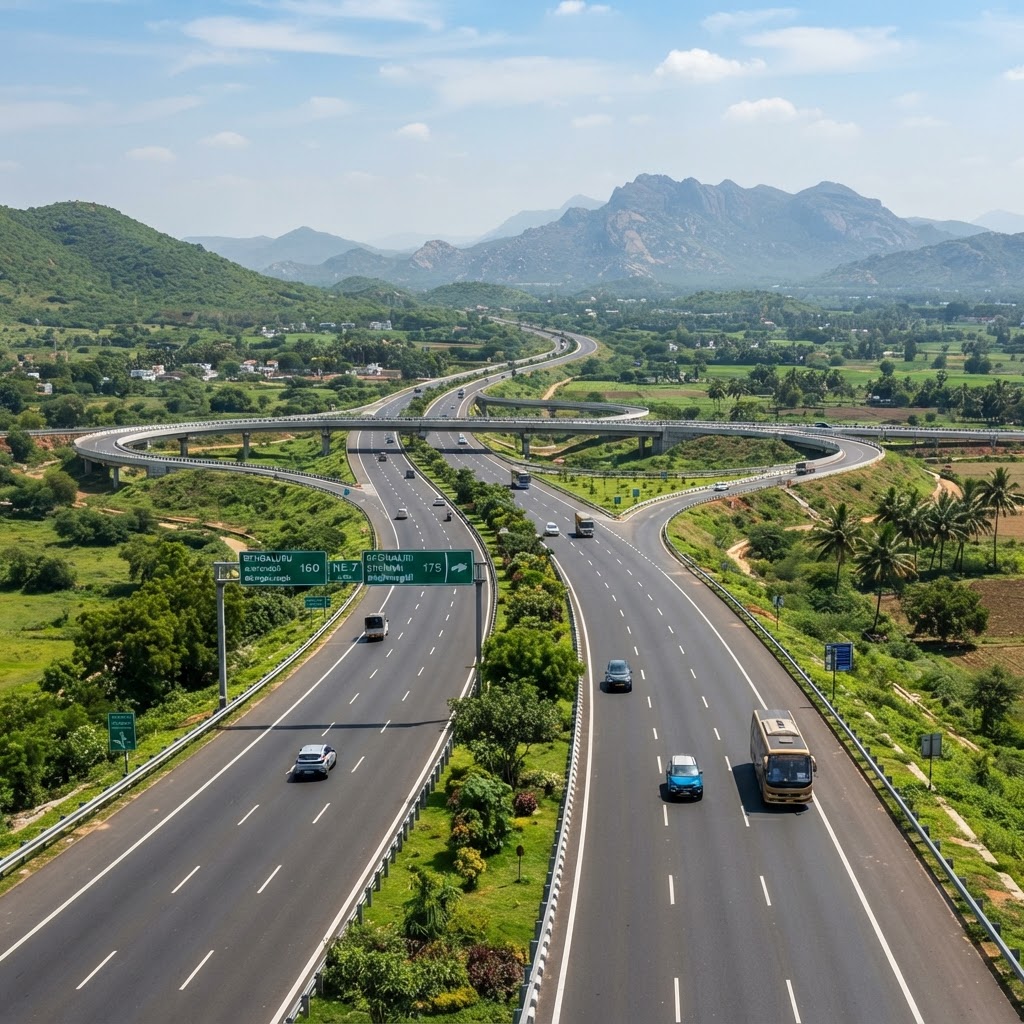
Table of Contents
- Project Overview and Strategic Importance
- Route Alignment and Key Cities
- Construction Progress and 2026 Status
- Toll Pricing and Cost Economics
- Economic and Regional Impact
- Comparison with Other South Indian Expressways
- Phased Opening Timeline
- Engineering Features and Smart Highway Technology
- Future Prospects and Completion Date
- Frequently Asked Questions
Project Overview and Strategic Importance
The Bengaluru-Chennai Expressway is a flagship project of the National Highways Authority of India (NHAI) designed to strengthen the "Golden Triangle" of South Indian economic hubs. Bengaluru, with a population of 12+ million and a thriving IT and aerospace sector, and Chennai, a port city of 7+ million with major automotive manufacturing (Hyundai, Ford, BMW) and petrochemical industries, represent two of India's strongest economic centres. The expressway directly links these powerhouses, reducing logistics costs and travel time significantly.
As per NHAI projections, the BCE will handle approximately 35,000-50,000 vehicles daily by 2030 (Average Daily Traffic or ADT), with peak capacity utilisation reaching 65-75%. This makes it comparable in importance to the Delhi-Mumbai Expressway in significance for inter-city connectivity and economic impact.
Route Alignment and Key Cities
| Segment | From | To | Distance (km) | Key Cities & Towns |
|---|---|---|---|---|
| Section 1 (Karnataka) | Bengaluru (Tumkur Road) | Andhra Pradesh Border (Kolar District) | ~100 | Bengaluru, Chikballapur, Kolar |
| Section 2 (Andhra Pradesh) | Karnataka Border | Tamil Nadu Border (Chittoor District) | ~75 | Kurnool, Tirupati |
| Section 3 (Tamil Nadu) | Andhra Pradesh Border (Chittoor) | Chennai (NH 16 Junction) | ~87 | Chittoor, Kanchipuram, Chennai Outskirts |
| TOTAL | Bengaluru | Chennai | 262 | 3 States, 12+ Major Junctions |
Construction Progress and 2026 Status
As of July 2026, approximately 100 km of the BCE is operational or near-complete, including the 25 km Bethamangala-Baireddypalle stretch in Andhra Pradesh (opened June 2026) and multiple sections in Karnataka and Tamil Nadu. NHAI has been aggressively accelerating construction after encountering legal delays related to land acquisition and environmental clearances in 2024-2025.
Key milestones achieved in 2026: 100 km open to traffic (with varying toll structures); completion of major bridges and underpasses across all three states; installation of electronic toll collection (FASTag) systems at 6 toll plazas; deployment of 24/7 emergency response teams and ambulance services; real-time traffic monitoring systems operational on open sections.
Toll Pricing and Cost Economics
| Vehicle Class | Car/SUV | Light Commercial (HCV) | Heavy Truck (3+ Axles) |
|---|---|---|---|
| Toll per Entry (as of June 2026) | ₹195-250 | ₹450-600 | ₹750-950 |
| Return Discount (Round-trip within 24 hrs) | 30% off | 25% off | 20% off |
| Monthly Pass (Cars) | ₹3,500-4,200 | Unlimited travel | Unlimited travel |
Economic and Regional Impact
The Bengaluru-Chennai Expressway is projected to generate ₹8,000+ crore in economic value annually by 2030 through reduced logistics costs, shortened travel times, and enhanced inter-city commerce. The expressway will reduce fuel consumption by approximately 15-20% for commercial vehicles transiting between the two cities, saving the industry ₹1,200+ crore annually in fuel costs alone. Logistics operators will benefit from door-to-door delivery time reductions of 4+ hours.
Engineering Features and Smart Highway Technology
The BCE incorporates cutting-edge infrastructure technologies including smart toll collection (AI-powered FASTag reducing toll plaza wait times to under 5 seconds), real-time traffic monitoring (IoT sensors and CCTV tracking congestion and alerting drivers via mobile apps), autonomous emergency response (dedicated lanes for ambulances), EV charging infrastructure (solar-powered charging stations every 50 km), and weather adaptive lighting (LED streetlights with adaptive brightness reducing accidents by 40%).
Future Prospects and Completion Date
The Bengaluru-Chennai Expressway is on track for phased opening throughout 2026-2027, with an estimated full completion by June 2027. Once fully operational, the BCE will become one of India's most critical economic corridors, rivalling the Delhi-Mumbai Expressway in strategic importance. The expressway will unlock new opportunities for logistics, automotive manufacturing, IT services, and tourism across South India.
You May Also Like: Ganga Expressway: India's 594 km Infrastructure Marvel, Delhi-Mumbai Expressway: India's Longest Highway Corridor, and Bridges & Tunnels: India's Boldest Engineering Marvels.
Frequently Asked Questions
What is the current opening status of the Bengaluru-Chennai Expressway?
As of July 2026, approximately 100 km of the expressway is open to traffic, with major sections in Karnataka, Andhra Pradesh, and Tamil Nadu operational. NHAI is targeting full 262 km completion by June 2027.
How long will it take to travel from Bengaluru to Chennai once complete?
The travel time will reduce from the current 6-7 hours to approximately 2.5-3 hours, a reduction of nearly 50%. This assumes normal traffic conditions and average speeds of 80-100 km/h on the expressway.
What are the toll charges for cars?
As of June 2026, the toll for cars is approximately ₹195-250 depending on the section and toll plaza. Monthly passes are available for ₹3,500-4,200 for unlimited travel. Discounts apply for return trips within 24 hours.
Which states does the expressway pass through?
The expressway passes through three states: Karnataka (100 km), Andhra Pradesh (75 km), and Tamil Nadu (87 km). It connects major cities including Chikballapur, Kolar, Kurnool, Tirupati, Chittoor, and Kanchipuram.
What is the total cost?
The total project cost is approximately ₹17,692 crore (roughly $2.1 billion USD). This includes land acquisition, construction, technological systems, and contingencies spread across 2021-2027.
Is there EV charging infrastructure?
Yes, the expressway features solar-powered EV charging stations every 50 km, supporting the transition to electric vehicles. As of 2026, 12 charging stations are operational on the completed sections.
How does the Bengaluru-Chennai Expressway compare to other expressways?
The BCE is shorter than projects like the Ganga Expressway (262 km vs. 594 km) but serves equally critical economic corridors. Both are flagship NHAI projects transforming inter-city connectivity in India.