Cambridge South railway station is one of the most significant new additions to the UK rail network in 2026. The station began public service on Sunday 28 June 2026 after authorisation by the Office of Rail and Road, creating a new rail gateway for the Cambridge Biomedical Campus, Addenbrooke’s Hospital, surrounding neighbourhoods and the wider South Cambridgeshire growth area. For years, the science and health cluster had been one of Europe’s most important employment locations without a dedicated railway stop. The new station changes that pattern by putting rail, bus, cycling and walking closer together rather than forcing every journey through Cambridge city centre. Network Rail, the Department for Transport, Greater Cambridge Partnership and train operators have all had roles in delivering and opening the project. This guide explains what Cambridge South offers, how it fits into the timetable, why the station matters for the local economy, and what passengers should know before travelling.
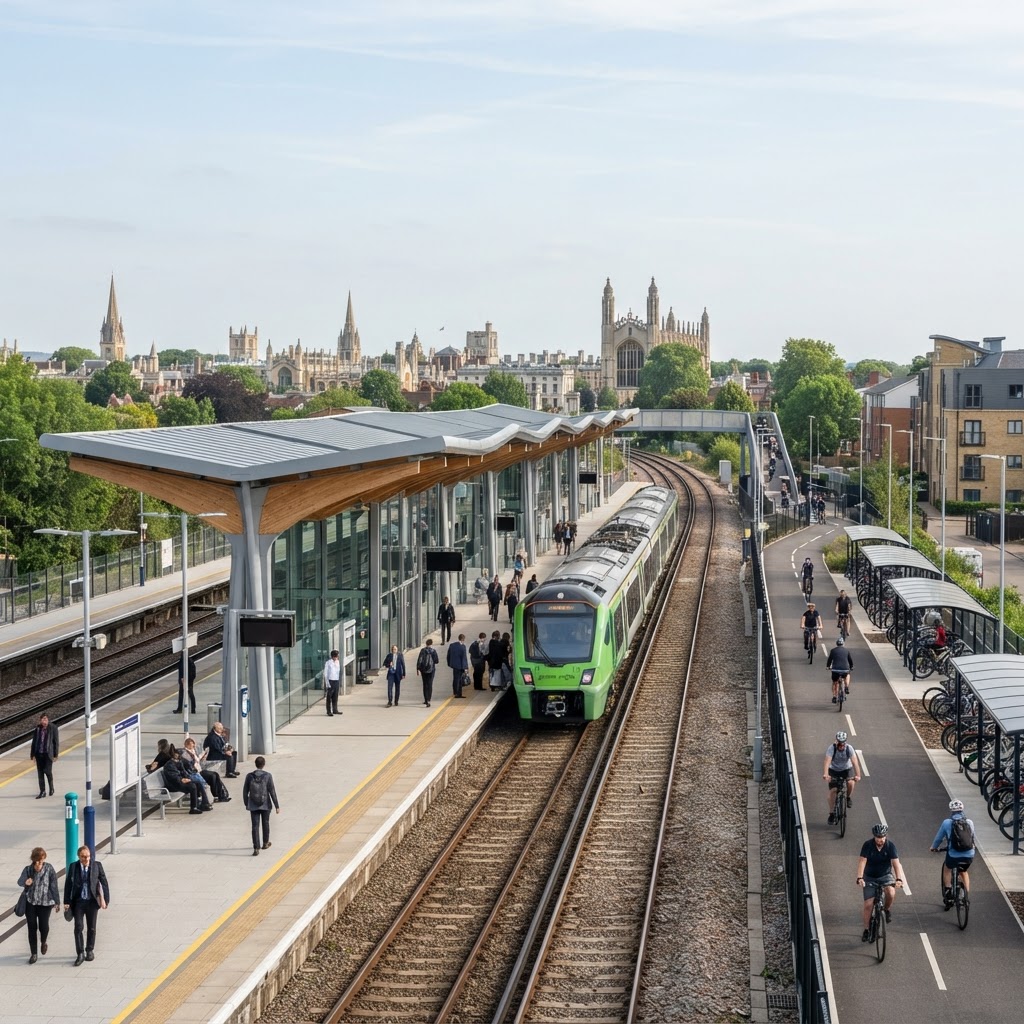
Table of Contents
- Project overview and 2026 status
- Route, design and passenger experience
- Capacity, connectivity and local impact
- Delivery, funding and governance
- Safety, accessibility and sustainability
- How it compares with other transport projects
- Practical guide and what happens next
Cambridge South railway station: the 2026 opening and purpose
The station opened on the southern edge of Cambridge beside the Biomedical Campus. Its purpose is more than adding another stop on the Liverpool Street–Cambridge corridor. It is designed to serve a concentrated employment and research district where thousands of staff, patients, students, visitors and suppliers travel daily. A station at this location reduces the need for a separate taxi, bus or car leg from Cambridge station, and it gives communities south of the city a more direct rail option. The opening date followed the completion of construction, safety approvals and operational readiness checks. ORR authorisation is a particularly important milestone because a new station cannot simply begin accepting passengers when the building is finished; platforms, signalling interfaces, evacuation arrangements, accessibility systems and operating procedures must all be demonstrated.
The project also reflects a wider change in the way UK transport schemes are evaluated. A station is now expected to support housing, employment and low-carbon travel, not only to shorten a journey between two existing railway points. Cambridge South sits within a region experiencing pressure on roads, housing and public services. By bringing rail closer to a major destination, it can help distribute demand across several modes. However, the station is not a magic solution to congestion. Its success will depend on a reliable timetable, safe walking and cycling routes, affordable fares, good interchange with buses, and enough capacity on the railway for services to stop without making the wider network less dependable.
Passengers should check live journey information before travelling, particularly during the first months of operation. New stations often require timetable adjustments, platform familiarisation and changes to local bus services. The most useful measure of the project will therefore be sustained everyday use: commuters making rail their default option, hospital visitors finding the campus easier to reach, and residents being able to travel without driving into central Cambridge.
Location, platforms and the passenger experience
Cambridge South is positioned to serve the biomedical and hospital district directly, while remaining connected to the existing railway north towards Cambridge and beyond. The station’s design is intended to make the transfer from train to street straightforward. Passengers need clear routes to the campus, nearby bus stops, cycle facilities, taxi areas and accessible drop-off points. These details matter because the final 500 metres of a journey can determine whether a station feels convenient or frustrating. A fast train is of limited value if passengers leave the platform into a confusing road layout or an unsafe crossing.
The station is designed around step-free access, with lifts and level routes helping wheelchair users, people with luggage, parents with pushchairs and passengers with temporary mobility difficulties. Good accessibility also includes readable signs, audible announcements, adequate lighting, seating, sheltered waiting areas and assistance arrangements. These features should be assessed as part of the complete journey, including the path from the entrance to the hospital and research campus. A modern station is not genuinely inclusive if the platform is accessible but the surrounding footway is narrow or poorly lit.
Cycling is equally important in Cambridge. A substantial share of short local trips can be completed by bicycle, and a station that supports secure cycle parking can extend the practical catchment far beyond walking distance. The best interchange design separates people walking from moving vehicles, provides intuitive cycle access and allows passengers to continue their trip without carrying a bike through a crowded concourse. The station’s impact will be stronger if local authorities continue improving the wider network rather than treating the station entrance as the end of the project.
For visitors, the simplest plan is to look up the destination building before travelling. The Biomedical Campus is large, so the most convenient exit can depend on whether the journey is for the hospital, a university department, a laboratory, a hotel or a meeting venue. Travellers should allow extra time during the opening period while staff, operators and passengers settle into the new layout.
Rail links, interchange and Cambridge connectivity
Cambridge South’s value comes from the connections it creates rather than from the station building alone. Direct train services can bring passengers from communities on the existing routes, while local bus links and active-travel paths connect destinations that are not served by rail. The station can also take pressure off Cambridge city station for journeys whose true destination is south of the centre. That can improve the overall network by reducing backtracking and making journey planning more logical.
The station should be understood as part of a corridor. Train paths are shared by stopping services, faster inter-city trains and, in some areas, freight. Adding a stop requires careful timetable planning because dwell time, acceleration and junction conflicts can affect reliability several stations away. A good timetable therefore balances frequency at Cambridge South with dependable journeys for passengers travelling through Cambridge. If service patterns are too infrequent, passengers will continue to drive; if too many trains are scheduled without resilience, small delays may spread across the route.
Interchange with buses is another long-term issue. A new rail station can attract passengers from a wide area, but only if the local bus network is planned around it. Timetables should provide useful connections rather than leaving passengers waiting for long periods. Integrated information, consistent ticketing and real-time departure displays can make the change from train to bus feel like one journey. Cambridge’s cycling culture offers an additional advantage, but safe junctions and continuous routes are necessary to turn that potential into daily use.
The station also has a strategic relationship with future growth. New homes, research buildings and employment sites can either be designed around sustainable transport or become car-dependent developments with a station nearby. Planning policy, parking controls and the quality of walking routes will determine which outcome emerges. Cambridge South therefore represents both a completed construction project and a test of whether transport investment can shape land use responsibly.
| Factor | Cambridge South | Cambridge station | Practical implication |
|---|---|---|---|
| Primary role | Serves Biomedical Campus and south Cambridge | Central city gateway | Choose the station closest to the final destination |
| Interchange | Bus, walking and cycling focus | Wider city connections | Allow time for the final leg |
| Network position | Stop on existing regional rail corridor | Major established interchange | Check whether the train stops at both |
| Best use case | Hospital, research and south-city trips | City centre, colleges and wider connections | Avoid unnecessary cross-city travel |
Funding, construction and governance lessons
Large railway stations are delivered through several layers of responsibility. Central government provides policy and, in many cases, funding support; Network Rail manages railway infrastructure and operational interfaces; local authorities and regional partnerships help define the economic case and local access; train operators deliver the passenger service. The division is necessary because a station affects tracks, signalling, roads, land, planning and public services at the same time. It can also make decision-making slower when responsibilities overlap or budgets are released in stages.
The business case for Cambridge South rests on more than fare revenue. A station can reduce road traffic, improve access to employment, support inward investment and make public services easier to reach. It may also increase land values and encourage development. Those benefits are real but must be measured carefully. Construction costs, maintenance, staffing, timetable capacity and the carbon impact of the build all need to be considered alongside wider economic gains. A balanced evaluation should compare the station with alternatives such as more buses, road improvements, cycling infrastructure or remote-working changes.
The project also illustrates why opening dates should be treated as operational commitments, not just construction targets. Before passengers arrive, the railway must prove that the station can be staffed, cleaned, maintained and evacuated safely. Signage and digital journey information need to work in real conditions. The first months provide valuable evidence about passenger flows, crowding, cycle demand and accessibility. Authorities should publish lessons and adjust the surrounding network rather than assuming the original design will be perfect.
For the wider UK rail sector, Cambridge South offers a useful model for destination-led stations. New stops can be most valuable when they connect rail directly to a major employment or public-service cluster. They are less effective when they are built as isolated infrastructure without a clear plan for local access and service frequency.
Safety, accessibility and sustainability
Rail safety is built into the station through platform design, lighting, surveillance, staff procedures, information systems and safe interfaces between trains and passengers. Yet safety does not end at the platform edge. The approach roads, cycle crossings, taxi area and pedestrian routes need consistent design so that passengers are not placed in conflict with vehicles immediately after leaving the station. Clear wayfinding reduces hurried crossings and helps visitors unfamiliar with the campus.
Accessibility should be monitored through real passenger experience. Step-free lifts need redundancy and rapid response when faults occur. Announcements should be understandable, visual displays should be readable, and staff should know how to provide assistance without making passengers feel singled out. Good design also benefits older travellers and people carrying equipment, not only those who identify as disabled.
Sustainability is a combination of construction choices and operational behaviour. Rail travel can reduce emissions compared with individual car trips, but the result depends on passengers reaching the station sustainably and on trains being well used. Secure cycle parking, bus priority, low-energy lighting, efficient heating and responsible drainage all contribute. The station can also support climate resilience by managing surface water and reducing overheating in exposed public areas.
A station near a hospital and research campus must consider unusual travel patterns. Staff may work early or late shifts, patients may need assistance, and visitors may be unfamiliar with the network. Security, lighting and staffed support are therefore not optional extras. A reliable, welcoming station can improve access to healthcare; a poorly supported one could create new barriers for people already under stress.
How Cambridge South compares with other UK transport projects
Cambridge South is smaller than a major inter-city railway programme but potentially more targeted in its benefits. It does not need to serve an entire region to be valuable; it needs to solve a clear access problem for a large and important destination. This differs from projects such as Northern Powerhouse Rail, which seek to reshape connectivity between multiple city regions. It also differs from digital upgrades such as 5G on trains, where the infrastructure is distributed across an existing network.
The strongest comparison is with other destination stations. A station beside an airport, university, hospital or business district can generate high demand if the walking route is direct and services are frequent. However, such stations are vulnerable to single-purpose demand. If an employment cluster changes its working patterns, passenger numbers may vary significantly by day and time. A diverse catchment of residents, students, patients and visitors makes the investment more resilient.
Cambridge South also sits within a broader debate about rail capacity. A new stop can improve local access while using valuable train paths. The answer is not automatically to prioritise either speed or stopping services; the network needs a timetable that offers both where infrastructure allows. Future upgrades, platform changes and signalling improvements could determine how much service can be added without sacrificing reliability.
| Project or mode | Main benefit | Main constraint | Lesson for Cambridge South |
|---|---|---|---|
| Cambridge South station | Direct access to Biomedical Campus | Needs frequent trains and good last-mile links | Destination-led rail works best with interchange |
| Northern Powerhouse Rail | Regional city-to-city connectivity | Large funding and delivery complexity | Benefits depend on network-wide capacity |
| 5G train connectivity | Better onboard productivity and information | Coverage and infrastructure costs | Digital improvements complement, not replace, stations |
| Bus rapid transit | Flexible local coverage | Road space and congestion | Feeder services must be planned around rail |
Passenger guide and what happens next
Passengers should begin by checking whether their train calls at Cambridge South, because not every service on a route will necessarily stop there. Use official journey planners on the day of travel, especially during engineering works or timetable changes. If visiting the Biomedical Campus, confirm the walking route to the exact building and allow extra time for a first visit. Travellers with mobility requirements should arrange assistance through the rail operator in advance where possible, while still using station staff if plans change.
For regular commuters, the most useful comparison is door to door rather than train to train. Add the time needed to reach the station, wait for a connection, walk across the campus and return home. A slightly slower train can be the better choice if it avoids a taxi or a cross-city transfer. Cyclists should check cycle parking arrangements and carry a backup plan for busy periods. Drivers should not assume that station parking is the most convenient or sustainable option; local bus and cycle links may be faster at peak times.
Over the next year, watch service frequency, passenger numbers, bus changes, cycle use, lift reliability and crowding. These indicators will show whether the station is meeting its intended purpose. Future housing and employment proposals should be assessed against the capacity of the station and its access routes, not merely against the existence of a rail stop. Cambridge South has opened, but the full transport benefit will be built through years of coordinated operation and planning.
Conclusion
Cambridge South railway station is a focused piece of infrastructure with consequences far beyond its platforms. Opened on 28 June 2026, it gives the Biomedical Campus and south Cambridge a direct rail gateway, improves the potential for sustainable commuting and offers a practical example of destination-led transport planning. Its long-term success will depend on frequent and reliable trains, safe walking and cycling routes, useful bus connections, step-free access and careful development around the station. The project should be judged by complete journeys and everyday passenger experience, not only by the opening ceremony. For travellers, the immediate advice is simple: check the timetable, plan the final campus leg and allow extra time while the new interchange settles into service.
You May Also Like: 5G connectivity on UK trains, Northern Powerhouse Rail in 2026, and Okehampton Interchange station guide.
Frequently Asked Questions
When did Cambridge South railway station open?
Cambridge South opened to public passengers on Sunday 28 June 2026 after the Office of Rail and Road authorised the station to enter service.
Who does Cambridge South station serve?
The station primarily serves the Cambridge Biomedical Campus, Addenbrooke’s Hospital, research organisations, nearby communities and passengers travelling to south Cambridge.
Are trains stopping at Cambridge South?
Services are scheduled to call at the station, but stopping patterns can change. Check the official journey planner before travelling.
Is Cambridge South station step-free?
The station is designed with step-free passenger routes and accessible facilities. Check live information and assistance arrangements if you need a lift or staff support.
How can passengers reach the Biomedical Campus from the station?
Passengers can continue by walking, cycling or local bus connections. The best route depends on the specific hospital, laboratory or university building.
Will Cambridge South reduce Cambridge traffic?
It can reduce some car journeys by making rail more convenient, but the effect depends on service frequency, local access, fares and integration with buses and active travel.
What should visitors do before their first journey?
Check whether their train stops at Cambridge South, confirm the route to the exact destination building and allow extra time to learn the new interchange.