Indian Railways has approved a major 29-kilometre Danapur–Fatuha multitracking project in Bihar, an investment that shows why capacity—not only new trains—is becoming the defining railway story of 2026. The ₹976 crore scheme will add third and fourth lines on a heavily used section of the East Central Railway network, helping separate suburban, long-distance and freight movements around Patna. This guide explains what has actually been approved, how the corridor fits into the wider Delhi–Howrah route, what passengers and logistics operators may gain, and which construction risks could affect delivery. It also places the announcement alongside automatic signalling, station upgrades, electrification and dedicated freight corridors so readers can understand the wider network effect rather than viewing the project as an isolated track-laying exercise.
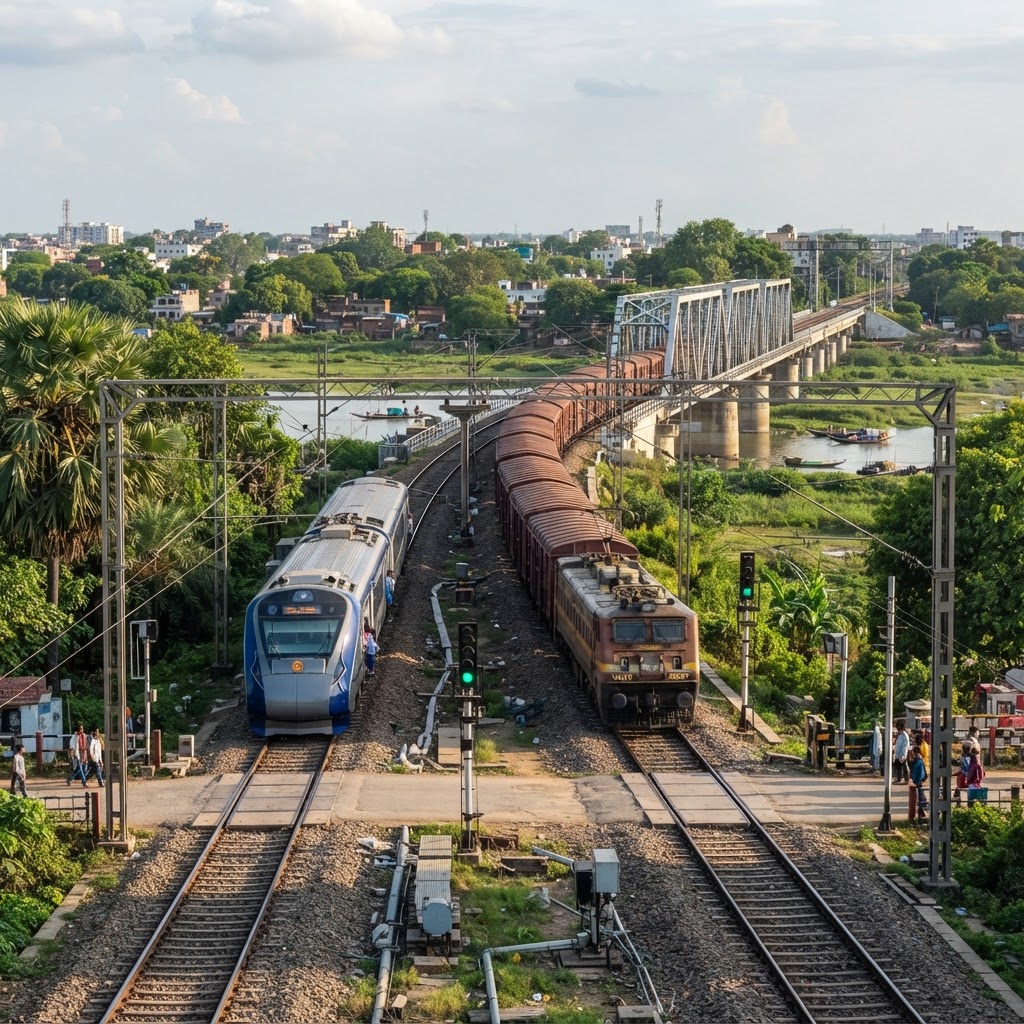
Table of Contents
- What the project includes
- Why this Bihar corridor matters
- How extra tracks improve operations
- Passenger and freight benefits
- Construction and safety challenges
- Comparison with other capacity projects
- Timeline and outlook
What the Danapur–Fatuha project includes
The Union government has approved multitracking of the 29 km Danapur–Fatuha section under East Central Railway at an estimated cost of ₹976 crore. The practical meaning of multitracking is the creation of additional running lines beside the existing railway formation, with associated earthworks, bridges, signalling, level-crossing changes, station modifications and overhead electrification. Public announcements describe the work as adding third and fourth lines, giving the route four running paths where the existing layout has fewer paths and limited flexibility.
That distinction matters. A new train service cannot simply be inserted into a timetable when a busy line has no spare paths. A train may have to wait outside a station for an express to pass, or a freight service may be held for a passenger train. Additional lines create overtaking and routing options, but the final benefit depends on junction design, signalling headways, platform capacity and the ability of control offices to use the new infrastructure intelligently.
The scheme should therefore be judged as a capacity and reliability investment rather than a headline speed project. It is not a new high-speed line and it will not make every Patna-area journey faster overnight. Its value is in reducing conflicts, improving timetable resilience and creating room for future services as demand grows. The official approval is the starting point; detailed engineering, tenders, construction blocks and commissioning will determine when passengers see the result.
Why this Bihar corridor matters
Danapur and Fatuha sit within the operational orbit of Patna, one of eastern India’s fastest-growing urban and administrative centres. The railway corridor serves daily commuters, students, government workers, long-distance passengers and freight movements feeding the wider Bihar and eastern Indian economy. Fatuha is strategically important because routes in the Patna region connect towards the Delhi–Howrah axis, Gaya, Kiul, Mokama and other parts of East Central Railway.
On a corridor with mixed traffic, the same pair of tracks has to accommodate trains with very different stopping patterns and speeds. A suburban-style service may stop repeatedly, while a premium express needs a clear path and a freight train may be long, heavy and slower to accelerate. When those services share limited infrastructure, a small delay can cascade through the timetable. Multitracking gives dispatchers more ways to segregate movements, although it does not remove every bottleneck at bridges, junctions or stations.
The scheme is also relevant to regional development. Better rail capacity can support industrial areas around Patna and Fatuha, improve access to education and healthcare, and make rail more dependable for workers who travel daily. Freight reliability can be just as important as journey time: manufacturers value predictable arrival windows, and retailers need consistent replenishment. The strongest economic effect will come if the railway coordinates track work with station access, bus links, road safety and last-mile logistics.
Readers looking at the national picture can compare this project with our guide to India’s Dedicated Freight Corridors, where traffic separation is built into the network concept from the outset.
How extra tracks improve operations
Railway capacity is not simply the number of tracks visible from a train window. It is the number of safe, usable train paths that can be offered at the right times. A four-line section can allow two lines to carry fast or long-distance services while other lines handle stopping or freight movements, but the exact operating plan depends on signalling, platform arrangements and directionality. Modern control systems can route trains dynamically, yet the physical layout remains the foundation.
Third and fourth lines can reduce the need for trains to queue behind a slower movement. They may also allow engineering possessions to take place while some lines remain open, improving maintainability. During disruptions, controllers gain alternative routes and can turn or regulate services with less severe consequences. These benefits are particularly valuable on busy routes where punctuality is affected by a single blocked line or a late-running train.
Automatic signalling and electronic interlocking will be central to the scheme. Signals divide the railway into protected sections and prevent conflicting movements; interlocking ensures points cannot be set in an unsafe combination. Track circuits or axle counters confirm whether a section is occupied. Electrification work must be integrated with clearances, bridges, platforms and traction substations. If these packages are sequenced poorly, civil works may finish while trains still cannot use the new line.
Capacity also depends on maintenance discipline. New track needs tamping, drainage inspections, geometry monitoring and periodic renewal. A well-designed project includes access roads, inspection arrangements and safe work sites from day one. Otherwise, the network may gain theoretical capacity but lose it during frequent maintenance.
Passenger and freight benefits
For passengers, the first benefit is likely to be reliability rather than a dramatic reduction in scheduled time. More paths can make it easier to add services, recover from late running and reduce the number of trains held outside stations. If the timetable is redesigned after commissioning, railways could offer more convenient departure times for commuters around Patna and improve connections towards major cities.
Passengers should keep expectations realistic. Construction may temporarily require speed restrictions, traffic blocks, platform changes and altered station access. The new infrastructure may also be commissioned in stages, so one section can open while signalling or a bridge package remains under work elsewhere. Indian Railways will need clear notices through station announcements, its website and passenger information systems.
Freight operators may benefit from longer and more predictable paths. On mixed-traffic routes, freight often waits for passenger services because its lower speed consumes more line capacity. Additional tracks can create windows for freight to move without disrupting the passenger timetable. This supports cement, food, engineering goods, coal, parcels and container traffic, although the commercial benefit depends on terminal capacity and last-mile road links.
The project complements our Indian Railways 2026 overview. Faster trains attract attention, but junction remodelling, additional lines and reliable signalling are what allow a larger network to run more trains safely.
| Measure | Danapur–Fatuha project | Why it matters |
|---|---|---|
| Length | 29 km | Targets a constrained urban-region section |
| Approved cost | ₹976 crore | Funds civil, track and systems packages |
| Planned capacity | Third and fourth lines | Separates and adds train paths |
| Railway | East Central Railway | Supports the Patna-area network |
| Traffic | Passenger, commuter and freight | Mixed traffic creates conflicts |
Construction, land and safety challenges
Building beside an operating railway is more complicated than constructing on an empty alignment. Workers must maintain safe separation from live tracks, protect passengers at stations and coordinate blocks without damaging punctuality. Temporary diversions, bridge launches and overhead-equipment work require precise planning. In an urban corridor, utilities, roads, drains and private boundaries can add further complexity.
Land requirements may be modest compared with a completely new railway, but even narrow strips can affect homes, shops, access roads and agricultural plots. Early survey work and transparent compensation processes reduce delays. The project also needs careful treatment of level crossings and pedestrian movement. A new line does not automatically make an unsafe crossing safe; fencing, road overbridges, underpasses and station footbridges may be needed at specific locations.
Monsoon conditions are another practical factor in Bihar. Embankment stability, drainage and waterlogging protection should be designed for intense seasonal rainfall, while bridge foundations need inspection for scour and changing river conditions. Construction schedules that ignore weather can create rushed work before the operating season. Quality control must cover rails, welds, ballast, sleepers, points, signalling cables and earthing.
Safety assurance is the final gate. Before passenger operation, completed sections must be inspected, signalling tested, staff trained and emergency procedures rehearsed. Speed restrictions may remain until track geometry and formation performance meet the required standard. The best outcome is a dependable asset that can be maintained for decades.
How it compares with other capacity investments
Danapur–Fatuha is one piece of a broader Indian strategy that uses different tools for different bottlenecks. A multitracking project works beside an existing route; a freight corridor separates heavy goods trains on a dedicated alignment; automatic signalling increases the number of paths that existing tracks can safely handle; station remodelling removes local conflicts. These solutions reinforce one another, but they are not interchangeable.
Signalling can reduce headways, but it cannot solve a platform throat where every movement crosses another route. A new line can create paths, but it cannot compensate for a terminal that lacks loading capacity. The project’s value should be measured using before-and-after indicators: trains per day, average detention, punctuality, freight path utilisation, speed restrictions and passenger complaints.
| Intervention | Bottleneck addressed | Advantage | Limitation |
|---|---|---|---|
| Danapur–Fatuha | Too few running lines | More routing flexibility | Live-railway construction |
| Automatic signalling | Long blocks | Shorter safe headways | Not a junction cure |
| Freight corridor | Mixed traffic | Separates heavy freight | High capital and terminal needs |
| Station remodelling | Conflicting routes | Faster platform moves | Local disruption |
| Electrification | Traction constraints | Lower emissions and costs | Needs substations and clearances |
Timeline, monitoring and 2026 outlook
The approval announced in 2026 should not be confused with a confirmed passenger opening date. A realistic sequence includes surveys, design, land and utility clearances, tendering, earthworks, bridges, track, electrification, signalling, testing and statutory inspection. Packages can proceed in parallel, but commissioning must follow a safe integrated plan.
Readers should watch for four meaningful milestones: award of major civil contracts, visible work at bridges and station approaches, installation of track and overhead equipment, and a formal commissioning or traffic-opening notice. Headlines about funding are useful, but physical progress and tested train paths are better indicators of when benefits will arrive.
Local stakeholders can help by respecting work-zone restrictions and using official travel information during blocks. Businesses should plan for temporary access changes but also prepare for improved rail connectivity once extra capacity is operational. If delivered with strong drainage, accessible stations and reliable passenger information, the project can become a model of practical capacity building.
Conclusion
The Danapur–Fatuha multitracking approval is a focused answer to a familiar railway problem: too many different services competing for too little infrastructure. Its ₹976 crore cost and 29 km length make it manageable compared with a new high-speed corridor, yet its operational importance could be significant because it sits in the busy Patna-area network. Additional lines, modern signalling and better separation of traffic can improve reliability, unlock future services and support freight growth. The key tests will be safe construction beside live tracks, disciplined delivery and a timetable that uses the capacity intelligently.
You May Also Like: India’s freight corridors, Namo Bharat RRTS, and Indian Railways modernisation.
How success should be measured
A capacity project needs a baseline before construction begins. East Central Railway can compare the number of trains that use the section, average waiting time at signals, late arrivals caused by congestion and the number of freight paths available each day. These measures should be published in a way that separates delays caused by the Danapur–Fatuha section from delays elsewhere on a train’s route. Otherwise, passengers may see investment but cannot tell whether it has improved their journey.
Passenger experience deserves equal attention. Surveys can ask whether trains are easier to board, whether information during blocks is adequate and whether connections have become more dependable. For freight, useful indicators include terminal turnaround, path acceptance, wagon utilisation and delivery consistency. A successful project should make the railway more predictable, not merely busier.
There is also a safety and maintenance scorecard. Officials should monitor trespassing, level-crossing incidents, drainage problems, rail defects and the number of temporary speed restrictions. New infrastructure creates new inspection responsibilities, so budgets for maintenance staff, patrols and equipment must be protected after construction. The public benefit is greatest when the asset remains reliable through monsoon seasons and heavy traffic.
What passengers should expect during the works
Major railway construction often happens in stages to keep trains moving. That can mean night blocks, platform changes, temporary speed limits and occasional cancellations or diversions. Passengers travelling through Danapur, Patna-area stations or Fatuha should check official notices before important journeys and allow additional time for station transfers. Information may change as bridge and signalling work reaches different phases.
Work sites can also alter local road access. Pedestrians should use designated footbridges, underpasses and crossing points rather than taking shortcuts across tracks or construction areas. Drivers should follow temporary signs near level crossings and station approaches. These simple precautions protect both the public and the workers delivering the project.
Once the lines open, the timetable may be revised gradually. Some trains may move to different platforms or paths, and additional services may be introduced only after the railway has observed operating performance. A measured commissioning process is preferable to an ambitious timetable that leaves no recovery margin.
Coordination beyond the railway boundary
The Danapur–Fatuha corridor crosses an urban and peri-urban landscape, so railway capacity cannot be planned in isolation. State agencies, municipal bodies and highway authorities need to coordinate road diversions, drainage, pedestrian routes and emergency access. A new overbridge or underpass may change local traffic patterns, and station improvements can shift demand to nearby bus stops and streets.
Freight benefits will also depend on logistics partners. Warehouses, parcel terminals and industrial customers need predictable collection windows, while road carriers need safe access that does not block station traffic. If the railway publishes clear operating plans after commissioning, businesses can adjust their schedules and make better use of the extra paths.
Finally, public communication should explain both disruption and benefit in plain language. People are more likely to tolerate temporary blocks when they understand which bridge, signal or line is being built and how it will improve future service. Transparent updates are part of project delivery, not an optional publicity exercise.
Budget control will matter as much as engineering. Materials, land compensation, bridge work and signalling packages can move at different speeds, so project managers should publish revised milestones when assumptions change. Independent quality checks and regular safety reviews can prevent late defects that cost more to fix after commissioning. For Bihar’s passengers, a carefully delivered railway is more valuable than a hurried opening followed by repeated restrictions.
Residents and businesses should be included in progress reviews, especially where construction affects crossings, drains or access roads. Local knowledge can identify school movements, market days and emergency routes that are invisible in a technical drawing. A project that listens early can avoid preventable disruption and leave a safer, better-connected corridor when the final line is commissioned.
Frequently Asked Questions
What is the Danapur–Fatuha railway project?
It is a ₹976 crore multitracking project covering 29 km in Bihar under East Central Railway. The plan adds third and fourth lines to increase capacity.
Will it reduce journey times?
Its main benefit is reliability and additional train paths. Some journeys may become faster after timetable improvements, but a major time saving is not guaranteed.
Which trains will benefit?
Commuter, long-distance passenger and freight services can benefit because extra tracks reduce conflicts between services with different speeds and stopping patterns.
When will construction finish?
The approval does not itself provide a final public opening date. Progress will depend on design, contracts, land, bridges, track, signalling, testing and inspection.
Is this a high-speed railway?
No. It is a conventional railway capacity project beside an existing route, not a dedicated high-speed line.
Why is multitracking important?
It creates more safe train paths and gives controllers more options for overtaking, routing and recovering from delays on a busy mixed-traffic corridor.